Key Takeaways
- The fastest realistic route into environmental work in Canada is a 2-year Environmental Technology diploma at a college such as Georgian College, which prepares students for certifications including water and wastewater treatment operator certification.
- There is no mandatory ECO Canada EP licence for environmental professionals generally; the EP is voluntary, requires a minimum of 5 years of experience, and costs $300 for the application plus exam and $230 for the certification fee. Some roles, such as water/wastewater operator roles, have separate certifications.
- Coursera's Introduction to Environmental Science from Dartmouth College takes 2 months at 10 hours a week and gives a shareable certificate, but it does not count as a diploma, degree or EP designation.
- Job Bank lists NOC 21110, biologists and related scientists, at a Canada median of $40.00 per hour, ranging from $35.90 in PE to $42.85 in SK.
- Fiona's verdict: start with a short online course; Coursera pricing is not listed in this pack. Then commit to the 2-year diploma if you want field work, or a bachelor's if you want policy or consulting.
Environmental Studies in Canada prepares you for roles in environmental research, consulting, policy and resource management through interdisciplinary programs covering ecology, sustainability and impact assessment.
The realistic entry routes are a 2 to 3 year Environmental Technology diploma, a 4 year bachelor's degree such as Wilfrid Laurier's Bachelor of Environmental Studies, or the voluntary EP designation from ECO Canada once you have at least 5 years of experience. My advice as an advisor: test the field with a short online course first, because the money and years at stake in the degree routes are significant.
What Are The Ways To Study Environmental Studies In Canada?
The main credential routes in the pack are a college diploma, a bachelor's degree, and the ECO Canada EP designation; Coursera can be used to sample the field before you commit to one of them.
| Route | Time | Cost (CAD) | What You Get | Recognised By | Best For |
|---|---|---|---|---|---|
| Introduction to Environmental Science | 2 months at 10 hours a week | Not listed | Shareable certificate | Coursera platform | Sampling the field before committing money and years |
| College Diploma in Environmental Technology (Georgian College) | 2-3 years | Varies | Ontario College Advanced Diploma | Georgian College, Technology Accreditation Canada | Hands-on field and lab roles |
| Bachelor's in Environmental Studies or Science (e.g. University of Waterloo) | 4 years | Varies | Bachelor's degree | Universities | Consulting, government research, policy and not-for-profits |
| EP Designation (ECO Canada) | Minimum 5 years experience for EP | $300 application + exam, $230 certification fee | EP® designation | ECO Canada | Working professionals formalising their credentials |
I recommend the Coursera course for anyone unsure about the field, the Georgian College diploma for people who want employable field skills fastest, and a bachelor's for those aiming at consulting or policy roles.
What Is The Fastest Way To Become An Environmental Professional In Canada?
The fastest credential route is the 2-year Environmental Technology diploma, followed by entry-level work, with the EPt stepping stone along the way to the EP designation.
- Complete a 2-year Environmental Technology diploma at a college such as Georgian College. Cost figures are not published in a verified form, so budget with the college directly.
- Gain entry-level experience on the job, or apply for the EPt, Environmental Professional in Training, designation through ECO Canada at $200.
- After at least 5 years of experience, apply for the EP designation: pay $300 for the application plus exam fee, and $230 for the certification fee once approved.
- Renew the EP annually: the $230 renewal plus taxes is due on April 1 each year, with professional development requirements.
- If your target role is in policy or consulting, add a 4-year bachelor's such as Wilfrid Laurier's Bachelor of Environmental Studies ($6,180 domestic tuition per year at 2026/27 rates) instead of, or after, the diploma.
Do You Need A Licence To Work As An Environmental Professional In Canada?
There is no mandatory ECO Canada EP licence for environmental professionals generally; the EP is voluntary. ECO Canada describes the EP® designation as a multidisciplinary certification for environmental professionals across all industries in Canada who are dedicated to promoting sustainable practices and responsible economic growth. Some roles, such as water/wastewater operator roles, have separate certifications.
| Scope | Mandatory? | Body | What It Means |
|---|---|---|---|
| All provinces | No | ECO Canada (voluntary EP designation) | Employers and clients may prefer it, and it signals 5+ years of verified experience, but it is not a licence to work |
| Ontario college pathway | Varies by role | Certifications depend on the role | Georgian College says the diploma prepares students for certifications/designations including water and wastewater treatment operator certification |
I tell clients not to confuse the EP designation with a licence. It is a credential you earn on top of experience, not a legal permission to work. Georgian College says its Environmental Technology diploma prepares students for certifications such as water and wastewater treatment operator certification, and those certifications are separate from the EP.
A Coursera course does not qualify you for the EP designation, or for any operator certification. What it does is show you the vocabulary of the field, ecology, sustainability and impact assessment, before you commit to a 2 or 4 year program.
Which Environmental Courses And Programs Are Worth Taking?
Here is how the main online courses and Canadian degree programs compare, starting with the low-commitment way to test the field.
Introduction to Environmental Science
Introduction to Environmental Science is a 2 month, 10 hours a week online specialization from Dartmouth College on Coursera that ends in a shareable certificate.
| Provider | Dartmouth College |
|---|---|
| Length | 2 months at 10 hours a week |
| Rating | 4.7 (482 reviews across courses) |
| Credential | Shareable certificate |
| Format | online |
Fiona's take: This is the one I point career changers to first. It is offered by Dartmouth College and has a 4.7 rating across 482 reviews. Ten hours a week for 2 months is a real but manageable commitment, roughly what a part-time job demands. Treat it as a field test: if you finish it energised rather than bored, environmental studies is worth your money.
Skip it if: Skip it if you already hold a science degree or have worked in an environmental role, because you will already know most of the material.
Start On CourseraEnvironmental Studies
Environmental Studies is a 2 month, 10 hours a week online course from the Birla Institute of Technology & Science, Pilani on Coursera that ends in a shareable certificate.
| Provider | Birla Institute of Technology & Science, Pilani |
|---|---|
| Length | 2 months at 10 hours a week |
| Credential | Shareable certificate |
| Format | online |
Fiona's take: This course covers Earth's ecosystems, biodiversity loss, climate change, resource depletion and circular economy principles, with a shareable certificate at the end. It is a solid option if you want an introductory survey of these topics. I would not take it alongside the Dartmouth specialization without checking the syllabi first.
Skip it if: Skip it if the Dartmouth specialization suits your schedule, since Dartmouth's specialization carries a 4.7 rating across 482 reviews.
Start On CourseraEnvironmental Science
Environmental Science is a 30 hour online course from Dartmouth College on Coursera that ends in a shareable certificate.
| Provider | Dartmouth College |
|---|---|
| Length | 30 hours |
| Credential | Shareable certificate |
| Format | online |
Fiona's take: At 30 hours total, this single course is the shorter Dartmouth option, useful if you want a 30-hour survey rather than a two-month program. It suits someone who wants a quicker overview before deciding whether to go deeper. Note that a single course carries less weight on a resume than a full specialization.
Skip it if: Skip it if you know you want the full specialization, because you will repeat this material anyway.
Start On CourseraEnvironmental Science: Earth Systems & Climate
Environmental Science: Earth Systems & Climate is a 5.5 hour on-demand video course from ISO Horizon on Udemy that costs $11.99 on sale and ends in a certificate of completion.
| Provider | ISO Horizon |
|---|---|
| Length | 5.5 hours |
| Cost (CAD) | $11.99 (on sale) |
| Rating | 4.6 (48 ratings) |
| Credential | Certificate of completion |
| Format | online |
Fiona's take: For $11.99 on sale, this is a low-risk way to sample earth systems and climate content, and the 4.6 rating across 48 ratings suggests solid delivery. The pack lists it as a Udemy certificate of completion, not as a university credential or ECO Canada designation, so I see it as a supplement or a curiosity test, not a career foundation.
Skip it if: Skip it if you need academic recognition, since the pack lists it only as a certificate of completion.
View On UdemyEnvironmental Science: Water, Waste Management & Ecosystems
Environmental Science: Water, Waste Management & Ecosystems is a 2.5 hour on-demand video course from Letstute Make it Easy on Udemy that costs $11.99 on sale and ends in a certificate of completion.
| Provider | Letstute Make it Easy |
|---|---|
| Length | 2.5 hours |
| Cost (CAD) | $11.99 (on sale) |
| Rating | 4.5 (190 ratings) |
| Credential | Certificate of completion |
| Format | online |
Fiona's take: It introduces water, waste management and ecosystem topics, covering the water cycle, water conservation, ecosystems, waste management and sustainability. At 2.5 hours it is an evening's work. The 4.5 rating across 190 ratings is respectable for a short course. Georgian's diploma is the program in the pack tied to operator certification preparation, so treat this as a topic preview rather than career preparation.
Skip it if: Skip it if you already have any water systems background, since it stays at introductory level.
View On UdemyAP Environmental Science
AP Environmental Science is a 1.5 hour on-demand video course from Vedika Shenoy on Udemy that is free, or with a paid upgrade, and ends in a certificate of completion.
| Provider | Vedika Shenoy |
|---|---|
| Length | 1.5 hours on-demand video |
| Cost (CAD) | Free (or paid upgrade) |
| Rating | 4.5 (1,845 ratings) |
| Credential | Certificate of completion |
| Format | online |
Fiona's take: This is aimed at the American AP exam syllabus, which is not a Canadian credential pathway. As a free 1.5 hour overview it costs you nothing but an evening, and the 4.5 rating across 1,845 ratings shows it is popular. Just do not mistake it for Canadian career preparation.
Skip it if: Skip it if you are building a Canadian career plan, because the AP syllabus does not map onto ECO Canada designations or college programs here.
View On UdemyBachelor of Environmental Studies (BA)
Bachelor of Environmental Studies (BA) is a 4 year full-time program from Wilfrid Laurier University in Ontario, delivered in person or hybrid, with domestic tuition of $6,180 per year at 2026/27 rates.

| Provider | Wilfrid Laurier University |
|---|---|
| Length | 4 years (full-time) |
| Cost (CAD) | Tuition $6,180 domestic per year (2026/27 rates) |
| Credential | Bachelor of Environmental Studies (BA) |
| Format | in person/hybrid, Ontario |
Fiona's take: This is a genuine Canadian credential, and the $6,180 domestic annual tuition at 2026/27 rates makes it one of the clearer published price points in this field. Laurier's program leads toward environmental consulting, policy analysis, field technician and resource management roles in government or the private sector. Four years at that tuition rate is a serious commitment, so test the field first.
Skip it if: Skip it if you need to be working in the field within two years, because a diploma route gets you there faster.
See Program DetailsBachelor of Arts in Environment and Sustainability
Bachelor of Arts in Environment and Sustainability is a 4 year in-person program from the University of British Columbia.
| Provider | University of British Columbia |
|---|---|
| Length | 4 years |
| Credential | Bachelor of Arts |
| Format | in person, British Columbia |
Fiona's take: UBC's environment and sustainability program focuses on the interaction between society and the environment, from local and global perspectives. Cost figures for this specific program are not listed here, so check UBC's current tuition directly. It suits students who want the university experience and a British Columbia job market, where Job Bank lists NOC 21110 at $42.00 per hour.
Skip it if: Skip it if you are outside British Columbia and want a hybrid or online option, since this program is delivered in person.
See Program DetailsBachelor in Environmental Science
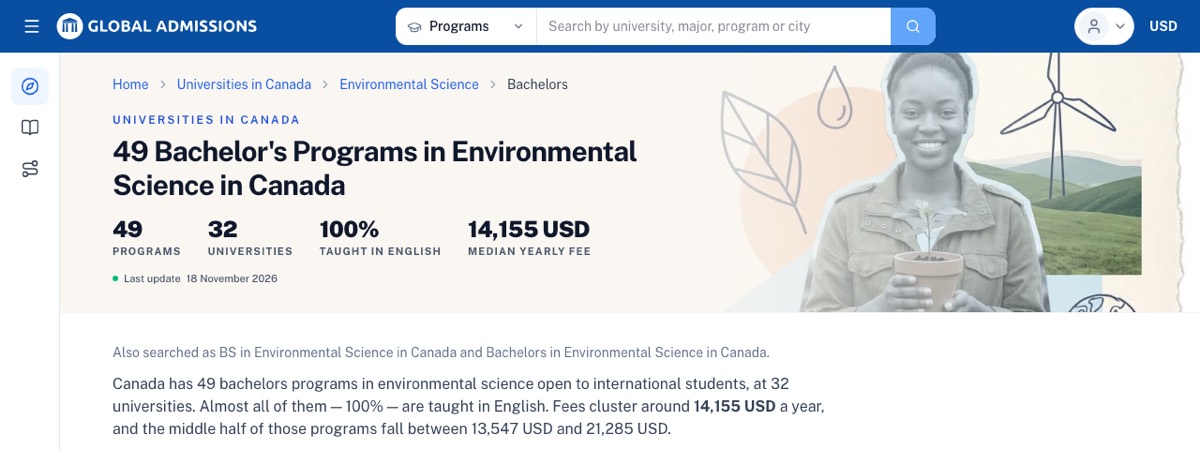
Bachelor in Environmental Science is a 4 year in-person bachelor's program from Carleton University in Ontario, with the international price shown as approx. 21,293 USD per year.
| Provider | Carleton University |
|---|---|
| Length | 4 years |
| Cost (CAD) | approx. 21,293 USD per year (international) |
| Credential | Bachelor's |
| Format | in person, Ontario |
Fiona's take: Carleton's Bachelor in Environmental Science is listed as a 4-year in-person bachelor's program, with the international price shown as approx. 21,293 USD per year, so domestic applicants must confirm their own rate with the university. It suits students comparing Ontario bachelor's options, where Job Bank lists NOC 21110 at a Canada median of $40.00 per hour.
Skip it if: Skip it if domestic cost is your priority and you have not yet confirmed Carleton's domestic tuition, since only the international figure is listed.
See Program DetailsHow Much Do Environmental Studies Courses Cost In Canada?
Costs split into three layers: the ECO Canada designation fees, the online course tier, and the degree tier.
| Item | Cost (CAD) | Notes |
|---|---|---|
| EP application + exam fee | $300 + taxes | Paid to ECO Canada when you apply for the EP designation |
| EP certification fee | $230 | Paid once approved |
| EP annual renewal | $230 + taxes | Due on April 1 each year, with PD requirements |
| EPt (Environmental Professional in Training) | $200 | Stepping stone designation while you gain experience |
| Udemy short courses | $11.99 on sale (or free for the AP course) | Certificates of completion, no academic standing |
| Wilfrid Laurier Bachelor of Environmental Studies | $6,180 per year domestic, 2026/27 rates | 4 years full time |
| Carleton Bachelor in Environmental Science | Approx. 21,293 USD per year (international) | Domestic rate not listed |
| Coursera courses | Not listed in this pack | Check current Coursera pricing and financial aid directly |
The pack verifies EP fees and some course and program prices; several program costs are not listed or must be checked with the institution. On the EP side: $300 for the application plus exam, $230 for certification once approved, then $230 plus taxes every April 1 to renew. What you are buying is recognition of experience you already have, not training.
Laurier's $6,180 domestic annual tuition at 2026/27 rates is the one published program figure I can stand behind, so use it as your reference point for a 4 year Ontario credential. Where a program's cost is not listed, budget directly with the institution before you apply.
How Much Does An Environmental Professional Earn In Canada?
Job Bank lists NOC 21110, biologists and related scientists, at a Canada median of $40.00 per hour.
| Province | Median Hourly (NOC 21110) |
|---|---|
| Canada (median) | $40.00 |
| Newfoundland and Labrador | $40.00 |
| Prince Edward Island | $35.90 |
| Nova Scotia | $37.50 |
| New Brunswick | $41.00 |
| Quebec | $38.46 |
| Ontario | $40.00 |
| Manitoba | $37.00 |
| Saskatchewan | $42.85 |
| Alberta | $41.44 |
| British Columbia | $42.00 |
The spread runs from $35.90 in Prince Edward Island to $42.85 in Saskatchewan, and the higher figures cluster in the western provinces and New Brunswick. If you have mobility, the wage map matters as much as the program choice.
Job Bank also lists a high of $66.67 nationally against that $40.00 median, which tells you the ceiling in this occupation is meaningful. ECO Canada's National Labour Report projects 480,510 net job openings by 2033, so the outlook supports a long-term bet on this field, with growth varying by region.
Is An Environmental Studies Qualification Worth It In 2026?
I think it is, with one condition: you commit to the right route for your target role. ECO Canada's National Labour Report projects 480,510 net job openings by 2033, and the $40.00 national median under NOC 21110 backs that up with real pay. This is not a field where the credential alone gets you hired, but the demand trend is on your side.
The condition is matching route to goal. If you want field and technician work, the 2 to 3 year Environmental Technology diploma is the efficient choice, and Georgian College says it prepares students for certifications including water and wastewater treatment operator certification. If you want consulting or policy, Waterloo and Laurier both describe bachelor's graduates going into consulting, government research and not-for-profits, and that is where the degree pays.
Start with Introduction to Environmental Science before you spend anything significant. Two months at 10 hours a week tells you whether ecology, sustainability and impact assessment genuinely interest you, and a shareable certificate documents the effort. That is the lowest-commitment due diligence step in this whole field.
Environmental Studies Questions Canadians Ask
What Degree Do I Need For Environmental Jobs In Canada?
A bachelor's in environmental studies or science, such as the University of Waterloo's Environmental Sciences program, is the typical entry credential. Diplomas and master's programs can also qualify you depending on the role, and Wilfrid Laurier's 4 year Bachelor of Environmental Studies is a published example at $6,180 domestic per year for 2026/27. Match the credential to the role: field work leans diploma, policy and consulting lean degree.
Is Certification Required To Work As An Environmentalist?
Certification as an environmentalist is not required in the general sense: there is no mandatory ECO Canada EP licence for environmental professionals, and the EP designation from ECO Canada is a voluntary certification recognised nationally. It requires a minimum of 5 years of experience, with a $300 application plus exam fee and a $230 certification fee once approved. Some roles, like water and wastewater treatment operator, carry their own certifications that Georgian College's diploma prepares students for.
What Is The Median Wage For Biologists And Related Scientists?
The median wage for NOC 21110, biologists and related scientists, is $40.00 per hour nationally in Job Bank data. Provincial medians range from $35.90 in Prince Edward Island to $42.85 in Saskatchewan, with Ontario at $40.00 and British Columbia at $42.00. Job Bank also lists a national high of $66.67, which shows the earning ceiling in this occupation.
How Long Does It Take To Become An Environmental Professional?
Becoming an environmental professional takes 4 years for a bachelor's or 2 to 3 years for a diploma, plus working experience. The EP designation itself requires 5 or more years of experience, and the EPt stepping stone designation at $200 lets you signal your trajectory while you build it. Coursera's Introduction to Environmental Science takes 2 months at 10 hours a week and is a way to sample the field, not a shortcut to the designation.
What Jobs Can I Get With An Environmental Studies Degree?
Environmental studies degree jobs include environmental consultant, policy analyst, field technician and resource manager, in government or the private sector. Wilfrid Laurier describes its Bachelor of Environmental Studies as leading to these roles, and Waterloo points its Environmental Sciences graduates toward environmental or ecological consulting, engineering firms, government research and not-for-profits. The EP designation from ECO Canada can formalise your standing once you have the experience.
What Is The Job Outlook For Environmental Roles?
The job outlook for environmental roles in Canada is projected growth, with 480,510 net job openings by 2033 according to ECO Canada's National Labour Report. Job Bank lists NOC 21110 at a $40.00 national median hourly wage, which supports the demand picture. Growth varies by region, so check provincial medians, from $35.90 in PE to $42.85 in SK, before choosing where to settle.
Do Environmental Professionals Need To Renew Certification?
Renewal is required if you hold the EP designation. ECO Canada charges $230 plus taxes annually, due on April 1 each year, and the designation carries professional development requirements you must keep up with. This is separate from any employment: the EP is voluntary for the general profession. Budget the renewal as a standing cost of maintaining the credential.
Can A Coursera Certificate Count Toward An Environmental Degree Or The EP Designation?
A Coursera certificate cannot count toward the EP designation, which requires a minimum of 5 years of verified experience, and this pack does not list any pathway for Coursera certificates to count toward a Canadian degree. What a course like Dartmouth's Introduction to Environmental Science offers instead is a 2 month, 10 hours a week test of the field with a 4.7 rating across 482 reviews. Use it to decide whether the diploma or degree is worth your money.
What's The Bottom Line On Environmental Studies Courses In Canada?
- There is no mandatory ECO Canada EP licence for environmental professionals generally; the EP is voluntary, needs 5+ years of experience, and costs $300 for application plus exam and $230 to certify. Some roles, such as water/wastewater operator roles, have separate certifications.
- The fastest credential route is a 2-year Environmental Technology diploma, which Georgian College says prepares students for certifications including water and wastewater treatment operator certification.
- Job Bank lists NOC 21110 at a $40.00 national median hourly wage, with provincial medians from $35.90 in PE to $42.85 in SK.
- ECO Canada projects 480,510 net job openings by 2033, so the demand trend supports a long-term investment in this field.
- Test the field first with Introduction to Environmental Science from Dartmouth College, 2 months at 10 hours a week, before committing to a 2 to 4 year Canadian credential.