Key Takeaways
- The fastest realistic route to working as a marine biologist is a 4-year BSc in Marine Biology, roughly $27,000 in total domestic tuition at Memorial University of Newfoundland at about $6,750 per year.
- A licence is not part of the standard marine biologist path, but regulation of biologists varies: Alberta and British Columbia are listed by Job Bank as jurisdictions where biologists are regulated, and Quebec has the Ordre des biologistes du Québec.
- Test the field first with the 7-hour Marine Biology course from the American Museum of Natural History on Coursera; it does not qualify you for any marine biologist role, but it shows you whether the subject holds your interest before you commit four years.
- Job Bank reports a median wage of $40 per hour for NOC 21110 across Canada, ranging from $35.90 in Prince Edward Island to $42 in British Columbia, with an outlook that varies by province from moderate to limited.
- Fiona's verdict: the degree suits students with strong Grade 12 sciences who want field and lab work; if you want a quicker credential, the 1-year Post-Degree Diploma in Fisheries and Aquaculture at Vancouver Island University only works after a completed BSc.
Marine biology is the study of marine organisms, their behaviours and their interactions with the environment. In Canada the standard entry into this field is a 4-year Bachelor of Science, most affordably at Memorial University of Newfoundland, where domestic tuition runs about $6,750 per year.
Before you commit that kind of time and money, I recommend a short online course first. The 7-hour Marine Biology course from the American Museum of Natural History on Coursera tells you quickly whether the subject grabs you. This page compares the real routes, costs, wages and requirements for Canadians.
What Are The Ways To Become A Marine Biologist In Canada?
A marine biology career in Canada runs through a university science degree, with one notable post-degree specialization option on the west coast.
| Route | Time | Cost (CAD) | What You Get | Recognised By | Best For |
|---|---|---|---|---|---|
| Marine Biology plus other short online courses | 7 hours for the AMNH course | Not listed | Shareable course certificate; a real taste of the subject | Not a credential for employment | Anyone testing interest before applying to a BSc |
| BSc in Marine Biology or a Biology major with marine focus | 4 years | $6,750 per year at MUN, about $27,000 total | Bachelor of Science | Memorial University of Newfoundland | The standard entry route into NOC 21110 roles |
| Post-Degree Diploma in Fisheries and Aquaculture or Applied Coastal Ecology | 1 year | $4,370 at VIU | Post-Degree Diploma | Vancouver Island University or Coast Mountain College | BSc holders adding a specialization |
| Marine Biology BSc at Dalhousie University | 120 credit hours, typically 4 years | Not listed | Bachelor of Science or Bachelor of Arts | Dalhousie University, Nova Scotia | Students wanting an Atlantic Canada in-person program |
I recommend the MUN BSc for cost-conscious domestic students, the Dalhousie program for those set on Nova Scotia, and the Coursera course for absolutely everyone as a first step before applying anywhere.
What Is The Fastest Way To Become A Marine Biologist In Canada?
Becoming a marine biologist takes at minimum a 4-year BSc, and there is no shortcut credential in Canada that replaces it.
- Finish high school prerequisites: English, Math, Biology, and Chemistry or Physics, typically completed by the end of Grade 12, at no cost beyond ordinary schooling.
- Enrol in a 4-year BSc in Marine Biology or an equivalent biology major with a marine focus at a Canadian university such as Memorial University of Newfoundland, about $27,000 in domestic tuition over four years.
- Optionally add a 1-year Post-Degree Diploma in Fisheries and Aquaculture or Applied Coastal Ecology at Vancouver Island University or Coast Mountain College for about $4,370, to specialize after the BSc.
- While still deciding, take the 7-hour Marine Biology course from the American Museum of Natural History on Coursera to confirm the field suits you before you spend a dollar on tuition.
Do You Need A Licence To Work As A Marine Biologist In Canada?
A licence is not a standard requirement for marine biology work in Canada, but regulation of biologists is not uniform: Job Bank lists biologists as regulated in Alberta and British Columbia, and Quebec has the Ordre des biologistes du Québec. The nature of regulation, such as title protection versus practice requirements, varies by province.
| Province | Required? | Regulator Or Registry | What It Means |
|---|---|---|---|
| British Columbia | No | College of Applied Biologists | Registration exists; some applied roles expect it |
| Alberta | No | Alberta Society of Professional Biologists (ASPB) | Registered Biologist category exists |
| Quebec | Regulated jurisdiction | Ordre des biologistes du Québec | Biologists are regulated in Quebec |
| All other provinces and territories | No | None | No regulator or registry listed in the pack |
For NOC 21110 roles, the credential that matters most is the degree. Job Bank lists biologists as regulated in Alberta and British Columbia, and Quebec has the Ordre des biologistes du Québec, so the picture varies by province. Check the requirements for the province where you plan to work, since title protection and registration rules differ.
In British Columbia and Alberta, registration with the College of Applied Biologists or the ASPB can matter for applied consulting roles, and it is a step you take after the degree, not instead of it. In other jurisdictions listed without a regulator, the degree remains the key credential.
Which Marine Biology Courses And Programs Are Worth Taking?
Start with the short online courses to test your interest, then move to the university programs that actually qualify you for the field.
Marine Biology
Marine Biology is a 7-hour online course from the American Museum of Natural History that introduces marine organisms and ecosystems, rated 4.8 from 618 reviews.
| Provider | American Museum of Natural History |
|---|---|
| Length | 7 hours to complete |
| Rating | 4.8 (618 reviews) |
| Credential | Shareable certificate |
| Format | online |
Fiona's take: This is the course I tell clients to take before anything else. Seven hours is one focused weekend, and it tells you whether the vocabulary and concepts of marine science excite you or bore you. The 4.8 rating from 618 reviews suggests it delivers. It grants a shareable certificate, but that certificate does not qualify you for any marine biologist role.
Skip it if: Skip it if you already hold a science degree and need a specialization credential rather than an introduction.
Start On CourseraOceanography: a key to better understand our world
Oceanography: a key to better understand our world is a 3-week online course at 10 hours per week from Universitat de Barcelona, rated 4.5 from 288 reviews.
| Provider | Universitat de Barcelona |
|---|---|
| Length | 3 weeks to complete at 10 hours a week |
| Rating | 4.5 (288 reviews) |
| Credential | Shareable certificate |
| Format | online |
Fiona's take: This is a 3-week online oceanography course from Universitat de Barcelona with a shareable certificate. At 10 hours a week for 3 weeks, it is a bigger commitment than the AMNH course, and it covers a related subject rather than marine biology itself. Like that course, it is a taster, not a credential.
Skip it if: Skip it if you want organisms and ecosystems rather than ocean science.
Start On CourseraLarge Marine Ecosystems: Assessment and Management
Large Marine Ecosystems: Assessment and Management is an online course from the University of Cape Town with a shareable certificate.
| Provider | University of Cape Town |
|---|---|
| Credential | Shareable certificate |
| Format | online |
Fiona's take: It is an online course from the University of Cape Town with a shareable certificate. The ecosystem-scale topic sits adjacent to marine biology, so it can serve as extra background reading while you decide on a degree route.
Skip it if: Skip it if you want a course with a stated length; the pack lists none for this one.
Start On CourseraThe Complete MARINE BIOLOGY 101 Course, Beginner to Advanced
The Complete MARINE BIOLOGY 101 Course, Beginner to Advanced is an online Udemy course by Sydney Baxter, rated 4.5 from 450 ratings.
| Provider | Sydney Baxter |
|---|---|
| Rating | 4.5 (450 ratings) |
| Credential | Certificate of completion |
| Format | online |
Fiona's take: A survey of the field from beginner to advanced material. It is a certificate of completion from Udemy, so treat it as personal learning, not a qualification.
Skip it if: Skip it if the Coursera introductions already cover what you need.
View On UdemyMarine Biology Introduction - Mantas, Turtles and Coral Reef
Marine Biology Introduction - Mantas, Turtles and Coral Reef is a 2-hour on-demand video course on Udemy by Joshua Davies, rated 4.5 from 15 ratings.
| Provider | Joshua Davies |
|---|---|
| Length | 2 hours on-demand video |
| Rating | 4.5 (15 ratings) |
| Credential | Certificate of completion |
| Format | online |
Fiona's take: Two hours of video on charismatic species is a genuinely fun first look. With only 15 ratings, I would not read much into the score, and coral reef content sits far from most Canadian work on cold coastal waters.
Skip it if: Skip it if you are deciding on a degree; it is too narrow to inform that choice.
View On UdemyMarine Biology (BSc) or (BA)
Marine Biology (BSc) or (BA) is a typically 4-year in-person or hybrid bachelor program at Dalhousie University in Nova Scotia.
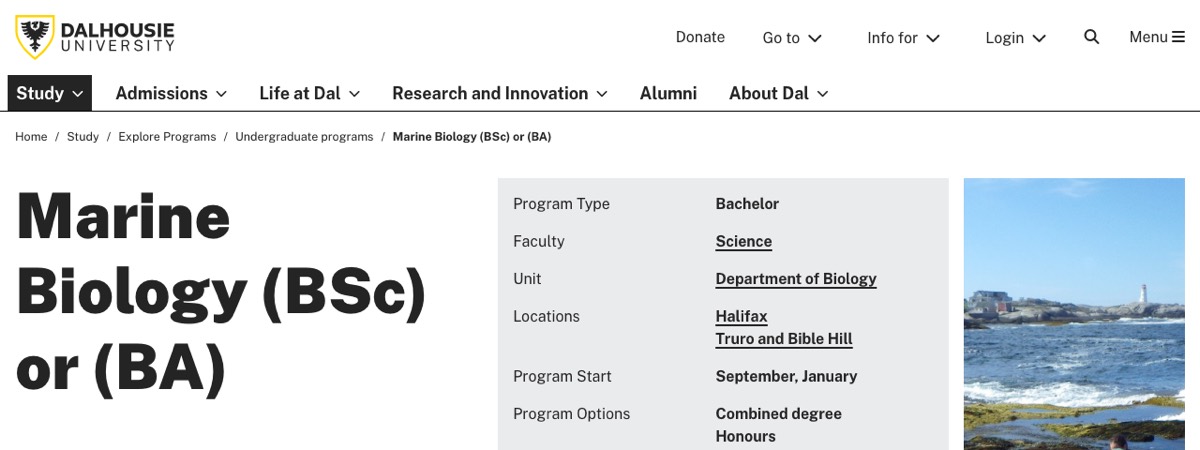
| Provider | Dalhousie University |
|---|---|
| Length | Bachelor (typically 4 years) |
| Credential | Bachelor of Science or Bachelor of Arts |
| Format | in person/hybrid, NS |
Fiona's take: Dalhousie is a serious option for students who want an Atlantic Canada program with hands-on learning opportunities on the Atlantic Coast. The choice between BSc and BA matters: the BSc keeps the science pathway into NOC 21110 open. Check current tuition directly with Dalhousie before applying, as the figure is not listed here.
Skip it if: Skip it if keeping tuition at the MUN domestic rate of $6,750 per year is your top concern; confirm Dalhousie pricing before comparing.
See Program DetailsMarine Biology (BSc)
Marine Biology (BSc) at Dalhousie University is a 120 credit hour in-person Bachelor of Science program in Nova Scotia.
| Provider | Dalhousie University |
|---|---|
| Length | 120 credit hour |
| Credential | Bachelor of Science |
| Format | in person, NS |
Fiona's take: This is a 120 credit hour in-person Bachelor of Science program. If you want a marine biology curriculum at one institution, this is the program page to study closely, alongside MUN and VIU options.
Skip it if: Skip it if you need online delivery; this program is in person.
See Program DetailsApplied Coastal Ecology (ACE) Diploma
Applied Coastal Ecology (ACE) Diploma is an in-person diploma program at Coast Mountain College in British Columbia.
| Provider | Coast Mountain College |
|---|---|
| Credential | Diploma |
| Format | in person, BC |
Fiona's take: This is a hands-on west coast option worth comparing against the VIU post-degree diploma. Confirm with the college whether you meet its entry expectations, since it is listed in the pack without length or cost details.
Skip it if: Skip it if you specifically want the fisheries and aquaculture specialization at VIU instead.
See Program DetailsHow Much Does A Marine Biology Degree Cost In Canada?
A marine biology BSc in Canada costs about $6,750 per year in domestic tuition at Memorial University of Newfoundland, which works out to roughly $27,000 over four years.
| Item | Cost (CAD) |
|---|---|
| MUN BSc tuition, domestic, per year | $6,750 |
| MUN BSc tuition, international, per year | $22,500 |
| Additional student fees, per year | About $400 to $800 |
| Four-year domestic tuition total at MUN | About $27,000 |
| Post-Degree Diploma in Fisheries and Aquaculture at VIU, 1 year | $4,370 |
| Mandatory professional exam or registration fees nationally | None |
The MUN figure is the domestic provincial rate; international students at the same institution pay $22,500 per year, a very different calculation.
There is no mandatory professional exam fee for the marine biologist title listed in the pack, but regulation varies by province: check registration requirements with the College of Applied Biologists in British Columbia, the ASPB in Alberta, or the Ordre des biologistes du Québec if you plan to work in Quebec.
If you add the VIU post-degree diploma after a BSc, budget about $4,370 on top of the four years, buying a specialization in fisheries and aquaculture in one year.
How Much Does A Marine Biologist Earn In Canada?
A marine biologist in Canada earns a median of $40 per hour according to Job Bank figures for NOC 21110, with provincial medians ranging from $35.90 to $42.
| Province | Median Hourly Wage (NOC 21110) |
|---|---|
| Canada | $40.00 |
| Newfoundland and Labrador | $40.00 |
| Prince Edward Island | $35.90 |
| Nova Scotia | $37.50 |
| New Brunswick | $41.00 |
| Ontario | $40.00 |
| British Columbia | $42.00 |
British Columbia posts the highest median in this list at $42 per hour, and Prince Edward Island the lowest at $35.90. A $40 median works out to a solid professional salary for a four-year degree, but this is not a field you enter for the money alone.
The outlook varies by province, rated moderate to limited, with a national balance of job seekers and openings expected from 2024 to 2033. That means the degree alone will not carry you; build your strongest possible record within the program.
Is A Marine Biology Degree Worth It In 2026?
Worth it if the subject genuinely holds you. I tell clients to run the 7-hour American Museum of Natural History course on Coursera first, then decide. Four years and about $27,000 at MUN is a reasonable price for a professional science credential with a $40 median wage under NOC 21110, provided you finish and can compete in a moderate-to-limited outlook market.
Not worth it if your main driver is flexibility or fast entry. The BSc is the standard entry credential and there is no 1-year degree shortcut; the VIU 1-year post-degree diploma is for students with a prior BSc.
For Canadians already holding a science degree, the smart move is the $4,370 post-degree specialization at VIU or Coast Mountain College rather than a second bachelor. For everyone else, the MUN BSc at $6,750 per year is the clearest value route in the pack.
Can You Get Funding For A Marine Biology Degree?
Yes, degree students can apply to the Canada Student Financial Assistance Program, which offers both grants and loans.
- Canada Student Grants and Loans (Canada Student Financial Assistance Program). This federal program offers grants and loans to full-time and part-time students to help pay for post-secondary education. Be clear that the loan portion must be repaid; the grant portion does not. Check the Canada Student Financial Assistance Program and the school's financial aid office.
Marine Biology Degree Questions Canadians Ask
How Long Does It Take To Become A Marine Biologist In Canada?
It takes typically 4 years to become a marine biologist in Canada, via a BSc in Marine Biology or a related field, with an optional additional 1 to 2 years for post-degree diplomas or graduate studies. There is no faster degree route; the 1-year diplomas all require a completed BSc first.
Which Route To Study Marine Biology In Canada Costs The Least?
The lowest tuition figure listed is domestic study at Memorial University of Newfoundland, at approximately $6,750 per year for the BSc program, or about $27,000 over four years. International students pay a much higher $22,500 per year at the same institution, so cost depends heavily on your fee status.
Is There A 1-Year Marine Biology Degree Or Diploma Option In Canada?
There is no 1-year marine biology degree in Canada. 1-year post-degree diplomas do exist for those who already hold a BSc, such as the Post-Degree Diploma in Fisheries and Aquaculture at Vancouver Island University, which costs about $4,370.
Are There Online Marine Biology Programs In Canada?
Online options are limited in Canada. Some graduate diplomas are available online, such as Marine Studies in Fisheries Resource Management at the Marine Institute. The pack lists limited online options and identifies some online graduate diplomas.
Diploma Or Degree For Marine Biology Careers In Canada?
A BSc degree is the standard entry for marine biologist roles; Job Bank lists NOC 21110 as requiring a university degree. Diplomas provide specialization after a degree, such as the VIU post-degree diploma, rather than replacing the degree.
Do You Need A Licence To Work As A Marine Biologist In Canada?
A licence is not the standard requirement for marine biology work in Canada, but the picture varies. Job Bank lists biologists as regulated in Alberta and British Columbia, and Quebec has the Ordre des biologistes du Québec. Voluntary registration as a Professional Biologist exists through the College of Applied Biologists in BC and the ASPB in Alberta for some applied roles. Check the rules for your province.
What Are The Job Prospects And Wages For Marine Biologists In Canada?
Job prospects vary by province, rated moderate to limited, with a national balance of seekers and openings expected from 2024 to 2033. The median wage is $40 per hour under NOC 21110, from $35.90 in Prince Edward Island to $42 in British Columbia.
What High School Courses Are Needed For Marine Biology Admission?
High school requirements for marine biology admission include English, Advanced Functions or Math, and two or more sciences from Biology, Chemistry and Physics, with minimum averages around 70% at Memorial University of Newfoundland.
What's The Bottom Line On A Marine Biology Degree In Canada?
- A 4-year BSc is the entry credential for NOC 21110 marine biologist roles; the most affordable listed route is Memorial University of Newfoundland at about $6,750 per year in domestic tuition, roughly $27,000 total.
- Regulation of biologists varies by province: Job Bank lists biologists as regulated in Alberta and British Columbia, and Quebec has the Ordre des biologistes du Québec; the marine biologist title itself has no national licence requirement listed.
- Test the field for 7 hours with the Marine Biology course from the American Museum of Natural History on Coursera before committing four years: Marine Biology.
- Job Bank puts the median wage at $40 per hour for NOC 21110, with an outlook that varies by province from moderate to limited through 2033.
- Already hold a BSc? The 1-year, $4,370 Post-Degree Diploma in Fisheries and Aquaculture at Vancouver Island University is the fastest specialization on the board.