
Key Takeaways
- The fastest realistic route is on-the-job: halal butcher positions in federally licensed meat processing plants require no credential and no course, pay a median of $23.00 per hour under NOC 94141, and training takes several weeks.
- No licence is required anywhere in Canada. The Canadian Food Inspection Agency (CFIA) does not regulate halal standards or certifiers; any halal label must name the certifying body, a rule in force since April 4, 2016.
- Coursera's Understanding Food Regulations & Food Labeling is a 9-hour course on U.S. food regulation and food labeling; it does not qualify you for any halal credential.
- Median wages under NOC 94141 (industrial butchers and meat cutters) range from $19.00 per hour in Saskatchewan to $25.00 in British Columbia, with a national median of $23.00.
- I recommend testing interest with a short online course, then applying directly to federally licensed plants; this path suits practicing Muslims familiar with halal slaughter requirements who want quick entry into the food industry.
Halal meat certification is verification by private organizations that meat products and slaughter processes comply with Islamic dietary requirements; the federal government does not define or regulate halal standards.
The direct answer: no licence, course or credential is legally required to work in halal slaughter in Canada. Employers prefer practicing Muslims familiar with halal procedures, training happens on the job over several weeks, and the median wage is $23.00 per hour under NOC 94141.
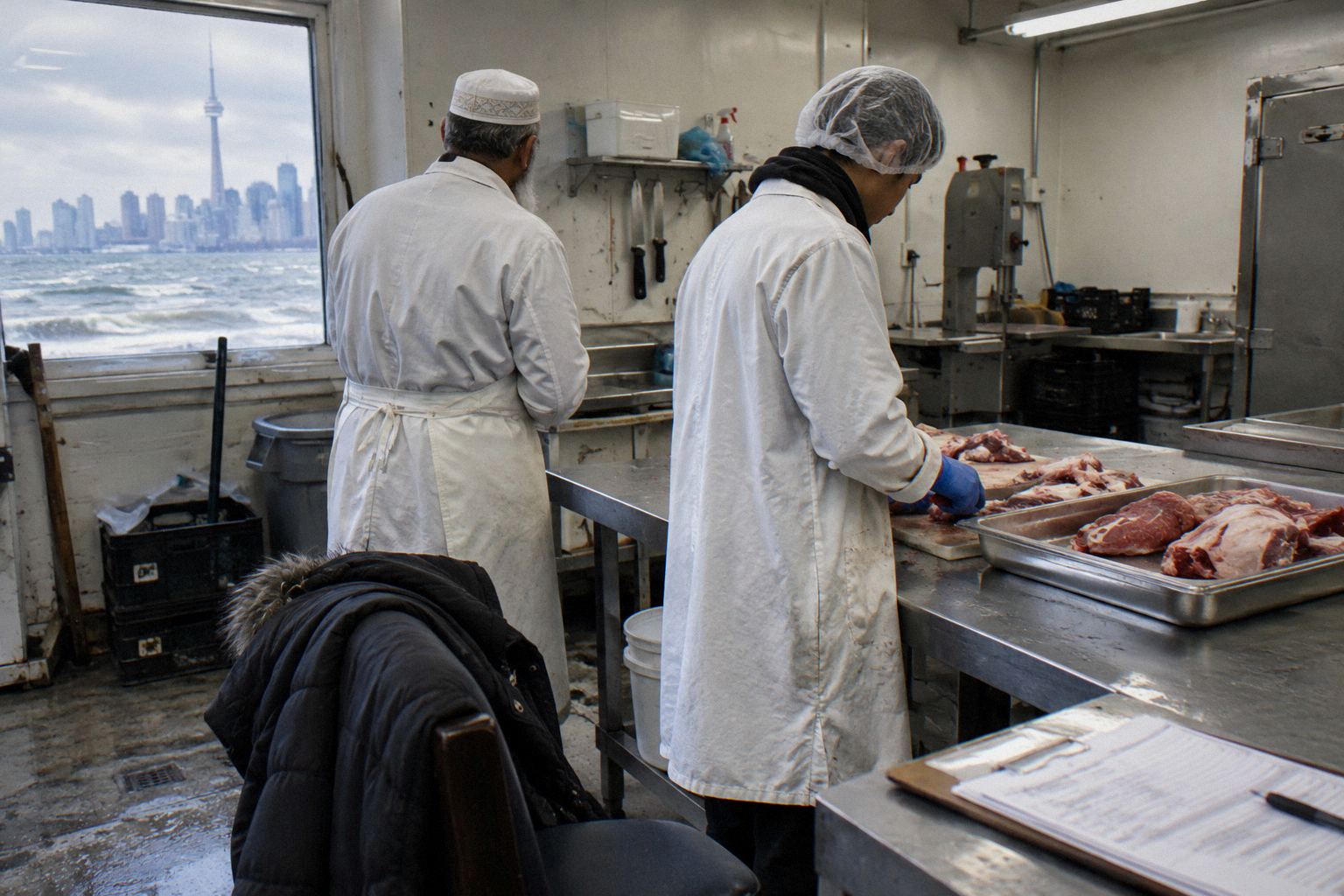
What Are The Ways To Get Into Halal Meat Certification In Canada?
The main career route is on-the-job training; the table also lists related courses.
| Route | Time | Cost (CAD) | What You Get | Recognised By | Best For |
|---|---|---|---|---|---|
| Understanding Food Regulations & Food Labeling plus other food compliance courses | 9 hours | Not listed | Career certificate; U.S. food regulation and labeling knowledge | Not a regulated credential | Testing interest in food regulation before committing |
| Halal butcher in a meat processing plant (on-the-job training) | Several weeks | 0 | Employment and hands-on halal slaughter experience | Private halal certifiers such as HMA and employers | Practicing Muslims ready to work |
| Udemy halal courses | 2.5 to 3 hours | Not listed | Certificate of completion; recognition not listed | Not listed | Learning halal theory independently |
| Micro Certificate in Muslim Studies at University of St. Michael's College | 12 hours per course | $150 per course | Micro Certificate | University of St. Michael's College | Building credentialled background knowledge |
I recommend the on-the-job route for anyone who meets the religious requirement, and the Coursera route first for those who want to confirm the field interests them before applying.
What Is The Fastest Way To Start Working In Halal Meat Certification In Canada?
The fastest way is direct employment, because the law requires no credential.
- Confirm you meet the core requirement: HMA's guidance says the slaughterman must be a practicing Muslim familiar with halal procedures, with Allah's name pronounced at the time of slaughter.
- Review the 9-hour Coursera course Understanding Food Regulations & Food Labeling, which covers U.S. food regulation and labeling; the cost is not listed.
- Search Job Bank for industrial butcher and meat cutter postings under NOC 94141 and apply to federally licensed plants.
- Complete on-the-job training over several weeks; employers train hires themselves and there is no tuition listed.
- If your interest is the business side, apply to the AgriAssurance Program, which provides up to $50,000 for initial red meat halal certification for eligible processors.
Is A Licence Or Certificate Required For Halal Slaughter In Canada?
Halal certification is voluntary, and no government body regulates halal standards or certifiers.
| Province | Required? | Regulator Or Registry | What It Means |
|---|---|---|---|
| All provinces | No | CFIA | Halal certification is voluntary; CFIA enforces food safety and requires the certifier's name on any halal claim |
The Canadian Food Inspection Agency (CFIA) licenses slaughter operations under the Safe Food for Canadians Act, but that licence covers humane treatment and food safety, not halal standards. Halal certification itself is handled entirely by private organizations such as HMA, and anyone can set up as a certifier because there is no federal accreditation.
One federal rule does bind the label: since April 4, 2016, it has been illegal to market a food as halal without naming who certified it. So a business cannot print a halal claim without disclosing its certifying body, but it can choose any certifier it likes.
Which Halal And Food Compliance Courses Are Worth Taking?
No course qualifies you as a halal certifier or slaughterman; these options teach theory and context, and hiring decisions rest on faith practice and hands-on training.
Understanding Food Regulations & Food Labeling
Understanding Food Regulations & Food Labeling is a 9-hour online career certificate course from Coursera covering U.S. food regulation and labeling.
| Provider | Coursera |
|---|---|
| Length | 9 hours |
| Credential | Career certificate |
| Format | online |
Fiona's take: This is my pick for testing the field. It covers key agencies involved in U.S. food regulation and food labeling rules. It does not qualify you for any halal credential, but it tells you whether regulatory and compliance work interests you for nine hours of effort.
Skip it if: Skip it if you only want hands-on butchery work and have no interest in compliance or labeling roles.
Start On CourseraHalal Training Course
Halal Training Course is a 2.5-hour on-demand video course from Udemy with a 4.2 rating and a certificate of completion.
| Provider | Udemy |
|---|---|
| Length | 2.5 hours on-demand video |
| Rating | 4.2 |
| Credential | Certificate of completion |
| Format | online |
Fiona's take: This is the closest thing to a dedicated halal course among the options here, covering the principles of halal requirements. A 4.2 rating is decent but not stellar, and the credential is a certificate of completion, so treat it as background learning.
Skip it if: Skip it if you already know the slaughter requirements from community or family knowledge.
View On UdemyHalal food Production and Market Opportunities.
Halal food Production and Market Opportunities is a 3-hour on-demand video course from Udemy rated 4.7, covering halal production and markets.
| Provider | Udemy |
|---|---|
| Length | 3 hours on-demand video |
| Rating | 4.7 |
| Credential | Certificate of completion |
| Format | online |
Fiona's take: The 4.7 rating is strong, and the course covers halal production and market opportunities, including the growing halal market. I suggest it for processors and business owners more than for job seekers.
Skip it if: Skip it if you are purely job hunting and not planning to certify a business.
View On UdemyMicro Certificate in Muslim Studies
Micro Certificate in Muslim Studies is a part-time online program from University of St. Michael's College in Ontario, with each course running 12 hours at $150 per course.
| Provider | University of St. Michael's College |
|---|---|
| Length | Each course is 12 hours |
| Cost (CAD) | $150 per course |
| Credential | Micro Certificate |
| Format | online, Ontario |
Fiona's take: This is the only university micro-certificate option listed, and it offers background in Islamic thought, spirituality and history. At $150 per 12-hour course it is a low-commitment way to earn a university micro certificate.
Skip it if: Skip it if your goal is immediate employment and you already practice and understand the requirements.
See Program DetailsHow Much Does Halal Certification Cost In Canada?
For individuals, entering the field costs essentially nothing; for businesses, certification carries real fees.
| Item | Cost (CAD) | Notes |
|---|---|---|
| On-the-job training as a halal butcher | 0 | Several weeks of on-the-job training; no tuition listed |
| Coursera compliance courses | Not listed | |
| HMA application fee (business) | $200 | Business certification, not individual |
| HMA monthly certification (business) | ~$250 | Covers inspection, admin and marketing |
| Document-based certification (business) | $497 USD | Flat fee example from one provider |
| Micro Certificate in Muslim Studies | $150 per course | University of St. Michael's College |
Note that the HMA and flat-fee figures are business costs, not personal ones. A red meat processor seeking initial halal certification can offset these with up to $50,000 from the AgriAssurance Program, covering 50% of costs for eligible applicants.
How Much Does A Halal Butcher Earn In Canada?
Halal butchers fall under NOC 94141, industrial butchers and meat cutters, with a national median of $23.00 per hour according to Job Bank.
| Province | Median Hourly Wage |
|---|---|
| Canada (median) | $23.00 |
| Alberta | $23.00 |
| British Columbia | $25.00 |
| Manitoba | $20.00 |
| New Brunswick | $20.44 |
| Newfoundland and Labrador | $20.49 |
| Nova Scotia | $20.00 |
| Ontario | $22.50 |
| Prince Edward Island | $20.00 |
| Quebec | $24.00 |
| Saskatchewan | $19.00 |
British Columbia and Quebec pay the highest medians at $25.00 and $24.00 respectively, while Saskatchewan sits lowest at $19.00. Job Bank rates the outlook as varying by province.
Is Halal Meat Certification Worth Pursuing In 2026?
As a job path, worth it for the right person: no tuition, several weeks of training, and a national median wage of $23.00 per hour. The catch is the entry requirement that no course can supply: HMA's guidance that the slaughterman be a practicing Muslim familiar with halal procedures, with Allah's name pronounced at slaughter.
As a business decision, halal certification is worth evaluating carefully. Since April 4, 2016, a halal claim requires naming your certifier, and certifier quality varies because there is no federal accreditation. Reputable certifiers conduct on-site audits, ingredient reviews and ongoing monitoring, so choose one with a real inspection process.
If your interest is regulatory or quality assurance work rather than slaughter itself, the Coursera compliance courses are a sound first test before spending anything.
Can You Get Funding For Halal Certification?
Yes, for processors, through one federal program.
- AgriAssurance Program (Kosher and Halal component). Agriculture and Agri-Food Canada provides up to $50,000, covering 50% of costs, for red meat processors obtaining initial kosher or halal certification. This is a business grant, not personal training funding.
Halal Meat Certification Questions Canadians Ask
Is Halal Certification Mandatory In Canada?
No, halal certification is voluntary for businesses. However, if a halal claim appears on labels or advertising, the name of the certifying body must appear, per CFIA rules in force since April 4, 2016.
Who Regulates Halal Meat In Canada?
No government body regulates halal standards or certifiers. Private organizations handle certification while CFIA enforces general food safety, humane slaughter rules under the Safe Food for Canadians Act, and labeling disclosure.
What Are The Requirements For Halal Slaughter In Canada?
Animals must be healthy, slaughtered by a practicing Muslim invoking Allah's name, with proper cuts to sever major vessels without severing the spinal cord, per certifier standards and CFIA humane rules.
How Much Does Halal Certification Cost For A Business?
Costs vary by certifier. HMA charges a $200 application fee plus roughly $250 monthly, while some document-based services charge flat fees such as $497 USD. Red meat processors can offset initial certification costs with up to $50,000 from the AgriAssurance Program.
Can Anyone Become A Halal Certifier In Canada?
Yes, there is no federal accreditation or licensing for halal certifiers. The CFIA only requires that a certifier's name be disclosed on any halal claim, so anyone can enter the field, which is why certifier reputation matters.
What NOC Code Applies To Halal Butchers?
NOC 94141 covers industrial butchers, meat cutters, poultry preparers and related workers, with a national median wage of $23.00 per hour according to Job Bank.
Do Halal Certifiers Require On-Site Audits?
Most reputable certifiers conduct on-site audits, ingredient reviews and ongoing monitoring. Requirements vary by certifier and product, so businesses should verify the inspection process before signing a contract.
What's The Bottom Line On Halal Meat Certification?
- No licence, course or credential is legally required to work in halal slaughter in Canada; CFIA does not define halal, and certification is handled by private bodies like HMA.
- The fastest route is direct employment in a federally licensed plant, with several weeks of on-the-job training and a median wage of $23.00 per hour under NOC 94141.
- Since April 4, 2016, any halal claim on a label must name the certifying body, so choose a certifier with genuine on-site audits.
- Eligible red meat processors may receive up to $50,000, covering 50% of costs, for initial kosher or halal certification under the AgriAssurance Program.
- Test your interest first with Understanding Food Regulations & Food Labeling, a 9-hour Coursera course that does not qualify you for any halal credential but teaches food regulation and labeling.