Key Takeaways
- The fastest realistic route is the Coursera course itself: 2 weeks at 10 hours a week, with no standalone price shown and Coursera Plus at about CA$82 per month after a 7-day free trial, or CA$433 for 12 months (regularly CA$569); confirm live pricing at checkout.
- No licence or registration exists for study skills, and no regulator, professional body, college PLAR policy or job posting on Job Bank or Indeed Canada names this certificate as required or formally recognised.
- The try-first pick is Learning How to Learn itself: a beginner Coursera course of four modules listed at 4, 3, 4 and 4 hours with no prerequisites, and no Canadian regulator, professional body, college-credit policy or job posting found in this review requires or formally recognises it.
- The page shows a 4.8 rating from 93,299 reviews with 98% of learners liking it and 4,202,163 enrolled; financial aid, if approved, means a 150-word application, up to 16 days of review and 180 days to finish.
- Fiona's verdict: worth taking before any long program; pay if you want the Certificate experience, since the page also lists Partner-supported free access but does not describe what it includes.
Learning How to Learn: Powerful mental tools to help you master tough subjects is a beginner online course from Deep Teaching Solutions on Coursera, taught by Dr. Barbara Oakley and Dr. Terrence Sejnowski. It covers how the brain learns, chunking, memory and procrastination.
My verdict: the material is worth two weeks of almost anyone's study time, and the page shows a 4.8 rating from 93,299 reviews, but the certificate is a course certificate, not a Canadian credential, so decide what you are paying for before you pay.

What Are The Ways To Learn How To Learn In Canada?
The ways to learn how to learn in Canada run from a free 1h 19m Udemy course to a 3-credit Athabasca University course at $971.50 all-inclusive for an Alberta resident. Only one option on this list ends in transcripted university credit.
| Route | Time | Cost (CAD) | What You Get | Recognised By | Best For |
|---|---|---|---|---|---|
| Learning How to Learn: Powerful mental tools to help you master tough subjects (Deep Teaching Solutions) | 2 weeks at 10 hours a week | Not shown; included with Coursera Plus at about CA$82/month | Shareable Coursera certificate; 11 assignments, peer reviews | No Canadian regulator, college or employer found | Testing study-skills training before paying tuition |
| Mindshift: Break Through Obstacles to Learning and Discover Your Hidden Potential (McMaster University) | 1 week at 10 hours a week | Not shown; included with Coursera Plus | Shareable certificate; optional Honors Certificate | No Canadian recognition checked for this review | Career changers after the original |
| Practical Metacognition for Learning (Rice University) | 2 weeks at 10 hours a week | Not shown; included with Coursera Plus | Shareable certificate | No Canadian recognition checked for this review | |
| How to Learn: Effective Approaches for Self-Guided Learning (Udemy) | 1h 19m | Free, as stated on the course page | No certificate shown | None shown | A zero-cost first taste |
| Academic Skills for University Success (UBC Extended Learning) | Eight weeks, self-paced, two to three hours a week, 60 days to complete from registration | $260 | Letter of completion; assessed, not graded | UBC continuing education, not credit | Students wanting a Canadian provider |
| Introduction to Research and Study Skills (Revision 6) (Athabasca University) | Up to 6 months | $971.50 all-inclusive for an Alberta resident; $1,162.50 for a Canadian outside Alberta, as published for courses starting 1 Sep 2026 to 31 Aug 2027 | 3 undergraduate credits | A Canadian university transcript | People who need real credit |
| Academic Prep: How to Be a University Student (Carleton University) | 5 days | $275 including HST | Non-credit (CIED 0999) | Carleton's Centre for Initiatives in Education | Incoming first-years in Ottawa |
The Coursera route fits testing the field before tuition, UBC Extended Learning suits a learner who wants a Canadian provider at $260, and Athabasca University's COMM 100 is the pick when only transcripted credit will do.
What Is The Fastest Way To Earn The Learning How To Learn Certificate?
The fastest way to earn the Learning How to Learn certificate is one paid Coursera Plus month at about CA$82, worked at the page pace of 2 weeks at 10 hours a week, with the certificate issued on completion.
- Open the course page and pick an enrollment option. The page lists Partner-supported free access and says earning a Certificate requires purchasing the Certificate experience; the standalone price is not shown. Enrollment is immediate once you choose.
- Start Coursera Plus on the monthly plan, about CA$82 after a 7-day free trial, with the exact figure to confirm at checkout; the course page says the course is included with Coursera Plus. Cancel inside the trial if you only want a look.
- Finish the four modules at their listed times of 4, 3, 4 and 4 hours, plus 11 assignments, some AI-graded, two peer reviews and the final. The page pace is 2 weeks at 10 hours a week, and Module 1 says its core takes about an hour.
- Claim the shareable certificate from your Accomplishments page and add it to LinkedIn. Coursera issues it on completion, with no separate exam week stated.
- If you apply for financial aid instead of paying, budget up to 16 days for review, write at least 150 words, and finish within 180 days of enrollment.
Do Employers In Canada Recognise The Learning How To Learn Certificate?
No Canadian job posting found in this review required the Learning How to Learn certificate, and no licence exists for study skills. Searches of Job Bank, Indeed Canada and Canadian college PLAR pages found no provincial or federal program, college-credit policy or professional body that names this certificate as required or formally recognised. Ontario Colleges describes PLAR in general and does not name this course.
Coursera's shareable certificate can be printed or added to LinkedIn. That is a platform feature, not Canadian academic recognition. The course names no occupation, licence or Canadian credential, which is also why no Job Bank wage attaches to it: it is general-interest learning skill, not preparation for a National Occupational Classification job.
I tell clients to treat the certificate as a personal milestone for a LinkedIn profile and nothing more. If a credential is the real goal, Athabasca COMM 100 is the clearest open online 3-credit option listed, at $971.50 all-inclusive for a permanent resident of Alberta; UQAM's PHI 1100 is 3 credits but not offered in the listed terms, and Dalhousie ENSL 0004 is zero-credit Pass/Fail on a transcript.
What Does Learning How To Learn Teach, And What Are The Alternatives?
Learning How to Learn teaches focused and diffuse modes, chunking, illusions of competence, the memory palace and a test checklist across four modules listed at 4, 3, 4 and 4 hours. Here is my read on it and the eleven alternatives I compared for Canadians.
Learning How to Learn: Powerful mental tools to help you master tough subjects
Learning How to Learn: Powerful mental tools to help you master tough subjects is a beginner course from Deep Teaching Solutions on Coursera, paced at 2 weeks at 10 hours a week, that teaches how the brain learns, chunking, memory and procrastination management.
| Provider | Deep Teaching Solutions |
|---|---|
| Length | 2 weeks at 10 hours a week |
| Cost (CAD) | Not shown in CAD. The page says the course is “Included with” Coursera Plus, and a banner says “a full year of Coursera Plus, now $239” without labelling that amount as CAD. |
| Rating | 4.8 (93,299 reviews on coursera.org) |
| Credential | Shareable certificate |
| Format | online |
Fiona's take: The modules, What is Learning?, Chunking, Procrastination and Memory, and Renaissance Learning and Unlocking Your Potential, end in 11 assignments, some AI-graded, two peer reviews and a final. Dr. Barbara Oakley's instructor block shows 4.9 from 20,306 ratings, the course shows 4.8 from 93,299 reviews with 4,202,163 enrolled, and 98% of learners liked it. It is taught in English with 25 languages available.
Skip it if: Skip it if you want a credential a Canadian employer, college or regulator must recognise, because this certificate is none of those.
Start On CourseraMindshift: Break Through Obstacles to Learning and Discover Your Hidden Potential
Mindshift: Break Through Obstacles to Learning and Discover Your Hidden Potential is a 1 week at 10 hours a week course from McMaster University on Coursera, taught by Dr. Terrence Sejnowski and Dr. Barbara Oakley, that applies learning science to career change.
| Provider | McMaster University |
|---|---|
| Length | 1 week at 10 hours a week |
| Cost (CAD) | Not shown in CAD. The page says the course is “Included with” Coursera Plus, and a banner says “a full year of Coursera Plus, now $239” without labelling that amount as CAD. |
| Rating | 4.8 |
| Credential | Shareable certificate; the page also says an Honors Certificate is available if the two extra Honors assignments are completed |
| Format | online |
Fiona's take: Its four modules run 3, 2, 3 and 2 hours, and two extra Honors assignments earn an Honors Certificate. The page rates it 4.8 and says it can be taken independently, alongside or after Learning How to Learn: this course is more learning-focused, Mindshift is more career-focused.
Skip it if: Skip it if you wanted the memory and procrastination toolkit of the original.
Start On CourseraLearning How To Learn for Youth
Learning How To Learn for Youth is a 7-hour course from Arizona State University on Coursera that packages learning techniques for younger learners.
| Provider | Arizona State University |
|---|---|
| Length | 7 hours to complete |
| Cost (CAD) | Not shown in CAD. The page says the course is “Included with” Coursera Plus, and a banner says “a full year of Coursera Plus, now $239” without labelling that amount as CAD. |
| Rating | 4.8 |
| Credential | Shareable certificate |
| Format | online |
Fiona's take: It carries a 4.8 rating, a shareable certificate and inclusion with Coursera Plus, and it may suit younger learners who want a 7-hour version.
Skip it if: Adults should take the original Deep Teaching Solutions course instead.
Start On CourseraPractical Metacognition for Learning
Practical Metacognition for Learning is a 2-week course at 10 hours a week from Rice University on Coursera, taught by Jared Stenson and Vamsi Makineni, covering chunking, mind mapping, active recall and reflective learning.
| Provider | Rice University |
|---|---|
| Length | 2 weeks to complete at 10 hours a week |
| Cost (CAD) | Not shown in CAD. The page says the course is “Included with” Coursera Plus, and a banner says “a full year of Coursera Plus, now $239” without labelling that amount as CAD. |
| Credential | Shareable certificate |
| Format | online |
Fiona's take: It overlaps the Oakley syllabus but leans on named tactics like mind mapping and reflective learning. The page shows no rating and no standalone CAD price; it is included with Coursera Plus.
Skip it if: Skip it if you want the named instructors and huge review base of the original.
Start On CourseraHow to Learn: Effective Approaches for Self-Guided Learning
How to Learn: Effective Approaches for Self-Guided Learning is a free 1h 19m video course from Padraig Nash on Udemy, in 8 sections and 26 lectures, rated 4.5 out of 5.
| Provider | Padraig Nash (Udemy) |
|---|---|
| Length | 8 sections • 26 lectures • 1h 19m total length |
| Cost (CAD) | The course page extract states “Current price Free” and “Free course.” No CAD price is shown. |
| Rating | 4.5 out of 5 |
| Format | online |
Fiona's take: The page states Current price Free, so it costs nothing to test whether self-guided study advice suits you before any subscription. The course page showed no certificate or graded-work details.
Skip it if: Skip it if you need assignments, peer review or any certificate, since none is shown.
View On UdemyBecome a SuperLearner® 2: Learn Speed Reading & Boost Memory
Become a SuperLearner® 2: Learn Speed Reading & Boost Memory is a 4h 59m video course on Udemy from Jonathan Levi, Lev Goldentouch and Anna Goldentouch of SuperHuman Academy®, in 10 sections and 63 lectures, rated 4.5 out of 5.
| Provider | Jonathan Levi, Lev Goldentouch, Anna Goldentouch, SuperHuman Academy® (Udemy) |
|---|---|
| Length | 10 sections • 63 lectures • 4h 59m total length |
| Rating | 4.5 out of 5 |
| Format | online |
Fiona's take: It targets speed reading and memory systems rather than general study technique. The page I checked showed no CAD price and no certificate statement.
Skip it if: Skip it if your goal is passing university courses, not speed reading.
View On UdemyAcademic Skills for University Success
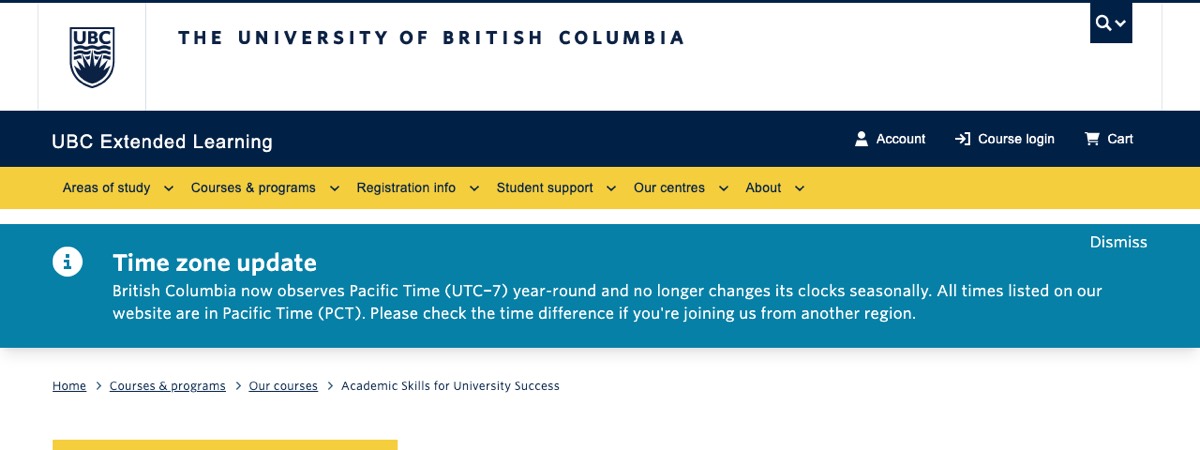
Academic Skills for University Success is an eight-week, self-paced online course from UBC Extended Learning, at two to three hours a week with 60 days to complete from registration, for $260.
| Provider | University of British Columbia Extended Learning |
|---|---|
| Length | Eight-week, self-paced course; “two to three hours” per week; 60 days to complete from the registration day |
| Cost (CAD) | $260 tuition, as listed for the start-anytime online session |
| Credential | Letter of completion; assignments are assessed but not graded |
| Format | online, British Columbia |
Fiona's take: You get a letter of completion; assignments are assessed but not graded, so it is support, not credit. It suits a student who wants a Canadian university behind the experience without credit-level fees.
Skip it if: Skip it if you need transcripted credit.
See Program DetailsIntroduction to Research and Study Skills (Revision 6)
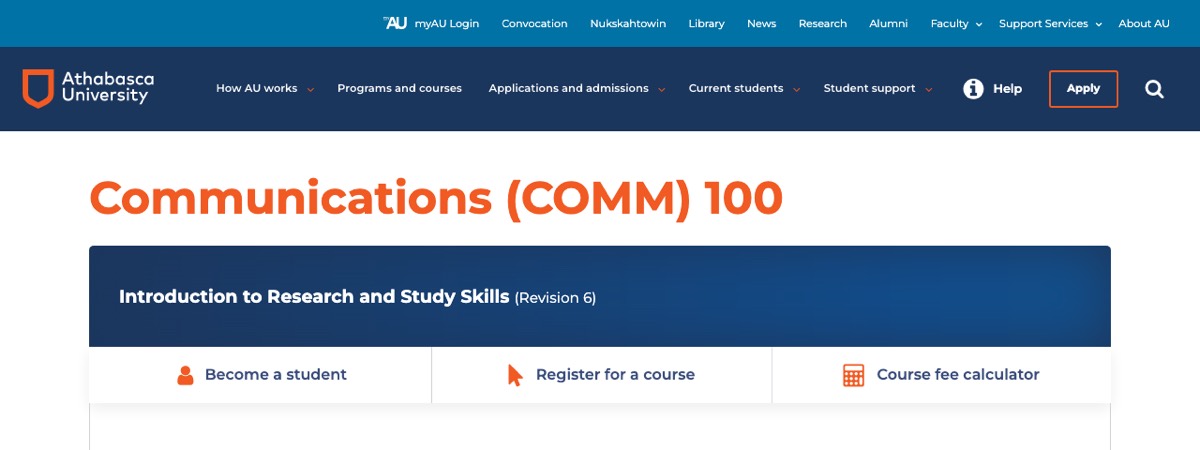
Introduction to Research and Study Skills (COMM 100, Revision 6) is a 3-credit individualized-study online course from Athabasca University's Faculty of Business covering planning, time management, critical thinking, research skills, reading, note-taking and exam preparation.
| Provider | Athabasca University, Faculty of Business |
|---|---|
| Length | 3 credits; individualized study online. Self-funded students register by the 10th of the month and start on the 1st of the next. |
| Cost (CAD) | Not listed on the COMM 100 page. The Athabasca undergraduate calendar, for courses starting Sep. 1, 2026 to Aug. 31, 2027, lists a Faculty of Business 3-credit regular or audit registration for a permanent resident of Alberta at $971.50 all-inclusive: tuition $681, course administration and technology fee $185, course materials fee $90 (exceptions apply), and Students’ Union ($13.50) and Alumni Relations ($2) fees. Source: https://www.athabascau.ca/calendar/undergraduate/fees-refunds-and-financial-assistance/canadian-student-fees.html |
| Credential | 3-credit undergraduate course; credit requires a composite mark of at least D (50 percent). There is no final examination. |
| Format | online, Alberta |
Fiona's take: You earn real undergraduate credit by completing four assignments, six quizzes and discussions with a composite mark of at least D (50 percent); there is no final exam and it is not available for challenge. The Athabasca calendar fee tables for courses starting 1 September 2026 to 31 August 2027 publish an all-inclusive $971.50 for a permanent resident of Alberta, built from tuition $681, course administration and technology fee $185, course materials fee $90, Students' Union $13.50 and Alumni Relations $2, and $1,162.50 for a Canadian resident outside Alberta; confirm current totals against the calendar before registering. Self-funded students register by the 10th and start the 1st of the next month, with up to 6 months to finish.
Skip it if: Skip it if you want quick technique tips; this is coursework at tuition prices.
See Program DetailsAcademic Prep: How to Be a University Student
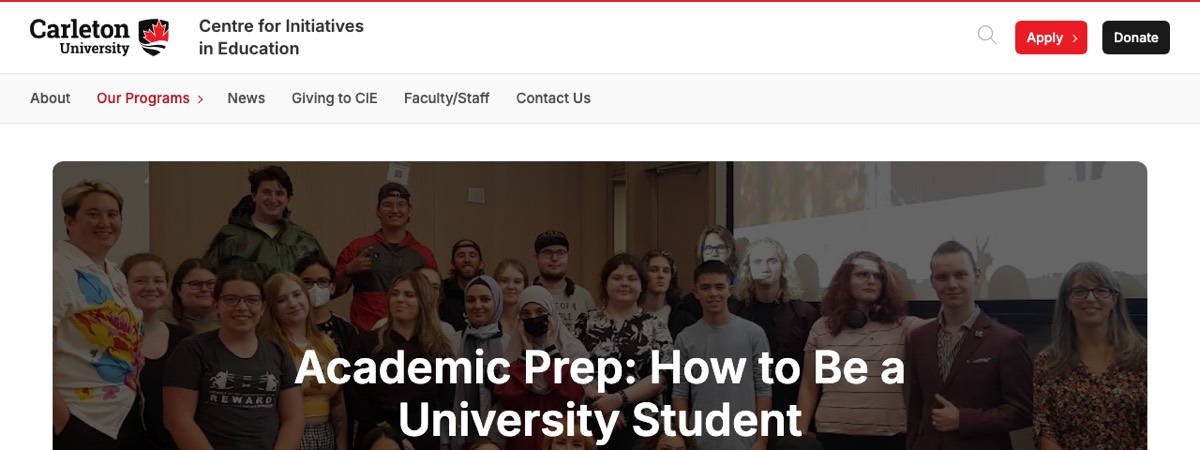
Academic Prep: How to Be a University Student (CIED 0999) is a 5-day, in-person, non-credit course at Carleton University's Centre for Initiatives in Education, 9:30 a.m. to 3:30 p.m., Monday, August 23 to Friday, August 27, for $275 including HST.
| Provider | Carleton University, Centre for Initiatives in Education |
|---|---|
| Length | 5-day course, Monday, August 23 – Friday, August 27, 9:30 a.m. to 3:30 p.m. (Academic Prep Fall 2027). Course code CIED 0999. |
| Cost (CAD) | $275 including HST for this 5-day course; the fee is added to Fall term fees and is due when those fees are due. Optional first-year newsletters, group check-ins, and academic coaching are included in the registration fee. |
| Credential | Non-credit course |
| Format | in person, Ontario |
Fiona's take: The fee is added to Fall term fees, and registration includes first-year newsletters, group check-ins and academic coaching. It is the shortest option on this page with a Canadian university attached.
Skip it if: Skip it if you are not entering first year in Ottawa.
See Program DetailsInitiation au travail intellectuel en philosophie
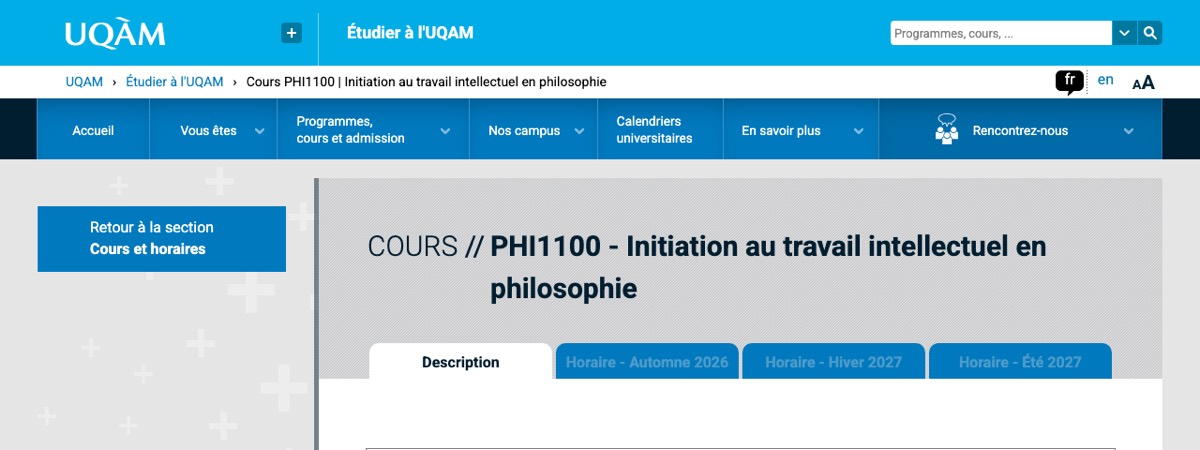
Initiation au travail intellectuel en philosophie (PHI 1100) is a 3-credit, cycle 1 lecture course (Magistral) at Université du Québec à Montréal.
| Provider | Université du Québec à Montréal (UQAM) |
|---|---|
| Length | 3 crédits; type de cours: Magistral. The same page says “Ce cours n'est pas offert lors de ce trimestre” for Automne 2026, Hiver 2027, and Été 2027. |
| Credential | 3 crédits, cycle 1, discipline Philosophie |
| Format | Magistral, as stated; a term-specific in-person, online, or hybrid mode is not shown because no section is offered in the listed terms, Quebec |
Fiona's take: The course page states it is not offered in Automne 2026, Hiver 2027 or Été 2027, and shows no fee. It is the only Quebec option on this list, and it sits in a philosophy discipline rather than a general study-skills box.
Skip it if: Skip it unless you can wait for a future offering at UQAM.
See Program DetailsENSL 0004: English Communication and Academic Skills
ENSL 0004: English Communication and Academic Skills is a zero-credit, 6-hours-per-week Fall-term course from Dalhousie University's Open Learning and Career Development that appears as Pass/Fail on the transcript.
| Provider | Dalhousie University, Open Learning and Career Development |
|---|---|
| Length | 6 hours per week; Fall term only |
| Cost (CAD) | Not shown for a general learner. The page says: “For students from the Joint Program (China Program), please consult your program directly regarding the applicable fees.” |
| Credential | Zero-credit course that appears as Pass/Fail on the transcript |
| Format | Nova Scotia |
Fiona's take: It pairs academic skills with English communication, so it fits English language studies students in Halifax. The page shows no fee for general learners; Joint Program (China Program) students are told to consult their program.
Skip it if: Skip it if you are not in English language studies at Dalhousie.
See Program DetailsCOMM-1211 Academic Success Strategies
COMM-1211 Academic Success Strategies is a course listed in Red River College Polytechnic's catalogue under the full-time International Pathway to Nursing program at its Winnipeg locations.
| Provider | Red River College Polytechnic |
|---|---|
| Format | not shown for the course; the catalogue places it under “FULL-TIME | WINNIPEG LOCATIONS” in International Pathway to Nursing, Manitoba |
Fiona's take: The catalogue entry shows no length, cost, delivery mode or credential detail; it exists inside a pathway program rather than as an open enrolment course.
Skip it if: Skip it unless you're admitted to that nursing pathway.
See Program DetailsHow Much Does Learning How To Learn Cost In Canada?
Learning How to Learn shows no standalone price on its course page. The page says the course is included with Coursera Plus and that a Certificate requires purchasing the Certificate experience, so the confirmed cost is the Coursera Plus subscription you choose; Coursera also says you can pay once for a single course, but no one-time price for this course is shown.
| Item | Price (CAD) | Notes |
|---|---|---|
| This course, standalone | Not shown | Page says included with Coursera Plus; no dollar amount displayed |
| Coursera Plus, monthly | About CA$82/month | After a 7-day free trial; exact figure varies, confirm at checkout; course included |
| Coursera Plus, annual | CA$433 for 12 months | Regularly CA$569; confirm live pricing and renewal terms on the Coursera Plus page |
| Coursera catalogue range for single courses | CA$69 to CA$112/month | Coursera's stated range for individual courses and programs, not this course's price |
| Course-page banner | $239 for 12 months of Coursera Plus | Printed with no CAD or USD label |
| Financial aid | Amount not stated | 150-word application, up to 16 days review, 180 days to finish |
| Partner-supported free access | Listed on the course page | What that option includes is not described there |
The 7-day free trial does not cover the page's own 2-week pace, so finishing and keeping the certificate costs at least one paid month at about CA$82 unless a one-time course price, which the page does not show, is lower. Annual subscribers get a 14-day refund window instead of a trial, and any certificate earned within the first 14 days is revoked if you refund.
Is Learning How To Learn Worth It In 2026?
Learning How to Learn is worth it in 2026 for what it teaches, not for what it certifies. The page shows 4.8 from 93,299 reviews, with 86.07% five stars and another 12.11% four stars, and 98% of learners liked it. In an August 2026 r/coursera thread about this exact course, commenters called it worth taking, while noting the certificate requires payment or financial aid; those are user comments, not Coursera policy.
It suits three groups: high school and university students facing a hard subject, career changers about to start a long program who want their study habits fixed first, and newcomers preparing for Canadian study. The techniques are the deliverable: focused versus diffuse modes, chunking, interleaving, the memory palace and a test checklist.
It is not worth paying for if you need a credential. No source in this review ties this certificate to a Canadian job, licence or credit, and Athabasca University's COMM 100 is the honest route when credit is the goal. My verdict: take the course, question the purchase.
Can You Get Funding For Learning How To Learn?
Funding for Learning How to Learn comes down to a few doors, and the main Canadian tax credit is not confirmed for this course. The practical routes are Coursera's own financial aid and employer reimbursement.
- Canada training credit (line 45350). This refundable credit can help with eligible fees at eligible educational institutions. This review found no Canada.ca or Coursera page showing that Coursera or Deep Teaching Solutions is a designated institution or issues a T2202 for this course, so treat it as not confirmed eligible.
- Canada training credit limit. Eligible claimants accumulate $250 per year up to $5,000 in a lifetime. To accumulate $250 towards a 2026 limit you needed at least $12,058 of working income in 2025 and net income no greater than $177,882. The limit alone does not make this Coursera course eligible.
- Employer reimbursement. If your employer reimburses online learning, Coursera emails a Coursera Plus receipt you can submit. This is a private benefit, not a government grant.
- Coursera financial aid. The course page lists financial aid. Coursera's help article says approved applicants access all content and can earn a certificate, with 180 days from enrollment to finish, a minimum 150-word application and a review of up to 16 days. The amount for a Canadian applicant is not stated.
Learning How To Learn Questions Canadians Ask
Is Learning How To Learn Worth It?
Learning How to Learn carries a Bestseller label, a 4.8 rating from 93,299 reviews and a 98% liked score on its Coursera page. A featured review calls it a useful foundation before other Coursera courses. Whether the paid certificate is worth it is a separate question: this review found no Canadian regulator or job posting that requires it.
How Long Does Learning How To Learn Take?
Learning How to Learn is paced at 2 weeks at 10 hours a week on a flexible schedule. The four modules are listed at 4, 3, 4 and 4 hours, and Module 1 says its core should take about an hour, with extra time for optional activities. The listed module times add up to 15 hours.
Is Learning How To Learn Free?
Learning How to Learn is not described as free for certificate purposes: the page says you must purchase the Certificate experience to access materials, assignments and a Certificate. It does list Partner-supported free access, and Coursera's FAQ says some courses offer a Full Course, No Certificate option with assessments and a final grade but no certificate.
Is The Learning How To Learn Certificate Recognised In Canada?
The Learning How to Learn certificate has no formal recognition found in this review: no provincial regulator, professional body, college-credit policy or Canadian job posting requires it. Coursera's shareable certificate can be added to LinkedIn, which is a platform feature, not Canadian academic recognition. For recognition, Athabasca University's COMM 100 is the credit route in this review.
How Hard Is Learning How To Learn, And What Are The Prerequisites?
Learning How to Learn is labelled Beginner level with no prior experience required. The work includes 11 assignments, some AI-graded, plus quizzes, retrieval practice, two peer reviews and a final. It is taught in English with 25 languages available, and Dr. Barbara Oakley's instructor block shows 4.9 from 20,306 ratings.
What Do People On Reddit Say About Learning How To Learn?
Reddit commenters in an August 2026 r/coursera thread about this exact course called it worth taking, with one saying the certificate requires payment or financial aid and another saying it can be audited through Partner-Supported Free Access. The original poster reported financial aid produced a limited-time 90% offer; that discount is one person's report, not a published Coursera rate.
Is Financial Aid Available For Learning How To Learn?
Financial aid is listed on the course page. Coursera's help article says approved applicants can access all course content and earn a certificate, with 180 days from enrollment to finish, a minimum 150-word application and a review process that can take up to 16 days. The dollar amount is not stated for a Canadian applicant.
Who Is Learning How To Learn For, And Does It Prepare You For A Canadian Job?
Learning How to Learn is for anyone who wants techniques to master a tough subject. Coursera positions it as the learning-focused companion to the more career-focused Mindshift, and says it can be taken before, with or instead of that course. It names no occupation, licence or Canadian credential, so no Job Bank wage attaches to it.
What's The Bottom Line On Learning How To Learn?
- Learning How to Learn: Powerful mental tools to help you master tough subjects is a beginner Coursera course from Deep Teaching Solutions at 2 weeks and 10 hours a week, rated 4.8 from 93,299 reviews; the content is the value, not the certificate.
- No Canadian regulator, college PLAR policy or job posting on Job Bank or Indeed Canada requires this certificate; for transcripted credit, Athabasca University's COMM 100 is published at $971.50 all-inclusive for a permanent resident of Alberta.
- No standalone price is shown: Coursera Plus runs about CA$82 a month after a 7-day free trial (confirm at checkout), or CA$433 for 12 months, regularly CA$569.
- Financial aid on this course means a 150-word application, up to 16 days of review and 180 days to finish.
- Fiona's verdict: take it before any long program, and pay if you want the Certificate experience; the page also lists Partner-supported free access, but does not describe what it includes.