Key Takeaways
- The fastest realistic route is the course itself: 6 hours on Coursera from Stanford Online, with certificate access through a paid Coursera Plus subscription, a 7-day free trial on the monthly plan, or financial aid; confirm current Coursera Plus prices on the official page.
- No licence or registration comes with it: no Canadian regulator, college-credit rule or job posting names the certificate, and dietitian registration runs through a provincial regulatory body with the Canadian Dietetic Registration Examination required in every province except Quebec.
- The try-first option is this same course: beginner level, no prior experience, five assignments over five modules. It does not qualify you to work as a dietitian or nutritionist in Canada.
- A paid individual course expires after 180 days from the session start, and approved financial aid is also valid for 180 days, so finish inside that window.
- Fiona's verdict: take it for practical food and cooking skills or a low-commitment test of nutrition interest; skip it if you need a credential Canadian employers recognise.
Stanford Introduction to Food and Health is a beginner, self-paced online course from Stanford Online on Coursera, taught by Maya Adam, MD. It gives learners practical skills to choose real food, cook at home, and eat in a way that supports personal health.
My verdict for Canadians: the 6 hours and five modules are genuinely useful, and the 4.7 rating from 34,244 reviews holds up. Treat the certificate as a LinkedIn note to self, not a career credential. The dietitian path runs through a university degree, supervised practice and, in every province except Quebec, the Canadian Dietetic Registration Examination.

What Are The Ways To Learn About Food And Health In Canada?
The ways to learn about food and health in Canada stretch from a 6-hour Coursera course to a two-year Saskatchewan Polytechnic diploma. Here are the main routes side by side.
| Route | Time | Cost (CAD) | What You Get | Recognised By | Best For |
|---|---|---|---|---|---|
| Stanford Introduction to Food and Health | 6 hours, self-paced | Not shown in CAD; included with Coursera Plus (monthly plan starts with a 7-day free trial) | Shareable course certificate | No Canadian regulator, college or job posting found that names it | Testing your interest before committing money |
| Food Sustainability, Mindful Eating, and Healthy Cooking Specialization (Stanford Online) | 4 weeks at 10 hours a week; FAQ also lists 12 weeks | Not shown in CAD; included with Coursera Plus | Shareable specialization certificate; FAQ says no university credit | Not listed | A deeper Stanford dive after this course |
| Diet And Nutrition Coach Certification (Udemy, Felix Harder) | 4h 50m, 105 lectures | Not listed | CPD certificate with 10 credits | CPD accreditation stated on the Udemy page | Fast theory in a coaching style |
| Nutrition, George Brown Polytechnic (GSCI 1120) | 42 hours | $323.61 as listed (currency not labelled on the page) | Continuing-education course counting toward General Education electives in most full-time George Brown diploma and certificate programs | George Brown Polytechnic | Ontarians stacking college credit |
| Nutrition and Healthy Lifestyle Promotion, Humber Polytechnic | 4 semesters, in person | Domestic $4,875.91 per two semesters in 2026/2027; international $19,397.97 | Diploma | Humber Polytechnic | A career-facing Ontario diploma |
| Food and Nutrition Management, Saskatchewan Polytechnic | Year 1 and Year 2 | Year 1 $8,920; Year 2 $6,700 for 2026-27 (currency not labelled) | Diploma accredited by the Canadian Society of Nutritional Management (CSNM) | CSNM | Food-service management careers |
| Natural Nutrition Introduction Certificate, CSNN Distance Education | 6 months | $775.92 total, not including tax ($50 down payment plus $725.92) | Certificate and letter of completion; form says it does not qualify you to dispense advice commercially | CSNN | Structured natural-nutrition study |
I recommend the Stanford course first for kitchen confidence and curiosity, George Brown's 42-hour Nutrition course for Ontarians who may want college credit later, and Humber Polytechnic or Saskatchewan Polytechnic when the goal is a formal diploma program.
How Long Does Stanford Introduction To Food And Health Take To Finish?
Stanford Introduction to Food and Health takes 6 hours to finish, at your own pace on a flexible schedule. The five module lines separately list 1 hour, 1 hour, 1 hour, 3 hours, and 1 hour, and a Coursera review describes one learner finishing this very beginner course in under a week.
- Enrol on the Coursera course page: 6 hours to complete, flexible schedule, at your own pace. Enrolment itself carries no printed dollar price.
- Choose access: purchase the Certificate experience, use Coursera Plus because the course page says it is included, or apply for financial aid from the course page, where review can take up to 16 days. The monthly Coursera Plus plan starts with a 7-day free trial; monthly and annual rates are not confirmed in CAD here, so confirm the live price at checkout on the Coursera Plus page.
- Work the five modules in order: 1 hour on food, nutrients and contemporary eating trends, 1 hour on Future Directions in Health part 1, 1 hour on part 2, the 3-hour Cooking Workshop, and 1 hour of optional resources.
- Finish the five assignments: three quizzes in module 1, one in module 2 and one in module 3. No extra fee is stated for them.
- Collect the electronic certificate from your Accomplishments page, then print it or add it to LinkedIn. Move inside the window: a paid individual course expires after 180 days, and approved financial aid is valid for 180 days.
Do Employers In Canada Recognise The Stanford Food And Health Certificate?
Employers in Canada are not shown to recognise this certificate anywhere: no job posting, provincial or federal program, college-credit or PLAR page, or professional body names Stanford Introduction to Food and Health. It is a Coursera course certificate, not a licence, registration or regulated credential. What employers can judge is the skill: label reading, meal planning, home cooking.
The regulated profession nearby is dietetics, and Dietitians of Canada describes a different route entirely: a specific university degree, a period of practical training, and registration with a provincial regulatory body. In every province except Quebec, the Canadian Dietetic Registration Examination is required once academic and practicum requirements are met. Nothing in a 6-hour Coursera course touches any of that.
Some alternatives are formal diplomas or accredited programs: Saskatchewan Polytechnic's Food and Nutrition Management diploma is accredited by the Canadian Society of Nutritional Management, and Humber Polytechnic's Nutrition and Healthy Lifestyle Promotion diploma runs four semesters in person in Ontario. A shareable Coursera certificate signals initiative beside those credentials, not equivalence. The University of Guelph's Plant-Based Nutrition Certificate page, a different program, states its own content is not for professional practice unless the learner already holds a regulated credential such as Registered Dietitian. That Guelph disclaimer is a useful caution for general nutrition courses: this kind of education can inform, but it is not dietitian registration.
What Does Stanford Introduction To Food And Health Teach, And What Are The Alternatives?
Stanford Introduction to Food and Health teaches five modules: background on food, nutrients and contemporary eating trends (1 hour), Future Directions in Health parts 1 and 2 (1 hour each), a 3-hour Cooking Workshop, and 1 hour of optional resources. Here is how it and the main alternatives compare.
Stanford Introduction to Food and Health
Stanford Introduction to Food and Health is a 6-hour beginner online course from Stanford Online on Coursera, taught by Maya Adam, MD, that builds practical skills to choose real food, cook at home and eat in support of personal health.
| Provider | Stanford Online |
|---|---|
| Length | 6 hours to complete |
| Cost (CAD) | not shown in CAD; page says the course is "Included with" Coursera Plus and a banner states "Build in-demand skills with a full year of Coursera Plus, now $239" (currency not labelled) |
| Rating | 4.7 (34,244 reviews on coursera.org) |
| Credential | Shareable certificate |
| Format | online |
Fiona's take: The modules run from nutrients, processed foods and sugar, through Michael Pollan's food mantra, label reading and balanced plates, into a Cooking Workshop with crêpes, roasted chicken, Pad Thai, lasagna and egg sandwiches. Graded work is light: five assignments, three in module 1. The page shows 4.7 from 34,244 reviews, 99% of learners liking it, and Maya Adam at 4.8 from 10,633 ratings, taught in English with 30 languages available.
Skip it if: Skip it if you need a credential a Canadian employer, college or regulator recognises, because none was found that names this certificate.
Start On CourseraChild Nutrition and Cooking
Child Nutrition and Cooking is a 1-week-at-10-hours-a-week online course from Stanford Online on Coursera that covers what constitutes a healthy diet for children and adults and how to prepare simple home-cooked meals.
| Provider | Stanford Online |
|---|---|
| Length | 1 week at 10 hours a week |
| Cost (CAD) | not shown in CAD; page says the course is "Included with" Coursera Plus and a banner states "a full year of Coursera Plus, now $239" (currency not labelled) |
| Rating | 4.8 |
| Credential | Shareable certificate |
| Format | online |
Fiona's take: The course page promises simple, delicious foods aimed at inspiring a lifelong celebration of easy home-cooked meals, and it carries a 4.8 rating. I point parents here right after the Food and Health Cooking Workshop, because it extends the same Stanford kitchen philosophy to family eating. The price is not shown in CAD; the page says it is included with Coursera Plus.
Skip it if: Skip it if you want adult clinical or sports nutrition content, because the focus is children and families.
Start On CourseraCooking for Busy Healthy People
Cooking for Busy Healthy People is a 1-week-at-10-hours-a-week online course from Stanford Online on Coursera that concentrates Stanford's practical home-cooking teaching for time-pressed learners.
| Provider | Stanford Online |
|---|---|
| Length | 1 week at 10 hours a week |
| Cost (CAD) | not shown in CAD; page says the course is "Included with" Coursera Plus and a banner states "a full year of Coursera Plus, now $239" (currency not labelled) |
| Rating | 4.6 |
| Credential | Shareable certificate |
| Format | online |
Fiona's take: It shows a 4.6 rating. This one sits between the 6-hour Food and Health course and the 4-week specialization, so I suggest it when the Cooking Workshop was the draw and you want more knife time and less theory. Price is not shown in CAD; the page says it is included with Coursera Plus.
Skip it if: Skip it if you wanted graded nutrition science, because the emphasis is cooking.
Start On CourseraFood Sustainability, Mindful Eating, and Healthy Cooking Specialization
Food Sustainability, Mindful Eating, and Healthy Cooking is a 4-week-at-10-hours-a-week specialization from Stanford Online on Coursera that targets health, planetary impact and a more positive relationship with food.
| Provider | Stanford Online |
|---|---|
| Length | 4 weeks to complete at 10 hours a week |
| Cost (CAD) | not shown in CAD; page says the specialization is "Included with" Coursera Plus and a banner states "a full year of Coursera Plus, now $239" (currency not labelled). FAQ: "No, you cannot take this course for free." |
| Rating | 4.8 |
| Credential | Shareable certificate |
| Format | online |
Fiona's take: The page lists 4 weeks at 10 hours a week, and its FAQ also says 12 weeks, four weeks for each course, so plan inside that span. The rating is 4.8. Two FAQ answers matter to Canadians: there is no university credit, and no, you cannot take this course for free. Cost is not shown in CAD; included with Coursera Plus.
Skip it if: Skip it if the 6-hour Food and Health course already covered what you needed, because this repeats and extends the same territory.
Start On CourseraInternationally Accredited Certificate in Nutrition
Internationally Accredited Certificate in Nutrition is a 4h 59m on-demand video course from Udemy, presented by Akash Sehrawat of Fabulous Body with a teaching assistant, across 12 sections and 101 lectures.
| Provider | Udemy (Akash Sehrawat, Fabulous Body, Teaching Assistant) |
|---|---|
| Length | 12 sections • 101 lectures • 4h 59m total length |
| Rating | 4.7 out of 5 (13,191 ratings) |
| Credential | Internationally Accredited Certificate; page also states "We offer a CPD Certificate which is different from the Udemy's Certificate of Completion." |
| Format | online |
Fiona's take: It shows 4.7 out of 5 from 13,191 ratings. The page offers a CPD certificate it explicitly distinguishes from Udemy's Certificate of Completion, so check which one you are buying. Neither is a Canadian provincial credential. Treat it as breadth across nutrition topics at video pace.
Skip it if: Skip it if the word internationally in the title is the attraction, because no Canadian provincial licence or registration comes with it.
View On UdemyDiet And Nutrition Coach Certification: Beginner To Advanced
Diet And Nutrition Coach Certification: Beginner To Advanced is a 4h 50m on-demand video course from Udemy by Felix Harder, across 14 sections and 105 lectures.
| Provider | Udemy (Felix Harder) |
|---|---|
| Length | 14 sections • 105 lectures • 4h 50m total length |
| Rating | 4.6 out of 5 (10,350 ratings) |
| Credential | CPD Certificate; page states "THIS COURSE IS CPD ACCREDITED. COMPLETE IT AND YOU AUTOMATICALLY EARN YOUR CERTIFICATION & 10 CREDITS" |
| Format | online |
Fiona's take: It shows 4.6 out of 5 from 10,350 ratings, and the page states the course is CPD accredited with 10 credits earned on completion. That is a coaching-style certificate, not registration with a provincial regulatory body. I treat it as vocabulary and frameworks for talking about diet, not permission to practise.
Skip it if: Skip it if you want to give regulated nutrition advice in Canada, because CPD credits do not create that right.
View On UdemyNutrition
Nutrition (GSCI 1120) is a 42-hour online continuing-education course from George Brown Polytechnic in Ontario, listed at $323.61.
| Provider | George Brown Polytechnic Continuing Education |
|---|---|
| Length | 42 hours |
| Cost (CAD) | $323.61 course fee (page shows $; not labelled CAD) |
| Credential | Continuing education course (GSCI 1120); page states it "will be accepted as credit towards the General Education elective requirements of most full-time diploma and certificate programs." |
| Format | online, Ontario |
Fiona's take: This is the first rung with a Canadian college behind it: George Brown states the course will be accepted as credit towards the General Education elective requirements of most full-time diploma and certificate programs. If a George Brown diploma is any part of your future, the fee does double duty. The page shows $ without labelling CAD.
Skip it if: Skip it if you only want cooking confidence, because 42 hours of theory is more than curiosity needs.
See Program DetailsNutrition and Healthy Lifestyle Promotion
Nutrition and Healthy Lifestyle Promotion is a 4-semester, in-person diploma from Humber Polytechnic in Ontario, with 2026/2027 fees of $4,875.91 domestic and $19,397.97 international for two semesters.
| Provider | Humber Polytechnic |
|---|---|
| Length | 4 semesters |
| Cost (CAD) | The 2026/2027 fee for two semesters was: domestic $4,875.91; international $19,397.97. Fees are subject to change. Additional costs listed separately: "$450 – textbooks (for one semester); $100 – safety shoes; $175 – tool set" |
| Credential | Diploma |
| Format | in person, Ontario |
Fiona's take: This is the commitment-level route. Beyond tuition, Humber lists $450 for textbooks per semester, $100 for safety shoes and $175 for a tool set, and fees are subject to change. Compare that with the 6-hour Stanford course inside a single Coursera Plus month before signing anything.
Skip it if: Skip it if you are exploring personal interest, because four semesters in person is a career decision, not a weekend test.
See Program DetailsMicroprogramme en alimentation et nutrition
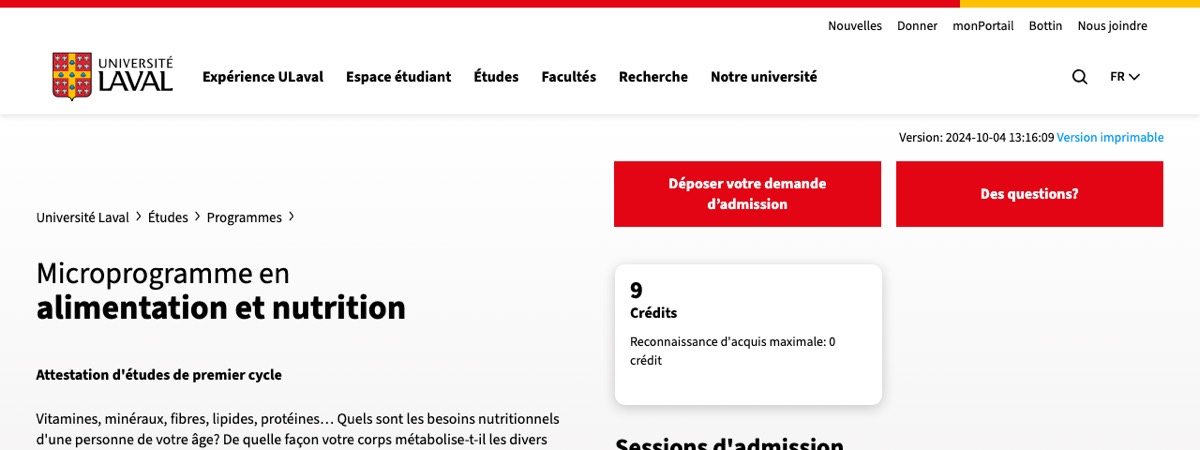
Microprogramme en alimentation et nutrition is a 9-credit, part-time-only online microprogram from Université Laval in Quebec that runs at least 2 sessions and leads to an Attestation d'études de premier cycle.
| Provider | Université Laval |
|---|---|
| Length | 9 crédits; temps partiel only; at least 2 sessions |
| Credential | Attestation d'études de premier cycle |
| Format | online, Quebec |
Fiona's take: For learners in Quebec this is a rare structured option: online, part time, at least two sessions. No price is posted in the material I reviewed. The attestation is more formal than a single Coursera certificate, but it is still not dietitian registration.
Skip it if: Skip it if you want a quick answer, because a microprogram over at least two sessions is a term-scale commitment.
See Program DetailsFood and Nutrition Management
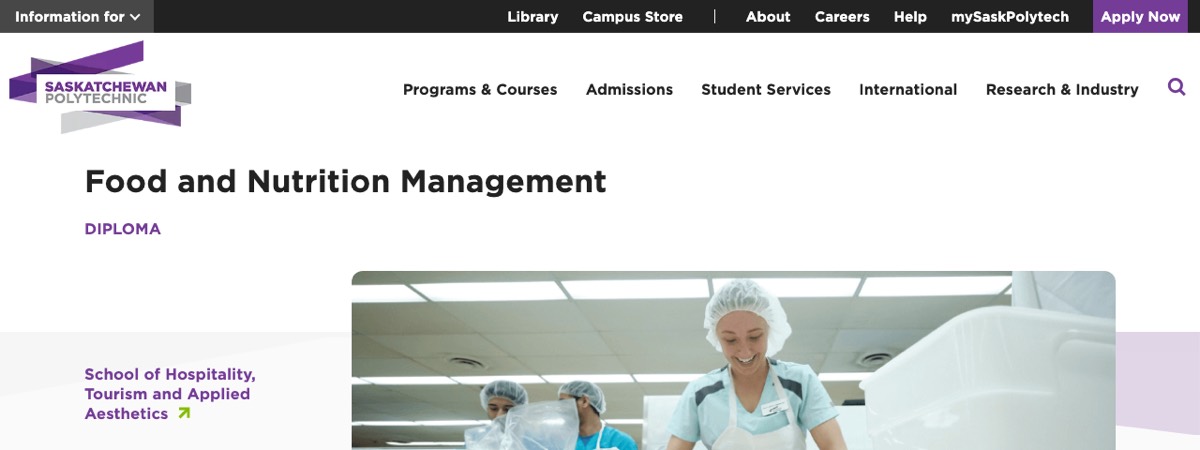
Food and Nutrition Management is a two-year, in-person diploma from Saskatchewan Polytechnic, with 2026-27 fees of $8,920 for Year 1 and $6,700 for Year 2, totals the page says include mandatory fees and approximate book and supply costs.
| Provider | Saskatchewan Polytechnic |
|---|---|
| Length | Year 1 and Year 2 (week count not shown on this page) |
| Cost (CAD) | $2026-27 academic year: Year 1 - $8,920; Year 2 - $6,700. Page states totals include all mandatory fees and approximate cost for books and supplies ($ not labelled CAD) |
| Credential | Diploma; "This program is accredited by the Canadian Society of Nutritional Management (CSNM)." |
| Format | in person, Saskatchewan |
Fiona's take: The page states the program is accredited by the Canadian Society of Nutritional Management (CSNM), and that is the difference that matters: a CSNM-accredited diploma answers an employer question a Coursera certificate cannot. Currency is not labelled as CAD on the page, so confirm with the registrar.
Skip it if: Skip it if your goal is personal cooking skill, because this trains managers, not home cooks.
See Program DetailsNutrition
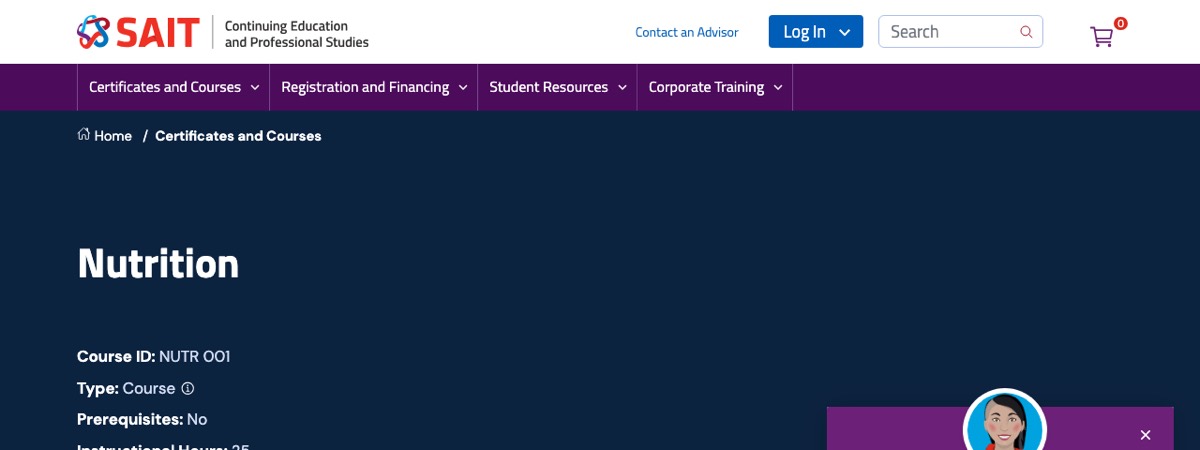
Nutrition is an online continuing-education course from the Southern Alberta Institute of Technology (SAIT) in Alberta, with hours and fees not shown in the material reviewed.
| Provider | Southern Alberta Institute of Technology (SAIT) |
|---|---|
| Credential | Course; "Upon successful completion of this course, you'll be able to self-print a proof of completion document from your Continuing Education student account." |
| Format | online, Alberta |
Fiona's take: On successful completion SAIT lets you self-print a proof of completion document from your Continuing Education student account. That is a lighter paper trail than a graded transcript, and it marks the Alberta option for a single structured course. Confirm current hours and fees with SAIT before enrolling.
Skip it if: Skip it if you want graded assignments and a shareable certificate, because SAIT describes a self-printed proof of completion.
See Program DetailsNatural Nutrition Introduction Certificate Package - Distance Education
Natural Nutrition Introduction Certificate Package is a 6-month distance-education program from the Canadian School of Natural Nutrition (CSNN), quoted in Canadian funds at $775.92 total, not including tax: a $50 non-refundable down payment plus $725.92 tuition and textbook with shipping within Canada.
| Provider | Canadian School of Natural Nutrition (CSNN Distance Education) |
|---|---|
| Length | 6 months (complete within 6 months of registration; includes a 6-month subscription to the online learning platform) |
| Cost (CAD) | Prices are quoted in Canadian funds. $50.00 non-refundable down payment plus $725.92 tuition and textbook (includes shipping within Canada); "$775.92 total not including tax." Tax added by province. |
| Credential | Certificate and letter of completion; form states "I understand that completion of this program does not qualify me to dispense advice commercially." |
| Format | online, Quebec |
Fiona's take: Six months with a textbook and a 6-month platform subscription is a real commitment, and it comes with an honest disclaimer: the registration form states you understand completion does not qualify you to dispense advice commercially. Tax is added by province.
Skip it if: Skip it if you hoped an introduction certificate would let you advise clients, because CSNN's own form says it does not.
See Program DetailsHow Much Does Stanford Introduction To Food And Health Cost In Canada?
Stanford Introduction to Food and Health does not publish its own price in CAD; the course page says it is included with Coursera Plus, and buying the Certificate experience is what unlocks materials, graded assignments and the certificate. Coursera's platform range for individual courses and programs runs CA$69 to CA$112 per month, but this course's confirmed one-time price is not listed.
| Item | Price | Notes |
|---|---|---|
| This course's checkout price | Not shown in CAD | Course page says included with; no dollar amount printed |
| Coursera Plus monthly | CA$0 for 7 days, then the current subscription rate | Payment info captured up front; charged only when the trial ends if not cancelled; confirm the live price on the Coursera Plus page |
| Coursera Plus annual | Not confirmed in CAD here | Renews automatically unless cancelled; check the current annual price on the Coursera Plus page |
| Coursera Plus annual promotions | Varies; limited-time offers | Past offers were limited to new subscribers, one per person, with a claim deadline; see the Coursera Plus page |
| Individual courses and programs, platform range | CA$69 to CA$112/month | Platform range; not this course's confirmed price |
| Financial aid | Amount not stated | Apply from the course page; review can take up to 16 days; approved aid valid 180 days |
| Paid individual course access | Expires after 180 days | Fee must be paid again if the certificate is not earned in that window |
The 7-day free trial is the test drive: Coursera captures payment information at sign-up but does not charge until the trial ends, and its Plus page says you earn unlimited certificates after the trial ends. Whether the trial days themselves yield this course's certificate is not stated. Some courses may also offer a Full Course, No Certificate option, which Coursera describes as materials, assessments and a final grade with no certificate; whether this course offers it is not stated on its page.
Financial aid, if approved, opens all course content and the certificate, per Coursera's support page, with no published dollar amount. That is the route I tell budget-focused clients to try first: apply from the course page, wait out the up-to-16-day review, then finish inside the 180-day approval window. Whichever paid route you choose, verify the live CAD amount at checkout on the Coursera Plus page; rates and promotions change, and some display in USD.
Is Stanford Introduction To Food And Health Worth It In 2026?
Stanford Introduction to Food and Health is worth it in 2026 for three groups: career changers testing whether nutrition study suits them before Humber Polytechnic or Saskatchewan Polytechnic money is on the table, busy adults who want the Cooking Workshop's crêpes, roasted chicken and Pad Thai in their actual week, and professionals who want shared vocabulary around food and chronic disease. The numbers back the content: 4.7 from 34,244 reviews, 99% of learners liking it, 1,029,685 already enrolled, and Maya Adam rated 4.8 from 10,633 ratings.
It is not worth it as a career move on its own. No Canadian job posting, college-credit rule or regulator was found that names the certificate, and Dietitians of Canada points to a degree, supervised practical training, a provincial regulatory body and, in every province except Quebec, the Canadian Dietetic Registration Examination. A Reddit r/stanford commenter gave similar advice from the learner side: the course is real, use the free version, because the certificate does not count toward a degree.
My advice to clients: do the 6 hours first. If you finish the Cooking Workshop hungry for more, Child Nutrition and Cooking or the Food Sustainability, Mindful Eating, and Healthy Cooking Specialization keep you inside Coursera Plus. If you finish wanting a job, go straight to George Brown's 42-hour Nutrition course or a diploma program, and skip the certificate chase.
Can You Get Funding Or Tax Credits For This Course?
Funding or tax credits for this course are effectively closed off: the Canada Training Credit and the out-of-country tuition tax credit both exclude it, and the only realistic help is an employer's own education plan or Coursera's financial aid.
- Canada Training Credit. The Canada Training Credit does not apply. The CRA counts as eligible institutions Canadian universities, colleges and other post-secondary institutions, or Canadian institutions certified by the Minister of Employment and Social Development for occupational skills courses. A Stanford course delivered on Coursera fits neither box.
- Tuition Tax Credit For A University Outside Canada. The out-of-country route is closed too. The CRA states that fees paid for distance-learning courses carried on by correspondence, including courses where students study largely at their own pace and submit work electronically, do not qualify for the tuition tax credit. That describes this course exactly.
- Employer Reimbursement. Employer reimbursement is possible, but only through your own employer's plan: Coursera's Plus page says you can be reimbursed if your employer offers educational reimbursements that include online learning programs. This is not a named Canadian government program, so ask HR before you subscribe, not after.
Stanford Food And Health Questions Canadians Ask
Is Stanford Introduction To Food And Health Worth It?
Stanford Introduction to Food and Health is worth it as a practical 6-hour introduction: the course page shows 4.7 from 34,244 reviews and 99% of learners liking it. It is not worth it as a career credential. One Coursera reviewer called it useful as a basic course and said they would not pay for the certificate.
How Long Does Stanford Introduction To Food And Health Take?
Stanford Introduction to Food and Health takes 6 hours to complete at your own pace, per the course page. The five modules list 1 hour, 1 hour, 1 hour, 3 hours, and 1 hour. A Coursera review describes it as a very beginner course that one learner finished in under a week.
Is Stanford Introduction To Food And Health Free?
Stanford Introduction to Food and Health is not offered as a free certificate. Materials, assignments and the certificate require the paid Certificate experience, though eligible learners may start with a free trial, and some courses may offer a Full Course, No Certificate option. Financial aid is listed on the course page.
Is The Certificate Recognised In Canada?
No Canadian regulator, college-credit rule or job posting was found that names this certificate. Coursera does let you add it to LinkedIn. Dietitians of Canada describes the actual professional route: a specific university degree, practical training and, in every province except Quebec, the Canadian Dietetic Registration Examination.
Does Stanford Introduction To Food And Health Qualify You As A Dietitian?
Stanford Introduction to Food and Health does not qualify you as a dietitian or nutritionist in Canada; no evidence was found that it does. Dietitians of Canada says dietitians must register with a provincial regulatory body, and the Canadian Dietetic Registration Examination, required in every province except Quebec, follows academic and practicum requirements. This course teaches personal eating skills.
What Do Reddit Users Say About The Stanford Food And Health Course?
Reddit users give it two consistent verdicts. In r/nutrition, a poster recommended it for people just starting with nutrition and called it free and foundational. In r/stanford, a commenter said the course is real and advised using the free version because the certificate does not count toward a degree.
What's The Bottom Line On Stanford Introduction To Food And Health?
- Stanford Introduction to Food and Health is a 6-hour beginner course from Stanford Online on Coursera, rated 4.7 from 34,244 reviews with 99% of learners liking it.
- The certificate is shareable and LinkedIn-ready, but no Canadian regulator, college-credit rule or job posting was found that names it, and it is not the route to dietitian registration.
- Access means the paid Certificate experience, a Coursera Plus subscription with a 7-day free trial on the monthly plan, or financial aid; confirm current subscription prices on the official Coursera Plus page. Paid individual-course access expires after 180 days; approved financial aid is valid for 180 days. Coursera Plus access follows the subscription term.
- Start with Stanford Introduction to Food and Health to test your interest in 6 hours of study, then move to George Brown Polytechnic if you want a course that may count toward General Education electives, or Humber Polytechnic if you want an Ontario diploma.
- If a formal credential in food or nutrition is the goal, Saskatchewan Polytechnic's diploma is CSNM-accredited; the Stanford Coursera certificate is not named by any Canadian regulator, college-credit rule or job posting found.