
Key Takeaways
- IBM is the shorter Coursera option: Python for Data Science & AI takes 2 weeks at 10 hours a week, included with Coursera Plus, whose Canadian pricing varies by promotion and appears at checkout in CAD, with recent annual offers around CA$274 to CA$282.
- On the pages reviewed, neither Coursera certificate is listed as a licence, a registration, or for PLAR or credit at Canadian colleges or by employers or professional bodies. Michigan's FAQ states the Specialization carries no university credit.
- The try-first pick is Michigan's Python for Everybody: 2 months at 10 hours a week with an FAQ pace of about 8 months, 4.8 from 280,850 reviews, no prerequisites. It does not by itself grant any Canadian credential.
- Job Bank's November 18, 2026 wage update lists NOC 21232 software developers and programmers at a Canada median of $50.00 an hour, from $42.31 in Manitoba to $55.29 in British Columbia.
- Fiona's verdict: never-coded beginners take Python for Everybody, coders who want Pandas and NumPy fast take the IBM course, and the SAIT, BCIT or McGill route suits Canadians who need an institutional credential.
Python for Everybody is a five-course Coursera Specialization from the University of Michigan; Python for Data Science & AI: Hands-On Development is a single Coursera course from IBM. Both end in shareable career certificates, and neither is a licence, a registration or a Canadian college credential.
My verdict for Canadians: start with Michigan's Python for Everybody if you have never written code, take IBM's course for Pandas and NumPy inside 2 weeks, and hold the college route for when an employer demands an institutional credential, from SAIT's two courses, CPRG 100 at $0.00 to $625.00 and Programming with Python at $415.00, to BCIT's $11,000 certificate.

Which Is Better For Canadians At A Glance?
Which is better depends on your starting point and the credential you need. Here are the main routes reviewed in this comparison: the University of Michigan Specialization, the IBM course and the Canadian college route, side by side.
| Python for Everybody | IBM Python for Data Science & AI | Canadian College Route | |
|---|---|---|---|
| The Coursera offer | Python for Everybody Specialization, University of Michigan | Python for Data Science & AI: Hands-On Development, IBM | SAIT in Alberta, BCIT in British Columbia, McGill in Quebec, NSCC in Nova Scotia |
| Length | 2 months at 10 hours a week; FAQ says most learners take about 8 months | 2 weeks at 10 hours a week | SAIT up to 3 years for two courses; BCIT 2 or 3 years part-time; NSCC 2 years full-time |
| Level | Beginner; no prior experience required | Beginner; recommended experience, FAQ allows zero | SAIT Continuing Education; BCIT part-time Flexible Learning; McGill part-time online; NSCC full-time diploma |
| Cost In Canada | Included with Coursera Plus; Canadian pricing varies by promotion and appears at checkout in CAD, with recent offers around CA$274 to CA$282 a year or about CA$82 a month | Included with Coursera Plus; Canadian pricing varies by promotion and appears at checkout in CAD, with recent offers around CA$274 to CA$282 a year or about CA$82 a month | SAIT: $0.00 to $625.00 for CPRG 100 and $415.00 for Programming with Python; BCIT: $11,000 budget; McGill: $6,169.90 to $6,376.90 |
| Credential | Shareable career certificate | Shareable career certificate; IBM Badge only inside named IBM programs | SAIT Certificate of Completion and transcript; BCIT Certificate; McGill Professional Development Certificate |
| Coursera Rating | 4.8 from 280,850 reviews | 4.6 from 43,889 reviews | Not shown |
| Best For | True beginners and cautious testers | Fast starters who want the data stack | Canadians who need a verifiable credential |
For most Canadians I recommend starting with Python for Everybody Specialization on a Coursera Plus subscription, and paying for a college credential only when an employer or a further program asks for one.
Can You Take Both, And In What Order?
You can take both, and the order I recommend is fast first, deep second, college last. One Coursera Plus subscription covers the two Coursera items with no second fee.
- Start with IBM's Python for Data Science & AI: 2 weeks at 10 hours a week, modules listed at 3, 3, 6, 6 and 7 hours, included with Coursera Plus, whose Canadian pricing varies by promotion and appears at checkout in CAD, with recent offers around CA$274 to CA$282 a year or about CA$82 a month.
- Continue to Michigan's Python for Everybody on the same subscription: header pace 2 months at 10 hours a week, courses listed at 17, 20, 19, 14 and 9 hours.
- Finish Michigan's capstone, a 9-hour fifth course where you build applications for data retrieval, processing and visualization, the piece the IBM course does not have.
- Put both certificates on LinkedIn, which both pages support with shareable certificates you can add to your profile, resume or CV.
- Enrol in a college credential only if needed: SAIT allows up to three years for its two-course certificate, BCIT's Applied Data Analytics Certificate typically runs 2 or 3 years part-time with a stated $11,000 budget, and McGill lists $6,169.90 to $6,376.90.
Do Canadian Employers Recognise Either Certificate?
On the pages reviewed, neither Coursera certificate is listed as a licence, a registration, or for PLAR or credit at Canadian colleges or by employers or professional bodies. What employers see is skills evidence you can back up in an interview.
On the pages reviewed, neither Coursera certificate is listed as a licence, a registration, or for PLAR or credit at Canadian colleges or by employers or professional bodies. Michigan's FAQ states the Specialization does not carry university credit, though some universities may choose to accept its certificates.
The IBM course's shareable certificate is not the same as an IBM Badge. The page says a badge requires taking the course inside the IBM Applied AI Professional Certificate, the Applied Data Science Specialization or the IBM Data Science Professional Certificate. That Applied Data Science Specialization is ACE recommended for up to 12 college credits, while its page also states it does not carry university credit.
The college routes issue credentials Canadian institutions administer themselves. SAIT's Python Programming certificate ends in an electronically issued Certificate of Completion and transcript; BCIT's COMP 2853 carries 3.0 credits and is required in the Applied Data Analytics Certificate; Red River's COMP-1257 ends in a digital badge and the page says completers are ready to take the PCAP, Certified Associate in Python Programming exam, which is not included.
What Does Each One Teach?
Each one teaches Python from a different angle: Michigan builds a general programmer across five courses, IBM rushes to the data stack in five modules, and the Canadian colleges teach credit or badge courses with local support.
Python for Everybody Specialization
Python for Everybody is a 2-month (at 10 hours a week) five-course Coursera Specialization from the University of Michigan that runs from your first program to a data visualization capstone.
| Provider | University of Michigan |
|---|---|
| Length | 2 months at 10 hours a week. FAQ also says most learners complete the Specialization in about 8 months. Listed course lengths: Course 1, 17 hours; Course 2, 20 hours; Course 3, 19 hours; Course 4, 14 hours; Course 5, 9 hours. |
| Cost (CAD) | not shown. Page says the program is included with Coursera Plus and advertises "a full year of Coursera Plus, now $239" (currency not labelled CAD; not a course-specific fee). FAQ: "You can pay for the entire Specialization upfront, or pay individually for each course as you progress." |
| Rating | 4.8 (280,850 reviews on coursera.org) |
| Credential | Shareable certificate / career certificate. FAQ: "This Specialization doesn't carry university credit, but some universities may choose to accept Specialization Certificates for credit." |
| Format | online |
Fiona's take: This is the on-ramp its FAQ promises: no prerequisites, and a path that carries you from installing Python in Course 1 to SQL, databases and a 9-hour visualization capstone. The 4.8 rating from 280,850 reviews is the strongest signal in this comparison. Budget honestly: the header says 2 months at 10 hours a week while the FAQ says most learners need about 8 months, and Course 4 brings SQL, databases and object-oriented Python.
Skip it if: Skip it if you need Pandas and NumPy fast, because Michigan spends its opening courses on basics, files and dictionaries before reaching the data stack.
Start On CourseraPython for Data Science & AI: Hands-On Development
Python for Data Science & AI: Hands-On Development is a 2-week (at 10 hours a week) single Coursera course from IBM covering Python basics through Pandas, NumPy, APIs and web scraping.
| Provider | IBM |
|---|---|
| Length | 2 weeks at 10 hours a week. Modules on the same page: Module 1, 3 hours to complete; Module 2, 3 hours to complete; Module 3, 6 hours to complete; Module 4, 6 hours to complete; Module 5, 7 hours to complete. |
| Cost (CAD) | not shown. Page says the course is included with Coursera Plus and advertises "a full year of Coursera Plus, now $239" (currency not labelled CAD; not a course-specific fee). |
| Rating | 4.6 (43,889 reviews on coursera.org) |
| Credential | Shareable certificate / career certificate. An IBM Badge is not from this course alone; the page says to take it inside the IBM Applied AI Professional Certificate, Applied Data Science Specialization, or IBM Data Science Professional Certificate. |
| Format | not explicitly stated as online, in person, or hybrid. Page describes a flexible, self-paced course with Jupyter labs and "nothing to install or set up." |
Fiona's take: IBM compresses Python basics, Pandas, NumPy, Jupyter Notebooks, REST APIs with the Requests library and BeautifulSoup into five modules, with more than 25 hands-on labs and a GDP data extraction project. For a Canadian testing whether data work suits them, the 2-week pace at 10 hours a week makes this the shorter Coursera option in the pair. The 4.6 rating from 43,889 reviews is solid, though the header's 'recommended experience' is fair: the pace is quick.
Skip it if: Skip it if you want a slow, general grounding in programming; the modules are listed at 3, 3, 6, 6 and 7 hours and move quickly.
Start On CourseraApplied Data Science Specialization
Applied Data Science Specialization is a 2-month (at 10 hours a week) five-course Coursera Specialization from IBM whose Course 1 is the Python for Data Science & AI course.
| Provider | IBM |
|---|---|
| Length | 2 months at 10 hours a week. FAQ also says recommended timelines are 3 to 4 months. Listed course lengths: Course 1, 24 hours; Course 2, 7 hours; Course 3, 16 hours; Course 4, 19 hours; Course 5, 14 hours. Course 1 is Python for Data Science & AI: Hands-On Development. |
| Cost (CAD) | not shown. Page says the program is included with Coursera Plus and advertises "a full year of Coursera Plus, now $239" (currency not labelled CAD; not a program-specific fee). |
| Rating | 4.6 |
| Credential | Career certificate from IBM, a Coursera Specialization completion certificate, and a digital badge from IBM. Page also says the program is ACE recommended for up to 12 college credits, and "This Specialization doesn't carry university credit." |
| Format | online |
Fiona's take: The five courses are listed at 24, 7, 16, 19 and 14 hours, and taking the Python course inside this Specialization is one of the named ways to earn an IBM Badge plus a career certificate and digital badge. The page says it is ACE recommended for up to 12 college credits and also that it does not carry university credit. I suggest it for Canadians who finish the IBM course hungry for more, not as a starting point.
Skip it if: Skip it if you only need Python fundamentals; the standalone IBM course covers that and you can stop there.
Start On Coursera100 Days of Code™: The Complete Python Pro Bootcamp
100 Days of Code: The Complete Python Pro Bootcamp is a 56-hour-47-minute on-demand video course from Udemy, created by Dr. Angela Yu, last updated 11/2026.
| Provider | Udemy (created by Dr. Angela Yu, Developer and Lead Instructor) |
|---|---|
| Length | 52 hours on-demand video. Course content also listed as 102 sections, 604 lectures, 56h 47m total length. Last updated 11/2026. |
| Cost (CAD) | not shown in CAD. Page shows a Udemy subscription "Starting at $13.00 per month. Cancel anytime." and a new-learner promo "courses from $14.99" (currency not labelled CAD). A one-time price for this course alone is not shown. |
| Rating | 4.7 |
| Credential | Certificate of completion |
| Format | online (on-demand video; access on mobile and TV) |
Fiona's take: The page lists 102 sections and 604 lectures with a 4.7 rating, a large on-demand course. Costs print without a CAD label: a subscription starting at $13.00 a month and new-learner courses from $14.99. Check the current checkout price and payment model before committing.
Skip it if: Skip it if you want instructor schedules, Canadian support or college credit; it is self-paced video ending in a certificate of completion.
View On UdemyPython for Data Science and Machine Learning Bootcamp
Python for Data Science and Machine Learning Bootcamp is a 24-hour-54-minute on-demand video course from Udemy, created by Jose Portilla of Pierian Training, last updated 5/2020.
| Provider | Udemy (created by Jose Portilla, Pierian Training) |
|---|---|
| Length | 27 sections, 165 lectures, 24h 54m total length. Last updated 5/2020. |
| Rating | 4.5 |
| Format | not explicitly stated on the opened page. The page lists video lectures. |
Fiona's take: The page lists 27 sections and 165 lectures aimed at data science and machine learning, with a 4.5 rating. The catch is the date: last updated 5/2020. Python libraries move fast enough that I steer clients toward fresher options for the same material, and the page shows no cost in CAD.
Skip it if: Skip it if current material matters to you; Udemy lists its last update as 5/2020.
View On UdemyIntroduction to Python for Data Analysis COMP 2853
Introduction to Python for Data Analysis (COMP 2853) is a 36-hour, 3.0-credit hybrid course from the British Columbia Institute of Technology.
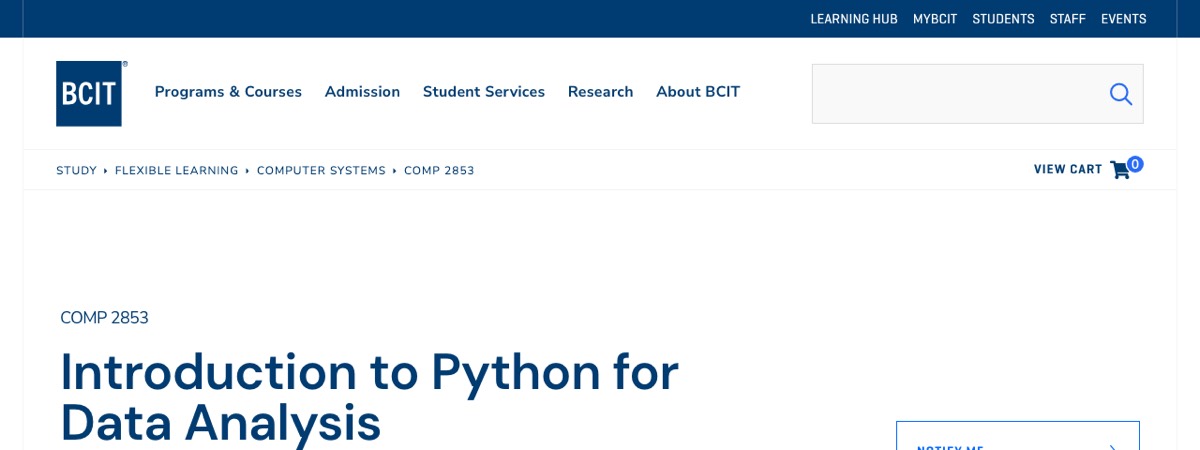
| Provider | British Columbia Institute of Technology (BCIT) |
|---|---|
| Length | 36 hours. Page also says 3.0 credits. Fall 2026 CRN 51302 runs Sep 11–Nov 27; Winter 2027 CRN 92514 runs Jan 08–Apr 02. |
| Cost (CAD) | $598.76 domestic fees for the listed sections (currency not labelled CAD). Page says international fees are typically 3.4 times the domestic tuition. Prerequisite: 60% in COMP 1630. |
| Credential | BCIT course credit. Page says it is a required course in the Applied Data Analytics Certificate (ADAC). |
| Format | hybrid for CRN 51302 and CRN 92514 (online synchronous classes with exams on campus); a separate section is described as 36 hours on campus, British Columbia |
Fiona's take: Domestic fees are $598.76, with international fees typically 3.4 times the domestic tuition, and the prerequisite is 60% in COMP 1630. As a required course in BCIT's Applied Data Analytics Certificate, it carries weight inside a real credential. Fall 2026 runs September 11 to November 27 and Winter 2027 runs January 8 to April 2, with online synchronous classes and exams on campus.
Skip it if: Skip it if you are outside British Columbia or want fully online study; the listed sections are hybrid with on-campus exams.
See Program DetailsICT 778 - Python Foundations
ICT 778, Python Foundations is a 30-hour online synchronous course from the University of Calgary Continuing Education at a flat fee of $829.00.
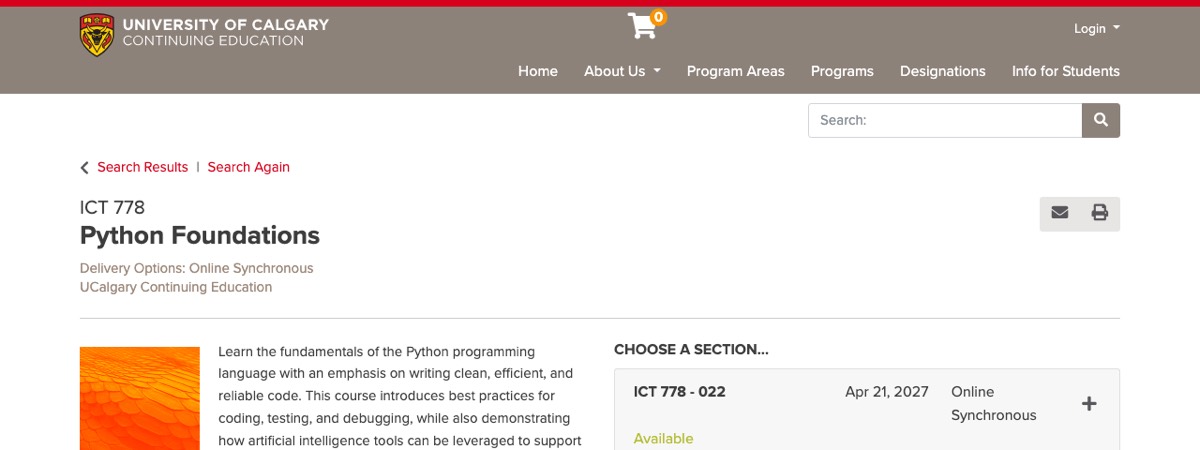
| Provider | University of Calgary Continuing Education |
|---|---|
| Length | 30.0 hours. Section ICT 778-022: Apr 21, 2027 to Jun 23, 2027, Wednesdays 6:00PM to 9:00PM. |
| Cost (CAD) | Flat fee $829.00 (currency not labelled CAD). Page says "No Required Textbook." |
| Credential | Continuing-education course. Listed as an optional course toward the Certificate in Business Intelligence and Analytics. |
| Format | online synchronous, Alberta |
Fiona's take: Section ICT 778-022 runs Wednesdays 6:00 pm to 9:00 pm from April 21 to June 23, 2027, with no required textbook. The page lists it as an optional course toward the Certificate in Business Intelligence and Analytics, so it can seed a larger credential. Live evening format suits working Albertans who want a scheduled classroom.
Skip it if: Skip it if Wednesday evenings do not work; that is the listed section time for spring 2027.
See Program DetailsCOMP-1257 Programming Essentials in Python
Programming Essentials in Python (COMP-1257) is an online continuing-education course from Red River College Polytechnic costing $709 per listed section.
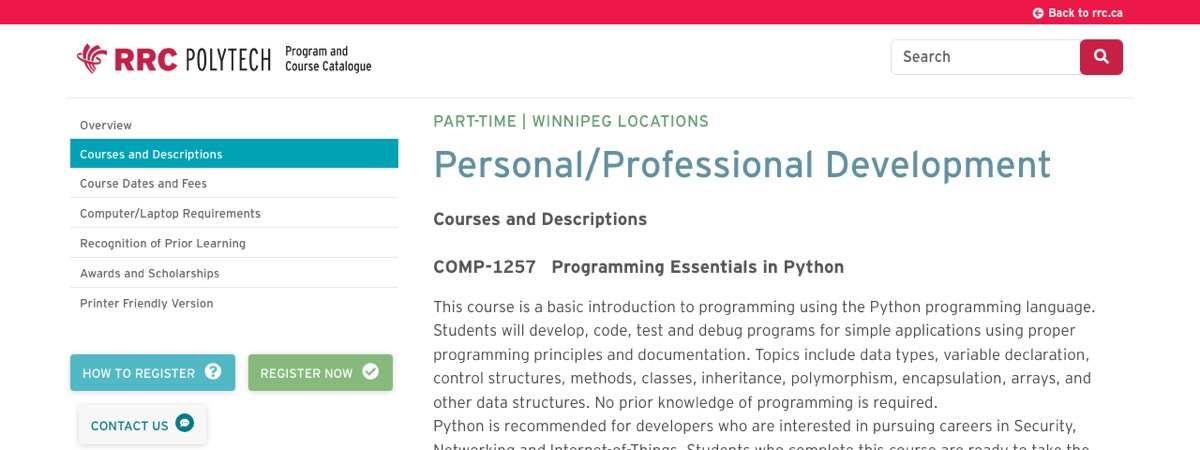
| Provider | Red River College Polytechnic |
|---|---|
| Length | Hours not shown. Listed sections: Jan 06, 27–Apr 06, 27; May 01, 27–Aug 31, 27; Aug 01, 27–Nov 30, 27. Page produced on 2026-11-20. |
| Cost (CAD) | $709 per listed section (currency not labelled CAD). Page says part-time and online students may be required to purchase textbooks. |
| Credential | Digital badge. Page also says completers are ready to take the PCAP – Certified Associate in Python Programming exam (exam not included). |
| Format | online, Manitoba |
Fiona's take: The course ends in a digital badge, and the page says completers are ready to take the PCAP, Certified Associate in Python Programming exam, which is not included. Listed sections run January 6 to April 6, 2027, May 1 to August 31, 2027 and August 1 to November 30, 2027. Part-time and online students may need to purchase textbooks.
Skip it if: Skip it if you want a transcripted college credential rather than a badge; the page lists a digital badge and no exam.
See Program DetailsIntroduction to Python for Data Science
Introduction to Python for Data Science is a 20-hour self-directed online course from George Brown Polytechnic Continuing Education at $334.45.
| Provider | George Brown Polytechnic Continuing Education |
|---|---|
| Length | 20 hours. One listed section (CRN F23815) is 09 Nov 2026–10 Jan 2027 and marked closed; other self-directed online CRNs are listed without dates. |
| Cost (CAD) | $334.45, includes a non-refundable materials fee of $135 (currency not labelled CAD). |
| Format | online (self-directed), Ontario |
Fiona's take: At $334.45, including a non-refundable materials fee of $135, this is the lowest listed single-course price among the college options here. The one dated section, November 9, 2026 to January 10, 2027, is marked closed, so you would rely on the undated self-directed CRNs. Treat it as a taster: the page shows no certificate for this course.
Skip it if: Skip it if you need a firm start date or a credential; the dated section is closed and none is listed.
See Program DetailsHow Much Does Each Route Cost In Canada?
Each route costs anywhere from about CA$82 a month for Coursera Plus to a $12,160 Saskatchewan Polytechnic year. Coursera Plus pricing in Canada varies by promotion and appears at checkout in CAD; recent offers have included annual plans around CA$274 to CA$282 (regularly higher) or monthly around CA$82, with a 7-day trial on the monthly plan, so check coursera.org/courseraplus for current rates. Both Coursera pages say their item is included with Coursera Plus, and Michigan's FAQ says you can also pay for the entire Specialization upfront or pay individually for each course as you progress; neither course page prints a course-specific CAD total.
| Item | Listed Price | What To Know |
|---|---|---|
| Coursera Plus, 12 months | Recent offers around CA$274 to CA$282 | Pricing varies by promotion and appears at checkout in CAD, regularly higher; 14-day money-back guarantee; includes both Coursera items |
| Coursera Plus, monthly | Recent offers around CA$82 a month | With a 7-day trial on the monthly plan; pricing varies and appears at checkout in CAD |
| Coursera single course or program | CA$69 to CA$112 a month | Range shown on the Coursera Plus page |
| The '$239' banner on both course pages | USD $239 for 12 months | Currency not labelled on the banner; linked offer terms say regularly USD $399 |
| SAIT CPRG 100, Introduction to Python Programming | $0.00 to $625.00 | Continuing education; currency not labelled CAD |
| SAIT Programming with Python | $415.00 | Second required course in the certificate |
| BCIT Applied Data Analytics Certificate | $11,000 | Budget for Canadian and PR students, tuition and books; around $600 to $800 per course |
| McGill Professional Development Certificate in Applied AI and Data Analytics for Business | $6,169.90 to $6,376.90 | Includes application fee, one prerequisite, three required courses, one complementary course |
| NSCC IT Data Analytics | $3,620 | Domestic tuition, 2025-26 academic year; books and other costs additional |
| Saskatchewan Polytechnic Artificial Intelligence and Data Analytics | $12,160 | 2026-27 academic year; includes mandatory fees and approximate books and supplies |
| Concordia CEBD 1100 and CEBD 1160 | $985 and $1,095 | Two verified course fees within the 5-course Data Science Programming diploma |
Single college courses undercut the full programs. George Brown's Introduction to Python for Data Science is $334.45 including a $135 non-refundable materials fee for 20 hours; Red River's COMP-1257 is $709; the University of Calgary's ICT 778 is $829.00 flat; BCIT's COMP 2853 is $598.76 in domestic fees, with international fees typically 3.4 times domestic tuition.
Free routes are limited. Both Coursera pages say financial aid is available for learners who qualify; Michigan's FAQ says flatly that you cannot take the course for free; the IBM page mentions a free trial for eligible learners and a Full Course, No Certificate option on some courses. The 7-day free trial on monthly Coursera Plus and the 14-day money-back guarantee on the annual plan are the safety nets.
What Jobs And Wages Can Each Route Lead To In Canada?
For a wage proxy, Job Bank lists NOC 21232, software developers and programmers, in its November 18, 2026 wage update. IBM's page names data science, data analytics, software development, data engineering, AI and DevOps as target careers; Michigan aims at programming and data analysis.
| Region | Median Hourly Wage (NOC 21232) |
|---|---|
| Canada | $50.00 |
| British Columbia | $55.29 |
| Ontario | $51.28 |
| Alberta | $48.08 |
| Quebec | $47.12 |
| New Brunswick | $45.66 |
| Saskatchewan | $45.00 |
| Nova Scotia | $45.00 |
| Newfoundland and Labrador | $43.96 |
| Prince Edward Island | $43.27 |
| Manitoba | $42.31 |
British Columbia posts the highest median at $55.29 an hour, with Ontario at $51.28 and the Canada median at $50.00. Manitoba's $42.31 is the lowest provincial median shown, and the Northwest Territories, Nunavut and Yukon show n/a on this profile. These are wages for people working in the occupation, not an entry promise for certificate holders.
Alberta sits at $48.08, Quebec at $47.12, New Brunswick at $45.66, Saskatchewan and Nova Scotia at $45.00, Newfoundland and Labrador at $43.96 and Prince Edward Island at $43.27. The spread matters for the college decision: BCIT's $11,000 certificate serves the highest-median province, while NSCC's $3,620 diploma serves a $45.00 market.
Who Should Pick Which One?
Who should pick Python for Everybody? True beginners. It states no prerequisites, holds 4.8 from 280,850 reviews, and its five courses, listed at 17, 20, 19, 14 and 9 hours, build from your first program to a 9-hour capstone with SQL, databases and visualization. The trade is time: the header says 2 months at 10 hours a week and the FAQ says about 8 months for most learners.
Who should pick the IBM course? People who already program or need data skills for a current job. Two weeks at 10 hours a week gets you Pandas, NumPy, Jupyter Notebooks, REST APIs and BeautifulSoup, with more than 25 hands-on labs and a GDP data extraction project. Its FAQ says zero experience is fine, but the pace assumes you absorb new tools quickly.
Who should pick a Canadian college program? Canadians who need a credential an employer or another school can verify. SAIT issues an electronically issued Certificate of Completion and transcript after two courses; BCIT's certificate typically takes 2 or 3 years part-time with an $11,000 budget; McGill lists $6,169.90 to $6,376.90. Pay for these when a posting asks, not before testing your interest on Coursera.
Can You Get Funding For Python Training In Canada?
Funding may be available if you meet program rules. None of the reviewed funding pages confirms payment for these Coursera certificates; check eligibility before enrolling.
- Canada training credit. The CRA reviews the criteria each year and increases your Canada training credit limit by $250 if you qualify, up to $5,000 in a lifetime, and the claim is the lesser of that limit and 50% of eligible tuition at a Canadian university, college or other Canadian post-secondary institution, or a Minister-certified institution. The CRA page does not name Coursera.
- Better Jobs Ontario. Eligible laid-off applicants can apply for up to $28,000 for training of 1 year or less, or up to $35,000 for programs longer than 1 year. The page does not name Coursera or either certificate.
- Ontario Job Grant. Employers, not individuals, apply: the grant covers eligible training costs up to $10,000 per trainee with an approved third-party trainer, with additional flexibility for small employers.
- Canada-Alberta Productivity Grant. The Government of Alberta contributes 75% of training costs to a maximum of $5,000 per employed trainee per fiscal year for job-relevant digital and technological skills. SAIT's continuing-education pages point learners to this grant.
- StrongerBC future skills grant. B.C. residents aged 19 and older can access up to $3,500 for eligible short-term training at B.C. public post-secondary institutions. The government page does not say it pays Coursera fees, and BCIT's certificate was not confirmed on the eligible list.
- Employer reimbursement for Coursera Plus. Where an employer already reimburses online learning, Coursera emails a Coursera Plus receipt you can submit. This is the one route that names Coursera directly.
Python Certificate Questions Canadians Ask
Which Is Shorter, Python For Everybody Or The IBM Python Course?
IBM's Python for Data Science & AI is the shorter one: the Coursera page lists 2 weeks at 10 hours a week. Python for Everybody's header says 2 months at 10 hours a week, and its own FAQ says most learners finish in about 8 months. On every stated figure, the IBM course is the quicker path.
Can Either Coursera Item Be Taken For Free?
Free access differs between the two. Python for Everybody's FAQ says 'No, you cannot take this course for free,' though both pages advertise financial aid for learners who qualify. The IBM page says eligible learners may start with a free trial and that some courses offer a Full Course, No Certificate option. Monthly Coursera Plus also carries a 7-day free trial.
What Does Coursera Plus Cost In Canadian Dollars?
Coursera Plus pricing in Canada varies by promotion and appears at checkout in CAD; recent offers have included annual plans around CA$274 to CA$282 (regularly higher) or monthly around CA$82, with a 7-day trial on the monthly plan. The banners on both course pages show '$239' without a currency label; the linked offer terms call it USD $239 for 12 months, regularly USD $399. Individual courses and programs are listed at CA$69 to CA$112 a month.
Do I Need Programming Experience?
Programming experience is not required for either. Michigan lists beginner level with 'No prior experience required' and says the Specialization has no prerequisites. IBM's header says beginner with recommended experience, but its FAQ answers the zero-experience question with 'Absolutely.' Michigan is the safer first stop if variables and loops are new to you.
Does The IBM Course Include Pandas And NumPy?
Pandas and NumPy are central to the IBM course. Its page says learners demonstrate proficiency with Pandas and NumPy in Jupyter Notebooks, and it also names REST APIs with the Requests library and BeautifulSoup. Michigan's Specialization takes a different path: its tools list names Python, SQL, databases and data visualization software, not the Pandas and NumPy stack.
Will Either Certificate Give Canadian University Or College Credit?
Credit is unlikely from either certificate. Michigan's FAQ states the Specialization does not carry university credit, though some universities may choose to accept its certificates. On the pages reviewed, neither certificate is listed for PLAR or credit at Canadian colleges or by employers or professional bodies. Canadian routes like SAIT's and BCIT's issue their own credentials.
Does The Canada Training Credit Pay For Coursera?
The Canada training credit does not name Coursera. The CRA says it covers eligible tuition at a Canadian university, college or other Canadian post-secondary institution, or an institution certified by the Minister of Employment and Social Development, and the claim is the lesser of your credit limit and 50% of eligible fees. It increases by $250 a year if you qualify, up to $5,000 lifetime.
What Do Canadian Software Developers And Programmers Earn?
Canadian software developers and programmers, listed under NOC 21232, show a Canada median of $50.00 an hour in Job Bank's November 18, 2026 wage update. Provincial medians run from $42.31 in Manitoba to $55.29 in British Columbia, with Ontario at $51.28 and Quebec at $47.12. These wages describe the occupation, not a guaranteed rate for certificate holders.
What's The Bottom Line On Python For Everybody Vs IBM Python?
- One Coursera Plus subscription covers both: IBM's 2-week course for the data stack and Michigan's 2-month Specialization for depth, with Canadian pricing varying by promotion and recent annual offers around CA$274 to CA$282.
- Start with Python for Everybody Specialization if you have never coded; switch to Python for Data Science & AI: Hands-On Development if Pandas and NumPy are the goal.
- On the pages reviewed, neither Coursera certificate is listed as a licence, a registration, or for credit at Canadian colleges; SAIT, BCIT and McGill issue the credentials employers can verify.
- Job Bank's NOC 21232 median is $50.00 an hour in Canada, from $42.31 in Manitoba to $55.29 in British Columbia.
- Pay for college only when a posting demands it: SAIT lists CPRG 100 at $0.00 to $625.00 and Programming with Python at $415.00; BCIT's budget is $11,000; McGill lists $6,169.90 to $6,376.90.