
Key Takeaways
- The Self-Driving Cars Specialization from the University of Toronto, a Canadian university, on Coursera is a 3-month advanced online program at 10 hours a week across four courses of 35, 27, 31 and 32 hours, included with Coursera Plus, whose annual page showed $239 for 12 months, regularly $399, with no CAD label; shorter options on this page include Michigan's 7-hour course and Okanagan College's 5-day course.
- No licence or registration comes with it: no regulator names this certificate, it carries no university credit, and it meets none of Professional Engineers Ontario's P.Eng. requirements, which for graduates of Canadian engineering programs start with a CEAB-accredited bachelor's degree plus at least two years of eligible experience, a competency-based assessment, the NPPE and a good character assessment.
- The try-first move is Course 1, Introduction to Self-Driving Cars, 35 hours, inside the same specialization; the FAQ states you cannot take the course for free, and financial aid requires one application per course. It qualifies you for nothing regulated.
- Job Bank figures for Robotics Engineers (NOC 21301) show a Canada median of $47.00 an hour, ranging from $40.34 in Prince Edward Island to $51.92 in New Brunswick.
- Fiona's verdict: worth it for working engineers and strong students who already have Python, linear algebra and control theory; skip it if you are starting from zero or need a credential a regulator or employer must accept.
The Self-Driving Cars Specialization is a four-course online program on the engineering and software stack behind autonomous vehicles, offered on Coursera by the University of Toronto and taught by Steven Waslander and Jonathan Kelly. It comes from a Canadian university, which matters when Canadians weigh it against US alternatives.
My verdict: for engineers who already have the math and Python, it is an advanced online credential builder in this niche, 3 months at 10 hours a week. It is not a licence, not university credit, and not for beginners.
What Are The Ways To Learn Self-Driving Cars In Canada?
The ways to learn self-driving cars in Canada run from a 7-hour online survey to a one-year Ontario college credential, with 3-month and 4-month specializations, technician courses and Quebec graduate credit in between. This table sets the routes side by side.
| Route | Time | Cost (CAD) | What You Get | Recognised By | Best For |
|---|---|---|---|---|---|
| Self-Driving Cars Specialization | 3 months at 10 hours a week | Not shown in CAD; the Coursera Plus annual page showed $239 for 12 months, regularly $399, with no CAD label | Shareable career certificate from the University of Toronto | No regulator; no university credit | Engineers with math and Python |
| AI for Autonomous Vehicles and Robotics | 7 hours | Not shown; included with Coursera Plus | Shareable certificate | No regulator named | Testing interest first |
| Self Driving and ROS 2 - Learn by Doing! Odometry & Control | 13 sections, 174 lectures, 28h 47m | Not listed | Not listed | Not listed | Hands-on ROS 2 practice |
| LAT 044 - Advanced Driver Assistance Systems (ADAS): Calibration and Diagnostics | 5 days (30 hours), January 26 to February 7, 2027 | $1,030.00 tuition for section LAT 044-002 | Certificate of completion | Okanagan College, British Columbia | ADAS technicians |
| Cybersecurity Analytics - Automobility | 1 year | Domestic $10,297.83 on the Fall 2026 fee sheet | Ontario College Graduate Certificate | Ontario college credential | Vehicle cybersecurity, in person |
| Autonomous Vehicles | 4.0 credits, Fall 2026 session | Not listed | Graduate credit course IFT 6757 | Université de Montréal | Admitted graduate students |
I recommend the University of Toronto specialization for readers with the math background and Michigan's 7-hour course for the undecided; Okanagan is the technician ADAS calibration option, and St. Clair is a closed automotive-cybersecurity graduate certificate.
How Long Does The Self-Driving Cars Specialization Take To Finish?
The Self-Driving Cars Specialization takes 3 months at 10 hours a week at the stated pace, or 4 to 6 months at the FAQ pace of 4 to 6 weeks per course. These steps take you from background check to certificate.
- Confirm the entry bar before paying anything: the page recommends background in linear algebra, probability, statistics, calculus, physics, control theory and Python, plus a computer that meets the stated CARLA simulator specifications.
- Enrol on Coursera. The page shows Enroll for free, a start date of Nov 20, and Included with Coursera Plus; the Plus annual plan is $239 for 12 months, regularly $399, an offer shown through November 30, 2026.
- Take Course 1 first: Introduction to Self-Driving Cars, 35 hours. Course 2, State Estimation and Localization, explicitly recommends taking Course 1 first.
- Finish Courses 2 to 4, listed at 27, 31 and 32 hours, holding 10 hours a week for a 3-month finish.
- If the fee is the barrier, apply for financial aid separately for each of the four courses; Coursera's help page says approval gives access to all course content and the certificate. Processing time is not stated.
- Add the shareable University of Toronto career certificate to LinkedIn, your resume or your CV; certificate access is tied to paid enrolment, Coursera Plus or approved financial aid.
Do Employers In Canada Recognise The Self-Driving Cars Certificate?
No verified regulator page, federal program, college-credit or PLAR rule, or Canadian job posting in the sources names this Coursera certificate. What you hold is a shareable career certificate from a Canadian university, not a credential any body must accept.
The licence question still matters for engineers. For graduates of Canadian engineering programs, Professional Engineers Ontario's academic requirement for a P.Eng. licence is a bachelor's degree from a CEAB-accredited program. Graduates of international engineering programs need a bachelor's degree on PEO's Recognized Programs List plus a technical exam program, and a World Education Services course-by-course report if the degree is from outside Canada and the USA. A licence also requires at least two years of eligible experience after the degree is conferred, a competency-based assessment, the NPPE, and a good character assessment. This specialization meets none of that.
The FAQ is blunt: the Specialization does not carry university credit, though some universities may choose to accept Specialization Certificates for credit. The course covers Kalman filters, convolutional neural networks, motion planning and CARLA-related simulation work. That content and the University of Toronto name are what you can show; the certificate itself is not a regulated credential and should not be presented as one.
What Does The Self-Driving Cars Specialization Teach, And What Are The Alternatives?
The Self-Driving Cars Specialization teaches the vehicle software stack end to end: modelling and control, state estimation, visual perception and motion planning, from Steven Waslander and Jonathan Kelly of the University of Toronto. Here is how it stacks against selected alternatives a Canadian reader may compare.
Self-Driving Cars Specialization
The Self-Driving Cars Specialization is a four-course advanced online program from the University of Toronto on Coursera that covers the full software stack behind autonomous vehicles.
| Provider | University of Toronto |
|---|---|
| Length | 3 months to complete at 10 hours a week. FAQ also states: each course is intended to take 4-6 weeks, and at that pace the Specialization takes 4-6 months. |
| Cost (CAD) | Not shown in CAD. Page shows a Coursera Plus full-year offer, “now $239,” and says the specialization is included with Coursera Plus. FAQ: “No, you cannot take this course for free.” A standalone price is not shown. |
| Rating | 4.7 (3,561 reviews on coursera.org) |
| Credential | Shareable certificate. FAQ: “This Specialization doesn't carry university credit, but some universities may choose to accept Specialization Certificates for credit.” |
| Format | online |
Fiona's take: The four courses are Introduction to Self-Driving Cars (35 hours), State Estimation and Localization (27 hours of Kalman filters, GPS, IMU and LIDAR matching), Visual Perception (31 hours of camera calibration, CNNs and semantic segmentation) and Motion Planning (32 hours), with Course 2 recommending you take Course 1 first; an order rule for all four courses is not verified. You work in the CARLA simulator. It rates 4.7 from 3,561 reviews with 87,158 learners enrolled, and the level is listed as Advanced, designed for those already in the industry.
Skip it if: Skip it without working knowledge of linear algebra, probability, calculus, physics, control theory and Python; the page recommends all of them.
Start On CourseraAI for Autonomous Vehicles and Robotics
AI for Autonomous Vehicles and Robotics is a 7-hour online course from the University of Michigan on Coursera that surveys AI methods for autonomous systems.
| Provider | University of Michigan |
|---|---|
| Length | 7 hours to complete |
| Cost (CAD) | Not shown in CAD. Page shows Coursera Plus “now $239” and says the course is included with Coursera Plus. A standalone price is not shown. |
| Rating | 4.5 |
| Credential | Shareable certificate |
| Format | online |
Fiona's take: Seven hours is a screening tool, not a skill builder, and it rates 4.5. It is included with Coursera Plus. It works as one evening of screening before you commit 3 months to the Toronto math.
Skip it if: Skip it if you already know you want the engineering stack; it will not teach the stack.
Start On CourseraSelf-Driving Car Specialization Course
The Self-Driving Car Specialization Course is a 9-hour online course from Packt on Coursera that passes through self-driving car material in one sweep.
| Provider | Packt |
|---|---|
| Length | 9 hours to complete |
| Cost (CAD) | Not shown in CAD. Page shows Coursera Plus “now $239” and states “Included with” Coursera Plus. FAQ: “This course is currently available only to learners who have paid or received financial aid, when available.” |
| Credential | Shareable certificate |
| Format | online |
Fiona's take: Packt is the listed provider, and the FAQ states the course is available only to learners who have paid or received financial aid. Nine hours cannot carry what the University of Toronto spreads across four courses, so I treat it as a paid preview for the committed.
Skip it if: Skip it if you want a university-branded certificate or mathematical depth.
Start On CourseraFoundations of Autonomous Systems Specialization
The Foundations of Autonomous Systems Specialization is a 4-month online program at 10 hours a week from the University of Colorado Boulder on Coursera covering autonomous systems foundations.
| Provider | University of Colorado Boulder |
|---|---|
| Length | 4 months at 10 hours a week |
| Cost (CAD) | Not shown in CAD. Page shows Coursera Plus “now $239” and says the specialization is included with Coursera Plus. FAQ: “No, you cannot take this course for free.” |
| Rating | 3.5 |
| Credential | Shareable certificate. Page also says courses can be taken for academic credit in CU Boulder’s MS in Computer Science on Coursera. |
| Format | online |
Fiona's take: Its page shows 42 reviews of courses in this program and does not display an average. The differentiator is credit: its page says the courses can be taken for academic credit in CU Boulder's MS in Computer Science on Coursera, a pathway the Toronto program does not offer. Its FAQ also states you cannot take it for free.
Skip it if: Skip it if your target is vehicles specifically; this is broader autonomous systems.
Start On CourseraThe Complete Self-Driving Car Course - Applied Deep Learning
The Complete Self-Driving Car Course - Applied Deep Learning is an 18h 4m video course from Udemy, 15 sections and 169 lectures, that builds self-driving applications with deep learning.
| Provider | Udemy |
|---|---|
| Length | 15 sections • 169 lectures • 18h 4m total length |
| Rating | 4.7 out of 5 |
| Format | online |
Fiona's take: It rates 4.7 out of 5 on Udemy. This is the build-first route: you train models and drive them rather than deriving estimators. No price or credential is listed on the page.
Skip it if: Skip it if you need a graded, university-backed certificate for LinkedIn.
View On UdemySelf Driving and ROS 2 - Learn by Doing! Odometry & Control
Self Driving and ROS 2 - Learn by Doing! Odometry & Control is a 28h 47m video course from Udemy, 13 sections and 174 lectures, that builds a self-driving robot with ROS 2 in Python and C++.
| Provider | Udemy |
|---|---|
| Length | 13 sections • 174 lectures • 28h 47m total length |
| Rating | 4.7 out of 5 |
| Format | online |
Fiona's take: It rates 4.7 out of 5. The Udemy course focuses on ROS 2, which is not listed in the Toronto specialization skills, so it complements rather than competes. Cost and credential are not listed.
Skip it if: Skip it without basic programming comfort; it is hands-on from the early sections.
View On UdemyCybersecurity Analytics - Automobility
Cybersecurity Analytics - Automobility is a one-year, in-person Ontario College Graduate Certificate from St. Clair College.
| Provider | St. Clair College |
|---|---|
| Length | One Year |
| Cost (CAD) | Dollar amount is not printed on the program page. The linked Fall 2026 fee sheet (https://www.stclaircollege.ca/sites/default/files/inline-files/Tuition-Fee-Sheet-2026-Fall.pdf), headed “Fall 2026 Intake,” lists “Cybersecurity Analytics-Automobilit” T895 A01/A02 totals as domestic $10,297.83, international $20,099.60, and USA $13,827.62 for 26F plus 27W. The program page says textbooks and other materials are in addition to tuition fees. The same page says “Status: Closed.” |
| Credential | Ontario College Graduate Certificate |
| Format | in person, Ontario |
Fiona's take: The Fall 2026 fee sheet lists a domestic total of $10,297.83 on both T895 rows; section T895 A01/A02 totals $20,099.60 international and $13,827.62 USA, while section T895 A03/A04 totals $16,166.82 international and $11,177.62 USA for 26F plus 27W, with textbooks extra. The program page shows Status: Closed. This is a closed one-year Ontario College Graduate Certificate in automotive cybersecurity, a different subject from perception and planning software.
Skip it if: Skip it if you need an open intake or cannot study in person in Ontario.
See Program DetailsAutonomous Vehicles
Autonomous Vehicles is a 4.0-credit graduate course, IFT 6757, from Université de Montréal, listed as a day course for the Fall 2026 session, in person.
| Provider | Université de Montréal |
|---|---|
| Length | 4.0 credits; session listed as Fall 2026; day course |
| Credential | Graduate course IFT 6757 (credit course; a separate certificate name is not shown) |
| Format | in person, Quebec |
Fiona's take: IFT 6757 is a 4.0-credit graduate course inside a Quebec university, a level above any MOOC. No fee is listed, and admission details are not stated on the page.
Skip it if: Skip it if you are not pursuing graduate study; the course is listed as in person for the Fall 2026 session.
See Program DetailsIntroduction à la robotique mobile autonome
Introduction à la robotique mobile autonome is a 14-hour continuing-education course from Université Laval, online or in person, ending in an attestation de participation.
| Provider | Université Laval |
|---|---|
| Length | 14 heures |
| Credential | Attestation participative (attestation de participation recognizing 14 hours) |
| Format | online or in person, Quebec |
Fiona's take: The 14 hours end in an attestation de participation, and Université Laval says those hours are admissible under the Ordre des ingénieurs du Québec (OIQ) continuing-education regulation. No fee is listed on the page. For a Quebec engineer collecting continuing-education hours, that admissibility is the point; for anyone else it is a short introduction to autonomous mobile robotics.
Skip it if: Skip it if you want graded projects or a career certificate.
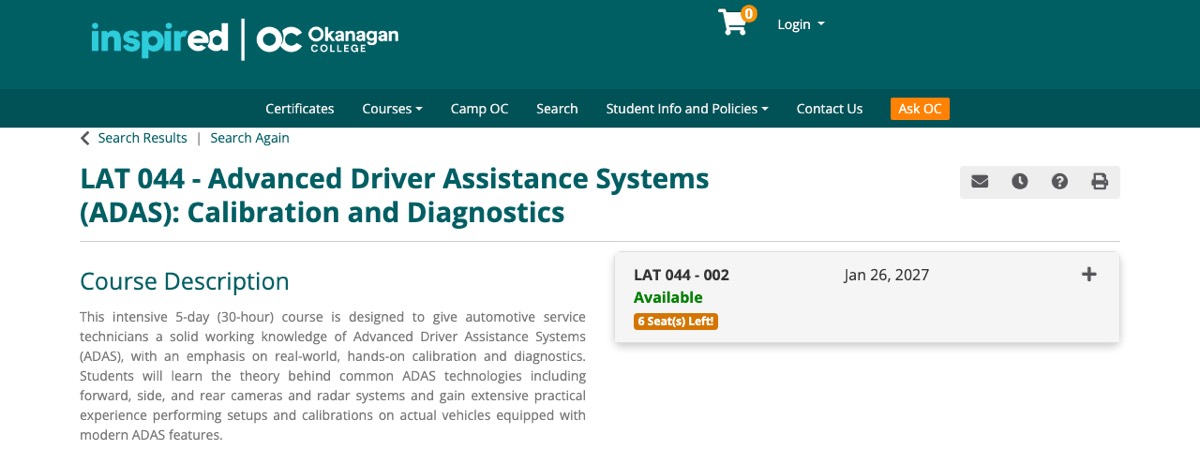
See Program DetailsLAT 044 - Advanced Driver Assistance Systems (ADAS): Calibration and Diagnostics
LAT 044 - Advanced Driver Assistance Systems (ADAS): Calibration and Diagnostics is a 5-day, 30-hour hybrid course from Okanagan College in British Columbia.
| Provider | Okanagan College |
|---|---|
| Length | 5-day (30-hour); listed section contact hours 30.9; Jan 26, 2027 to Feb 07, 2027 |
| Cost (CAD) | Tuition $1,030.00 for section LAT 044-002. The page does not say this covers textbooks or tools. |
| Credential | certificate of completion |
| Format | hybrid, British Columbia |
Fiona's take: Tuition is $1,030.00 for section LAT 044-002, with listed contact hours of 30.9, running January 26 to February 7, 2027. This is calibration and diagnostics on real vehicles, technician work rather than software engineering.
Skip it if: Skip it if your goal is writing perception or planning code.
See Program DetailsAdvanced Driver Assistance System (ADAS)
Advanced Driver Assistance System (ADAS) is a 2-day in-person course from Collège Boréal in Ontario.
| Provider | Collège Boréal |
|---|---|
| Length | 2 days |
| Format | in person, Ontario |
Fiona's take: Two days, with no cost, hours or credential listed on the page. That signals awareness-level training for automotive service staff rather than engineering.
Skip it if: Skip it if you need documented hours or a stated credential.
See Program DetailsIntroduction to Autonomous Vehicles: Concepts and Applications Training Course
Introduction to Autonomous Vehicles: Concepts and Applications Training Course is a 14-hour course from NobleProg Canada, online or in person, at CA$4,770 per participant online and CA$6,770 in the classroom.
| Provider | NobleProg |
|---|---|
| Length | 14 hours |
| Cost (CAD) | Price per participant on listed sessions: CA$ 4,770 (Online) and CA$ 6,770 (Classroom). Page says it runs with a minimum of 4+ people, and 1-to-1 or private group training is by quote. Next listed date on the page: 2026-12-21, Victoria - The Atrium. |
| Format | online or in person, British Columbia |
Fiona's take: Listed sessions run with a minimum of 4+ people, the next date shown is December 21, 2026 at The Atrium in Victoria, and private groups are by quote. That pricing is built for employer-sponsored teams, not individuals.
Skip it if: Skip it as an individual; the online seat alone is CA$4,770.
See Program DetailsHow Much Does The Self-Driving Cars Specialization Cost In Canada?
The Self-Driving Cars Specialization shows no standalone price in Canada: the page displays no dollar figure, says Included with Coursera Plus, and shows Financial aid available. The Plus annual page showed $239 for 12 months, regularly $399, but no CAD label is shown; local currency is shown at checkout.
| Item | Amount | Notes |
|---|---|---|
| Specialization standalone price | Not shown | The live page displays no dollar price |
| Coursera Plus annual | $239 for 12 months, regularly $399, no CAD label | Renews at $399 a year; local currency shown at checkout; offer through November 30, 2026 |
| Coursera single course or bundled specialization | $49 to $79 per month | Coursera's general range; not confirmed as this item's price |
| Enrollment | Enroll for free shown | FAQ states you cannot take the course for free |
| Financial aid | Amount not stated | One application per course |
Coursera shows no CAD amounts on these pages; the Coursera Plus page says local currency is used outside the US and shown at checkout. The Plus annual page showed $239 for 12 months against a regular $399, an offer through November 30, 2026 that renews at $399 a year unless canceled. Treat the $49 to $79 monthly range as Coursera's general range for single courses and bundled specializations, not a confirmed price for this one.
For scale, the Canadian alternatives print their prices: Okanagan's ADAS course is $1,030.00, NobleProg's online introduction is CA$4,770 per participant, and St. Clair's domestic total is $10,297.83. One Toronto number that looks related is not: the University of Toronto School of Continuing Studies lists course 4133, a non-credit self-driving-laboratory course about materials discovery, at a flat fee of $150.00, expected to take about a month with up to a year to finish. It is not training for autonomous vehicles.
How Much Does A Robotics Engineer Earn In Canada?
A Robotics Engineer in Canada earns a median of $47.00 an hour according to Job Bank figures for NOC 21301. The specialization page says it prepares learners to build a self-driving software stack and apply for autonomous-vehicle jobs; this table shows what that occupation pays.
| Region | Median Hourly Wage (NOC 21301) |
|---|---|
| Canada | $47.00 |
| New Brunswick | $51.92 |
| Alberta | $51.44 |
| Newfoundland and Labrador | $50.96 |
| Ontario | $47.12 |
| Nova Scotia | $46.23 |
| Saskatchewan | $44.23 |
| Quebec | $43.33 |
| British Columbia | $43.27 |
| Manitoba | $43.25 |
| Prince Edward Island | $40.34 |
The spread runs from $40.34 in Prince Edward Island to $51.92 in New Brunswick, with Ontario at $47.12, Alberta at $51.44 and Quebec at $43.33. The three territories show no figures in this table. Job Bank titles the occupation Robotics Engineer, and prints NOC 21301 next to these wages.
Attach these numbers to the occupation, not to the certificate. No Canadian job posting in the sources names this Coursera certificate, and the P.Eng. licence in Ontario requires a CEAB-accredited bachelor's degree. Plan the specialization as a layer on top of qualifications, not a substitute for them.
Is The Self-Driving Cars Specialization Worth It In 2026?
The Self-Driving Cars Specialization is worth it in 2026 for one reader: the engineer or senior student who already has linear algebra, control theory and Python and wants autonomous vehicles on their resume. For that person, 3 months at 10 hours a week buys the full stack, from least squares and Kalman filters to CNNs and motion planning, with CARLA simulation, from a Canadian university's engineering team.
The review base is strong: 4.7 from 3,561 reviews, with 80.54% at five stars and 14.94% at four. The tone of published reviews is consistent, challenging, fun, not for beginners, and in one visual-perception review, only the tip of the iceberg. That last point matters. The field is bigger than any four courses, and the honest framing is a spine to build on, not a destination.
It is not worth it if you need a credential employers must recognise. No Canadian regulator names it, it carries no university credit, and it meets none of Professional Engineers Ontario's P.Eng. requirements: for graduates of Canadian engineering programs, a CEAB-accredited bachelor's degree, then at least two years of eligible experience, a competency-based assessment, the NPPE and a good character assessment. Beginners should start with Michigan's 7-hour course or a Udemy build-along, and technicians should look at Okanagan's ADAS calibration course instead.
Can You Get Funding For The Self-Driving Cars Specialization?
Coursera eligibility is not shown. Better Jobs Ontario lists eligible provider types, but this article cannot confirm funding for any route here.
- Canada Training Credit. The credit requires fees paid to an eligible educational institution in Canada: a university, college or other institution providing courses at a post-secondary level, or an institution providing occupational skills courses certified by the Minister of Employment and Social Development. Coursera is not named, so I cannot confirm a Plus subscription qualifies.
- Better Jobs Ontario. Its training is provided by Colleges of Applied Arts and Technology, career colleges, universities, Indigenous Institutes and school boards. A Coursera subscription does not appear on that published list, and this article cannot confirm funding for any route on this page.
- Ontario Job Grant. Training must be delivered in Ontario by a third party with an Ontario presence that has provided that training for at least two years, and the provider must be a publicly assisted college, university or Indigenous Institute in Ontario, a district school board, a career college registered or exempt under the Ontario Career Colleges Act, 2005, a union-based training centre, a sector council, or an industry association. The grant does not fund subscription fees, so it does not fund this Coursera specialization.
Self-Driving Cars Questions Canadians Ask
How Long Does The University Of Toronto Self-Driving Cars Specialization Take?
The specialization takes 3 months at 10 hours a week at the stated pace. The four courses list 35, 27, 31 and 32 hours. The FAQ adds that each course is intended to take 4 to 6 weeks, which stretches the full program to 4 to 6 months at that gentler pace.
Is The University Of Toronto Self-Driving Cars Program Free?
The program is not free to finish. The page shows Enroll for free and Financial aid available, but the FAQ states you cannot take the course for free, and no standalone price is displayed. Approved financial aid, per Coursera's help pages, gives access to all course content and the certificate.
Do Canadian Employers Recognise The Certificate?
Canadian employers have no obligation to recognise it, and no regulator page or Canadian job posting I could verify names this certificate. The FAQ says the Specialization does not carry university credit. For a P.Eng., Professional Engineers Ontario requires, for graduates of Canadian engineering programs, a CEAB-accredited bachelor's degree, plus at least two years of eligible experience, a competency-based assessment, the NPPE and a good character assessment. This specialization meets none of that.
Is The Self-Driving Cars Specialization Worth It?
Worth hinges on background. Across 3,561 reviews it rates 4.7, with 80.54% five stars and 14.94% four stars, and 87,158 learners enrolled. A published review of the state-estimation course calls it challenging, fun and not for beginners. For a working engineer, yes; for a beginner, the money buys frustration.
How Hard Is The Specialization, And Who Is It For?
The specialization is Advanced level by Coursera's own label, designed for those already in the industry. It recommends background in linear algebra, probability, statistics, calculus, physics, control theory and Python, plus a computer meeting the CARLA simulator specifications. Without that base, one reviewer's verdict stands: not for beginners.
Do The Four Courses Have To Be Taken In Order?
The four courses have one verified order rule: the State Estimation and Localization page states you should take the first course prior to this one. The specialization's own FAQ lists the order question, but its answer text was not shown on the retrieved page, so an order requirement for all four courses is not verified.
What Do Learners Say About The Courses?
Learner feedback on the course pages is mostly high: 80.54% of 3,561 reviews are five stars. One visual-perception reviewer calls the content just the tip of the iceberg, a motion-planning reviewer thanks the University of Toronto for a self-paced advanced program, and another calls it challenging but very fun.
What's The Bottom Line On The Self-Driving Cars Specialization?
- Self-Driving Cars Specialization is the University of Toronto's four-course advanced program on Coursera, 3 months at 10 hours a week, rated 4.7 from 3,561 reviews.
- It carries no licence, no registration and no university credit; it meets none of Professional Engineers Ontario's P.Eng. requirements, which for Canadian-program graduates start with a CEAB-accredited bachelor's degree and add at least two years of eligible experience, the NPPE and a good character assessment.
- No standalone price shows in Canada; the Coursera Plus annual page showed $239 for 12 months, regularly $399, with no CAD label, and financial aid needs one application per course.
- Robotics Engineers, NOC 21301, earn a Canada median of $47.00 an hour in current Job Bank figures.
- Take it with Python, linear algebra and control theory already in hand; start with Michigan's 7-hour course if you are still testing the field.