
Key Takeaways
- The standard route is a registered apprenticeship of about 4 years: 6,330 hours of work-based training plus 28 weeks of technical training in BC, or four 1,500-hour periods in Alberta. The pack verifies fee categories such as registration, Alberta theory exams and renewals if applicable, but dollar amounts and tuition are not listed here.
- Certification is compulsory in Alberta through Alberta Apprenticeship and Industry Training (Tradesecrets) and compulsory in Quebec only within the construction industry; it is voluntary in BC under SkilledTradesBC and in the other provinces and territories.
- Coursera's Construction Equipment Maintenance & Safety from the Kalinga Institute of Industrial Technology takes 1 week at 10 hours a week to test your interest in the trade; it does not qualify you for any provincial licence, registration or certificate.
- Job Bank puts the median wage for NOC 72401 heavy-duty equipment mechanics at $37.12 an hour Canada-wide, ranging from $33.00 in Quebec to $45.00 in British Columbia.
- Fiona's verdict: this trade suits hands-on workers who can commit four years and want to work on equipment used in construction, mining, oil and gas, farming and other sectors; Job Bank's outlook varies by province. Start with the one-week Coursera course if you are still deciding.
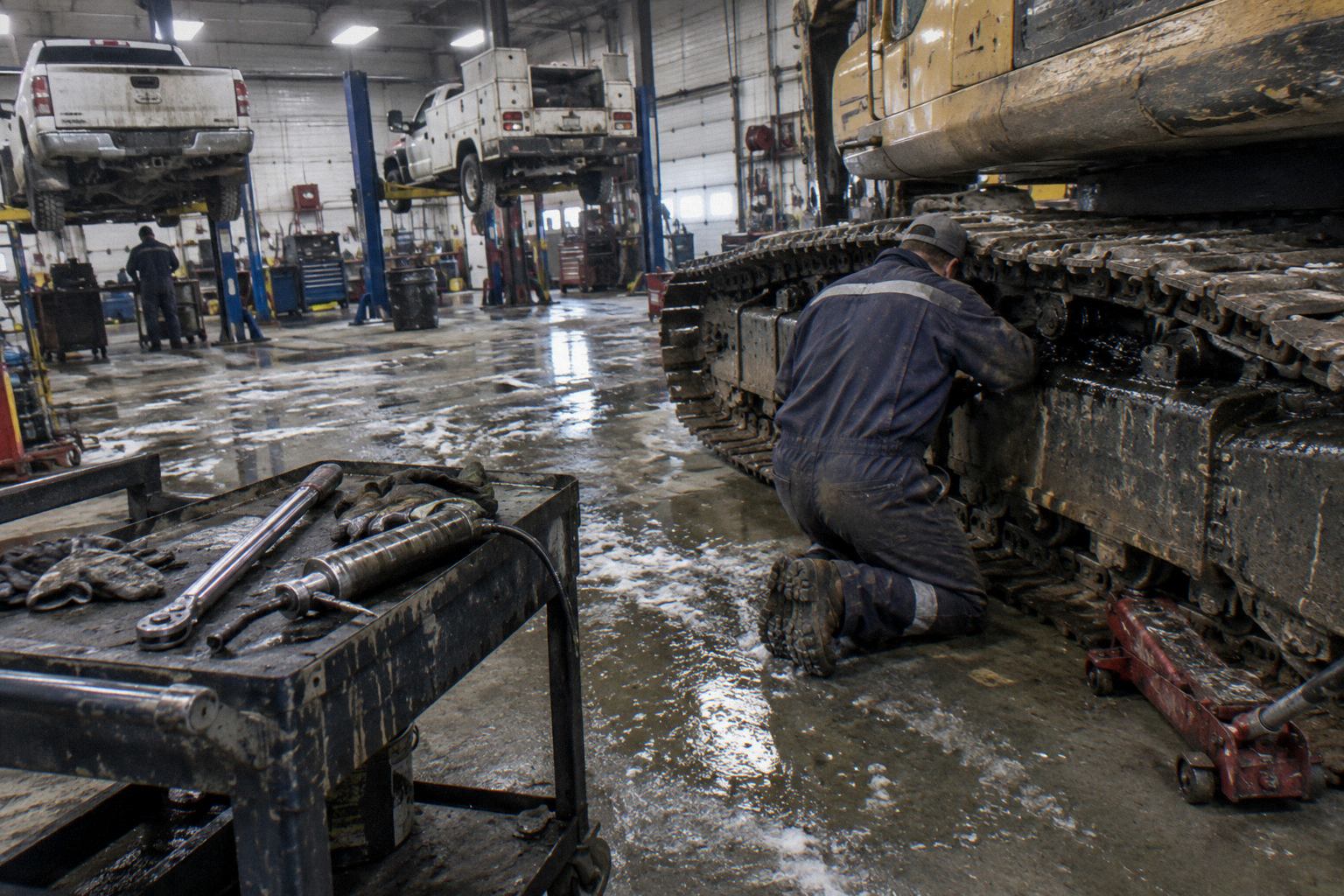
A heavy duty mechanic, formally a heavy-duty equipment mechanic under NOC 72401, repairs, troubleshoots, adjusts, overhauls and maintains the mobile equipment behind construction, transportation, forestry, mining, oil and gas, material handling, landscaping, land clearing and farming.
The standard route is a registered apprenticeship of about 4 years. In BC that is 6,330 hours of work-based training plus 28 weeks of technical training, ending in a Certificate of Qualification with Red Seal endorsement; in Alberta it is four 1,500-hour periods with 8 classroom weeks each, ending in a Journeyperson Certificate, with Red Seal endorsement where applicable after the interprovincial exam. Here is how the routes, courses, costs and wages compare, starting with a one-week way to test the field.
What Are The Ways To Become A Heavy Duty Mechanic In Canada?
Becoming a heavy duty mechanic in Canada comes down to five realistic routes: a one-week online test-drive, the standard registered apprenticeship, the Alberta version of it, a challenge exam for experienced hands, and a pre-employment program for people seeking to enter the industry.
| Route | Time | Cost (CAD) | What You Get | Recognised By | Best For |
|---|---|---|---|---|---|
| Construction Equipment Maintenance & Safety | 1 week at 10 hours a week | Not listed | Shareable career certificate; an introduction to equipment maintenance and safety | Coursera; not a provincial trade credential | Testing the trade before committing 4 years |
| Registered apprenticeship, BC example (SkilledTradesBC) | 4 years | Not listed | Certificate of Qualification with Red Seal endorsement after 6,330 hours of work-based training and 28 weeks of technical training | Red Seal and provincial authorities | New entrants in BC with an employer sponsor |
| Alberta apprenticeship (Tradesecrets) | 4 periods, about 4 years | Not listed | Journeyperson Certificate; 1,500 work hours and 8 weeks of classroom per period | Alberta Apprenticeship and Industry Training | Albertans entering a compulsory trade |
| Trades Qualifier / challenge | Typically 4+ years of experience first, then weeks to months of assessment | Not listed | Certificate of Qualification with Red Seal endorsement without a full apprenticeship | Red Seal and provincial authorities | Experienced, uncertified mechanics |
| Pre-employment program (SAIT) | 15 weeks | Not listed | SAIT Pre-employment Heavy Equipment Technician certificate | SAIT | Building shop basics before entering the industry |
For most readers I recommend the registered apprenticeship, the Trades Qualifier challenge for anyone already holding 6,000-plus documented hours, and the Coursera sampler for anyone still deciding whether shop life fits.
What Is The Fastest Way To Become A Heavy Duty Mechanic In Canada?
The fastest way to become a heavy duty mechanic in Canada depends on your starting point. New entrants should expect a typical 4-year apprenticeship; BC and Alberta publish the hour structures below. Mechanics already carrying 6,000-plus documented hours move fastest through the Trades Qualifier challenge, weeks to months of assessment followed by the certification exam.
- Confirm the trade fits you. Coursera's Construction Equipment Maintenance & Safety from the Kalinga Institute of Industrial Technology takes 1 week at 10 hours a week, and it does not qualify you for any provincial licence, registration or certificate.
- Get hired by an employer willing to sponsor you, then register with the right body: SkilledTradesBC in British Columbia or Alberta Apprenticeship and Industry Training (Tradesecrets) in Alberta. Registration fees apply, though the amounts are not listed.
- Work and study in blocks. In BC that is 6,330 hours of work-based training plus 28 weeks of technical training over 4 years; in Alberta it is 4 periods, each with 1,500 work hours and 8 weeks of classroom instruction.
- In Alberta, pass the theory exam at the end of every period; it is required to complete each of the 4 periods.
- Write the certification exam, a sitting of about 4 hours, and add the Red Seal endorsement to your Certificate of Qualification.
- Already have 6,000 or more hours on the tools? Apply to your provincial authority as a Trades Qualifier instead; assessment takes weeks to months and you challenge the exam without completing the full apprenticeship.
Is Heavy Duty Mechanic Certification Mandatory In Canada?
Heavy duty mechanic certification is mandatory in Alberta and, in Quebec, only within the construction industry; in British Columbia and every other province and territory it is available but voluntary, so the honest answer depends on where you plan to work.
| Province | Required? | Regulator Or Registry | What It Means |
|---|---|---|---|
| Alberta | Yes, compulsory | Alberta Apprenticeship and Industry Training (Tradesecrets) | Listed as a Compulsory Certification trade, so you register as an apprentice or certify to work in it |
| British Columbia | No, voluntary | SkilledTradesBC | Red Seal certification is available and valued, but not required to practise |
| Quebec | Compulsory in the construction industry only | Provincial apprenticeship authority | Certification is required only if you work in construction |
| All other provinces and territories | No, voluntary | Provincial apprenticeship authority | Certification is available but you may work without it |
What the paper actually is: in BC, SkilledTradesBC administers Heavy Duty Equipment Technician as a Red Seal certification, so you can hold a Certificate of Qualification with the endorsement even though the trade is voluntary there. Alberta Tradesecrets profiles the same trade under Compulsory Certification, which puts registration or a Journeyperson Certificate in front of anyone working in it there. The Red Seal endorsement is recognised by Red Seal and provincial authorities, which matters when you train in one province and take jobs in another.
Because certification is voluntary outside Alberta, experienced uncoded mechanics do exist, and the Trades Qualifier route exists precisely for them. I tell clients to certify regardless of where they work: the endorsement travels, and Alberta is compulsory territory for the whole trade. Confirm the current rules with your own province's apprenticeship authority before you plan a move.
Which Heavy Duty Mechanic Courses Are Worth Taking?
Heavy duty mechanic courses worth taking split into three tiers: short online introductions to test the field, paid video courses for theory, and in-person college programs. Coursera and Udemy items are not provincial trade credentials. The listed apprenticeship programs lead to provincial, journeyperson or Red Seal credentials; NAIT is a diploma and SAIT pre-employment is a SAIT certificate.
Construction Equipment Maintenance & Safety
Construction Equipment Maintenance & Safety is a 1-week online course at 10 hours a week from the Kalinga Institute of Industrial Technology that introduces the care and safe servicing of construction equipment.
| Provider | Kalinga Institute of Industrial Technology |
|---|---|
| Length | 1 week at 10 hours a week |
| Credential | shareable career certificate |
| Format | online |
Fiona's take: This is where I point people before they commit to a 4-year apprenticeship. Ten hours of reading and video tells you whether equipment maintenance holds your attention, and you finish with a shareable career certificate. It does not qualify you for any provincial licence, registration or certificate.
Skip it if: Skip it if you already hold a registered apprenticeship seat, since nothing here carries over.
Not a provincial licence, registration or certificate.
Start On CourseraTBMs,Pile Rigs,Cranes & Hauling Vehicles
TBMs,Pile Rigs,Cranes & Hauling Vehicles is a 1-week online course at 10 hours a week from a Subject Matter Expert on Coursera that surveys tunnel boring machines, pile rigs, cranes and hauling vehicles.
| Provider | Subject Matter Expert |
|---|---|
| Length | 1 week at 10 hours a week |
| Credential | shareable career certificate |
| Format | online |
Fiona's take: It surveys TBMs, pile rigs, cranes and hauling vehicles used in construction contexts. I see it as a second taste test after the maintenance course rather than a starting point. It does not qualify you for any provincial licence, registration or certificate.
Skip it if: Skip it if your interests lie outside the construction equipment this course covers.
Not a provincial licence, registration or certificate.
Start On CourseraHeavy Manufacturing
Heavy Manufacturing is a 4-course online series from L&T EduTech on Coursera that ends in a career certificate covering heavy equipment in manufacturing contexts.
| Provider | L&T EduTech |
|---|---|
| Length | 4 course series |
| Credential | career certificate from L&T EduTech |
| Format | online |
Fiona's take: The series leans toward plant and production equipment rather than mobile fleets, which suits mechanics eyeing industrial shops and material handling. Four connected courses give you more depth than a one-week sampler. It does not qualify you for any provincial licence, registration or certificate, and it will not register you with Tradesecrets or SkilledTradesBC.
Skip it if: Skip it if your goal is field work on trucks, excavators and dozers.
Not a provincial licence, registration or certificate.
Start On CourseraStrategies for Heavy Lifting
Strategies for Heavy Lifting is a 3-course online series from L&T EduTech on Coursera that awards a career certificate in lifting methods and planning.
| Provider | L&T EduTech |
|---|---|
| Length | 3 course series |
| Credential | career certificate from L&T EduTech |
| Format | online |
Fiona's take: Lifting is where heavy equipment meets real risk, and rigging vocabulary earns respect in any service bay. Three courses build that vocabulary without touching an engine. As with every Coursera item on this page, it does not qualify you for any provincial licence, registration or certificate in the trade.
Skip it if: Skip it if you want engine and drivetrain depth, because lifting planning is a different skill set.
Not a provincial licence, registration or certificate.
Start On CourseraASE – Medium/Heavy Truck Certification Tests (T1-T8)
ASE Medium/Heavy Truck Certification Tests (T1-T8) is an online prep course from Master Prep on Udemy, starting at $13.00 per month, that drills the eight ASE truck certification tests.
| Provider | Master Prep |
|---|---|
| Cost (CAD) | Starting at $13.00 per month |
| Format | online |
Fiona's take: ASE certification is not the credential Canadian regulators issue, and this course does not qualify you for any provincial licence, registration or certificate in Canada. Its value is drill practice on medium and heavy truck systems. I suggest it only alongside a Canadian apprenticeship, as extra exam practice.
Skip it if: Skip it if you are not preparing for the ASE T1-T8 tests themselves, because the content is tied to that exam set.
Not a provincial licence, registration or certificate.
View On UdemyDiesel Engine Fundamentals (Mechanical Engineering)
Diesel Engine Fundamentals is an online video course from saVRee 3D on Udemy, priced at $29.99 and rated 4.5 out of 5 from 484 ratings, that explains how diesel engines work with 3D visuals.
| Provider | saVRee 3D |
|---|---|
| Cost (CAD) | $29.99 |
| Rating | 4.5 out of 5 (484 ratings) |
| Format | online |
Fiona's take: The course explains diesel engines with 3D visuals and has a $29.99 price and 4.5 out of 5 rating from 484 ratings, which makes it an accessible theory primer for a future apprentice. The 3D approach suits visual learners. It carries no Canadian trade credential of any kind.
Skip it if: Skip it if diesel engine theory is ground you have already covered.
Not a provincial licence, registration or certificate.
View On UdemyHeavy Equipment Operator Certification
Heavy Equipment Operator Certification is an online course from Jaden Thompson on Udemy, priced at CA$12.99 and rated 4.0 out of 5 from 28 ratings, that awards an accredited certification in equipment operation.
| Provider | Jaden Thompson |
|---|---|
| Cost (CAD) | CA$12.99 |
| Rating | 4.0 out of 5 (28 ratings) |
| Credential | Accredited Certification |
| Format | online |
Fiona's take: Be clear about what this is: operating certification, not mechanic certification. It does not qualify you for any provincial licence, registration or certificate to work on heavy equipment as a mechanic. I would only use it to weigh operator seats against mechanic bays before choosing a direction.
Skip it if: Skip it if you have already chosen the mechanic path, since operators and mechanics are different roles.
Not a provincial licence, registration or certificate.
View On UdemyHeavy Duty Equipment Technician, Apprenticeship, Full-time
Heavy Duty Equipment Technician, Apprenticeship, Full-time is an in-person apprenticeship program from BCIT in British Columbia spanning 4 levels, 840 hours of technical training and 6,360 hours of work-based training.
| Provider | BCIT |
|---|---|
| Length | 4 levels, 840 hours technical training; 6,360 hours work based |
| Credential | SkilledTradesBC Certificate of Qualification (Heavy Duty Equipment Technician), Certificate of Apprenticeship and the Interprovincial Red Seal Endorsement |
| Format | in person, BC |
Fiona's take: This is the real thing in BC: complete it and you hold a SkilledTradesBC Certificate of Qualification, a Certificate of Apprenticeship and the Interprovincial Red Seal Endorsement. The structure mirrors the provincial standard, roughly four years of shop employment with classroom blocks. Registration runs through SkilledTradesBC with an employer sponsor.
Skip it if: Skip it if you live outside BC, because your own province's apprenticeship authority sets your training path.
See Program DetailsHeavy Equipment Technician Apprenticeship
Heavy Equipment Technician Apprenticeship is a 4-year in-person apprenticeship program from Red Deer Polytechnic in Alberta, with eight weeks on campus every year, ending in a Journeyperson Certificate with Red Seal Endorsement.
| Provider | Red Deer Polytechnic |
|---|---|
| Length | 4 Years; eight weeks on campus every year |
| Credential | Journeyperson Certificate with Red Seal Endorsement |
| Format | in person, AB |
Fiona's take: The trade covers equipment used in construction, oil and gas, farming and similar activities, and Red Deer Polytechnic delivers the Alberta apprenticeship in central Alberta. The eight-week annual class blocks suit apprentices who spend the rest of the year on the tools. The credential is the Journeyperson Certificate with Red Seal Endorsement through Alberta Apprenticeship and Industry Training.
Skip it if: Skip it if you cannot secure an employer in the region, since the yearly class blocks assume you are working in the trade between them.
See Program DetailsHeavy Equipment Technician Apprenticeship
Heavy Equipment Technician Apprenticeship is a 4-year in-person apprenticeship program from Lethbridge Polytechnic in Alberta, with eight weeks a year on campus, ending in certified Journeyman papers.

| Provider | Lethbridge Polytechnic |
|---|---|
| Length | 4 years; eight weeks a year on campus |
| Credential | Certified 'Journeyman' Papers |
| Format | in person, AB |
Fiona's take: This is the same Alberta structure delivered in the south of the province: four years, eight weeks a year in class, certified Journeyman papers at the end. If your sponsoring employer is within reach of Lethbridge, the shorter travel matters on an apprentice budget. The credential comes through Alberta Apprenticeship and Industry Training.
Skip it if: Skip it if another Alberta institution's intake dates line up better with your employer's slow season.
See Program DetailsIndustrial Heavy Equipment Technology
Industrial Heavy Equipment Technology is an in-person diploma program from NAIT in Alberta focused on industrial heavy equipment.
| Provider | NAIT |
|---|---|
| Credential | diploma |
| Format | in person, AB |
Fiona's take: A diploma route differs from an apprenticeship: the diploma teaches students to diagnose and repair heavy machinery, so you arrive with deeper theory before entering the workforce. Its length and fees are not listed here, so confirm both with NAIT before applying. The diploma itself is not the Journeyperson Certificate, so plan an apprenticeship if you want that credential.
Skip it if: Skip it if you would rather be in the shop than the classroom for the next stretch of your life.
See Program DetailsHeavy Equipment Technician
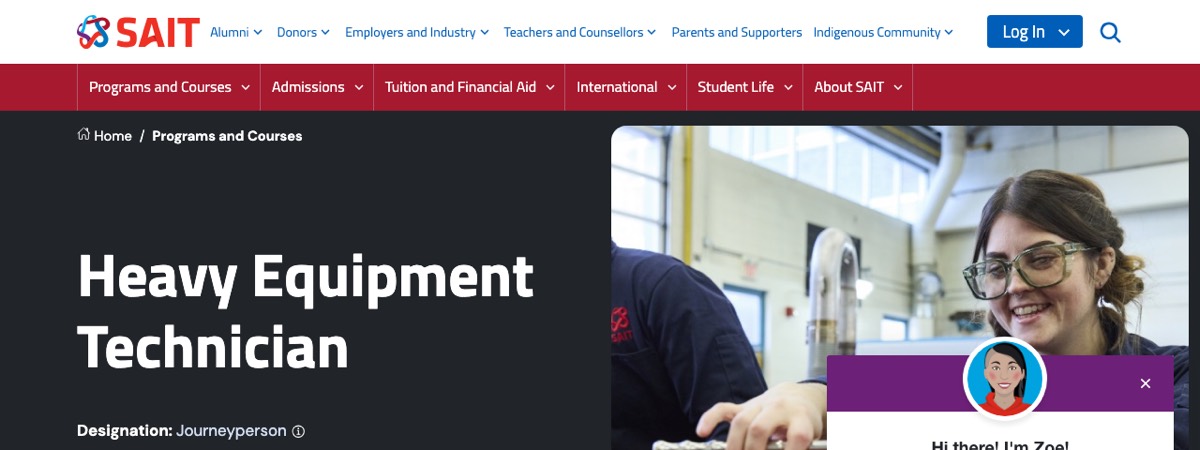
Heavy Equipment Technician is an in-person apprenticeship program from SAIT in Alberta covering 1 to 4 periods, ending in Journeyperson status with a Red Seal Endorsed certificate.
| Provider | SAIT |
|---|---|
| Length | 1 - 4 periods |
| Credential | Journeyperson; Red Seal Endorsed |
| Format | in person, AB |
Fiona's take: SAIT delivers the Alberta apprenticeship periods, so the same rules apply: 1,500 work hours and 8 weeks of classroom per period, plus the theory exam that closes each one. With 1 to 4 periods available, it serves apprentices at different stages rather than first-years only.
Skip it if: Skip it if you are in BC, where BCIT and SkilledTradesBC govern the equivalent program.
See Program DetailsPre-employment Heavy Equipment Technician
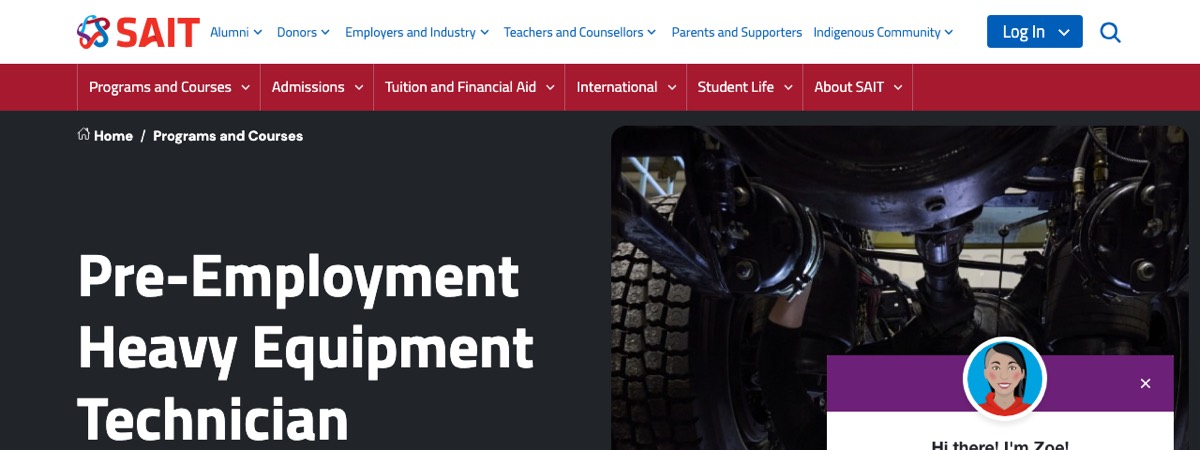
Pre-employment Heavy Equipment Technician is a 15-week in-person program from SAIT in Alberta that ends in a SAIT Pre-employment Heavy Equipment Technician certificate.
| Provider | SAIT |
|---|---|
| Length | 15 weeks |
| Credential | SAIT Pre-employment Heavy Equipment Technician certificate |
| Format | in person, AB |
Fiona's take: SAIT's 15-week pre-employment program is designed for people seeking to enter the transport and heavy equipment industry. It does not by itself make you an apprentice; you still register with Alberta Apprenticeship and Industry Training once an employer signs on.
Skip it if: Skip it if you already have an employer willing to register you, since direct entry saves you the 15 weeks.
See Program DetailsHow Much Does Heavy Duty Mechanic Training Cost In Canada?
Heavy duty mechanic training costs are hard to quote because the published sources attach no dollar amounts. The pack verifies fee categories such as registration, Alberta theory exams and renewals if applicable, but dollar amounts and tuition are not listed here, so the table reads Not listed rather than guessing.
| Item | Cost (CAD) | Notes |
|---|---|---|
| Apprenticeship registration (SkilledTradesBC or Tradesecrets) | Not listed | Charged by the provincial authority when your contract is signed |
| Theory exam per period (Alberta) | Not listed | Required to complete each of the 4 periods |
| Renewal fees | Not listed | If applicable in your province |
| Coursera sampler, 1 week at 10 hours a week | Not listed | Tests interest; no trade credential |
| Diesel Engine Fundamentals (Udemy, saVRee 3D) | $29.99 | Rated 4.5 out of 5 from 484 ratings |
| ASE prep series (Udemy, Master Prep) | Starting at $13.00 per month | Subscription pricing |
| Heavy Equipment Operator Certification (Udemy) | CA$12.99 | Operator credential, not a mechanic credential |
| BCIT apprenticeship technical training | Not listed | 840 hours of technical training across 4 levels |
| SAIT Pre-employment Heavy Equipment Technician | Not listed | 15 weeks, in person |
The pattern to understand is that an apprenticeship is not quoted as a single tuition figure in these sources. The fee items named are registration fees, the theory exam Alberta requires in each of its 4 periods, and renewal fees where applicable, and none of those amounts appears in the sources I reviewed. Your real investment is time: four years spanning 6,330 work-based hours plus 28 technical weeks in BC, or four Alberta periods of 1,500 work hours and 8 classroom weeks apiece.
College pages follow the same pattern. BCIT, Red Deer Polytechnic, Lethbridge Polytechnic, NAIT and SAIT do not list tuition or program fees in the material I reviewed, so ask each registrar for the current per-period figure before you budget. The online options are the exception, with Diesel Engine Fundamentals at $29.99, the ASE prep series starting at $13.00 per month, and the operator course at CA$12.99.
How Much Does A Heavy Duty Mechanic Earn In Canada?
A heavy duty mechanic in Canada earns a median of $37.12 an hour according to Job Bank for NOC 72401, with provincial medians running from $33.00 in Quebec to $45.00 in British Columbia.
| Region | Median Hourly Wage (Job Bank, NOC 72401) |
|---|---|
| Canada | $37.12 |
| British Columbia | $45.00 |
| Alberta | $42.00 |
| Saskatchewan | $37.00 |
| Manitoba | $35.00 |
| Ontario | $35.00 |
| Quebec | $33.00 |
The provincial spread is the real story. British Columbia at $45.00 and Alberta at $42.00 lead this data set, both well above the $37.12 national median, which sits just above Saskatchewan's $37.00. Manitoba and Ontario land at $35.00, with Quebec at $33.00. If you are choosing where to apprentice, weigh these medians against where your sponsor employers actually are.
Job Bank rates the outlook for NOC 72401 as varying by province, so read the market report for your own region before relocating. The industries named in the trade's own definition, construction, transportation, forestry, mining, oil and gas, material handling, landscaping, land clearing and farming, span the country, which spreads the hiring across sectors rather than concentrating it in one.
Is Becoming A Heavy Duty Mechanic Worth It In 2026?
Becoming a heavy duty mechanic in 2026 is worth it if you want a credentialed trade with work on equipment used across many sectors. The equipment this trade maintains underpins construction, transportation, forestry, mining, oil and gas, material handling, landscaping, land clearing and farming, so your skills apply from a city repair bay to a remote mine site.
The math is straightforward: four years of apprenticeship buys a Certificate of Qualification with Red Seal endorsement in BC or a Journeyperson Certificate in Alberta, with Red Seal endorsement where applicable after the interprovincial exam, and a median of $37.12 an hour Canada-wide, rising to $45.00 in BC and $42.00 in Alberta on Job Bank's NOC 72401 figures. Compulsory certification in Alberta gives journeypersons a protected position there, and the endorsement is recognised by provincial authorities elsewhere.
Think twice if you cannot picture yourself logging 6,330 hours of work-based training plus 28 weeks of technical training in BC or the four Alberta periods, or if you have never actually turned a wrench on large iron. That is why I recommend the one-week Coursera test-drive first: better to learn the trade is not for you in 10 hours than after signing an apprenticeship contract.
Can You Get Funding For Heavy Duty Mechanic Training?
Funding for heavy duty mechanic training does exist, and two programs in the sources are worth your attention: the Government of Canada's Red Seal Completion Bonus, with applications currently open, and Alberta's apprenticeship financial support through Tradesecrets.
- Government of Canada's Red Seal Completion Bonus. SkilledTradesBC lists this program with applications now open. If you are completing a Red Seal trade such as Heavy Duty Equipment Technician, check the program details for amounts and deadlines, since neither appears in the material I reviewed.
- Apprenticeship financial support (Alberta). Alberta Apprenticeship and Industry Training advertises financial support for apprentices on its Tradesecrets site. Amounts and eligibility rules are not listed here, so read the Tradesecrets financial support pages before budgeting your classroom periods.
Heavy Duty Mechanic Questions Canadians Ask
How Long Is The Heavy Duty Mechanic Apprenticeship In Canada?
The heavy duty mechanic apprenticeship in Canada typically runs 4 years, combining about 6,330 hours of work-based training with 28 weeks of technical training in BC. Alberta structures the same span as 4 periods of 1,500 work hours and 8 weeks of class each. Count on four years either way before you certify.
Is Heavy Duty Equipment Technician Certification Mandatory In Alberta?
Heavy duty equipment technician certification is indeed mandatory in Alberta: Tradesecrets lists it as a Compulsory Certification trade under Alberta Apprenticeship and Industry Training. In practical terms you register as an apprentice or certify as a journeyperson to work in the trade there, unlike in provinces where certification is voluntary.
What Is The NOC Code For Heavy Duty Mechanic?
The NOC code for heavy duty mechanics is 72401, titled heavy-duty equipment mechanics. Job Bank wage data, outlook reporting and job postings all use this code, and Job Bank lists hundreds of positions across Canada under it, so search 72401 directly when you hunt for apprenticeship openings.
Can I Challenge The Red Seal Exam For Heavy Duty Equipment Technician?
Challenging the Red Seal exam is possible through the Trades Qualifier route. Experienced workers with roughly 6,000 or more documented hours apply to their provincial authority, such as SkilledTradesBC, wait weeks to months for assessment, then write the certification exam without completing a full scheduled apprenticeship.
What Is The Median Wage For Heavy Duty Mechanics In Canada?
The median wage for heavy duty mechanics in Canada is $37.12 an hour, per Job Bank for NOC 72401. Provincial medians differ sharply: $45.00 in British Columbia, $42.00 in Alberta, $37.00 in Saskatchewan, $35.00 in both Manitoba and Ontario, and $33.00 in Quebec.
Is Red Seal Available For Heavy Duty Equipment Technician?
Red Seal endorsement is available for heavy duty equipment technician, designated in AB, BC, MB and most other provinces and territories. The endorsement sits on your Certificate of Qualification once you pass the interprovincial exam, and it is recognised by Red Seal and provincial authorities.
How Many Hours Of Work Experience For Apprenticeship In BC?
Work experience for the BC apprenticeship totals 6,330 hours of work-based training over 4 years, alongside 28 weeks of technical training, per SkilledTradesBC. BCIT's full-time program lists 6,360 hours of work-based training and 840 hours of technical training across its 4 levels.
Where Can I Find Heavy Duty Mechanic Apprenticeship Jobs?
Heavy duty mechanic apprenticeship jobs appear on Job Bank under NOC 72401, which lists hundreds of positions across Canada. A registered apprenticeship generally requires an employer pathway; other options here are samplers, pre-employment, diploma or challenge routes. I tell clients to apply directly to employers in construction, transportation, forestry, mining, oil and gas, material handling, landscaping, land clearing and farming, the industries this trade serves.
What's The Bottom Line On Heavy Duty Mechanic Careers In Canada?
- The bottom line on a heavy duty mechanic career: a registered apprenticeship of about 4 years, 6,330 work-based hours plus 28 technical weeks in BC ending in a Certificate of Qualification with Red Seal endorsement, or four 1,500-hour periods in Alberta ending in a Journeyperson Certificate.
- Certification is compulsory in Alberta through Alberta Apprenticeship and Industry Training and compulsory in Quebec only in construction; it is voluntary in BC and the other provinces and territories.
- Job Bank's median for NOC 72401 is $37.12 an hour, from $33.00 in Quebec to $45.00 in British Columbia.
- Test the field first: Construction Equipment Maintenance & Safety takes 1 week at 10 hours a week and grants no provincial trade credential.
- My verdict: commit if four years of combined work and classroom training fits your life, and check the Red Seal Completion Bonus and Alberta apprenticeship financial support pages for eligibility, amounts and timing.