
Key Takeaways
- The fastest realistic route is a registered apprenticeship with a sponsoring employer: about 4 years and 8,000 hours in Ontario (7,680 on the job, 320 in school), with a $169.50 certifying exam fee at the end.
- A trade certificate is not required in Ontario, where Skilled Trades Ontario lists Powerline Technician (434A) as voluntary; Powerline Technician is a compulsory Skilled Trades Certification trade in British Columbia, and Alberta waives certification if you are self-employed or your employer is satisfied with your skills.
- A Practitioner's Approach to Power Distribution & Automation on Coursera is a 4 week specialization at 10 hours a week, rated 4.6 across 254 reviews; it tests your interest in power work but does not qualify you for certification in any province.
- Job Bank puts the median wage for NOC 72203 at $46.00 an hour, inside a range of $28.40 to $62.00, with a high provincial median of $55.00 in Alberta.
- Fiona's verdict: worth it for applicants who can land a sponsor and want on-the-job training toward a Red Seal trade designated in 12 provinces and territories since 1976; start with the 4 week Coursera test before committing.
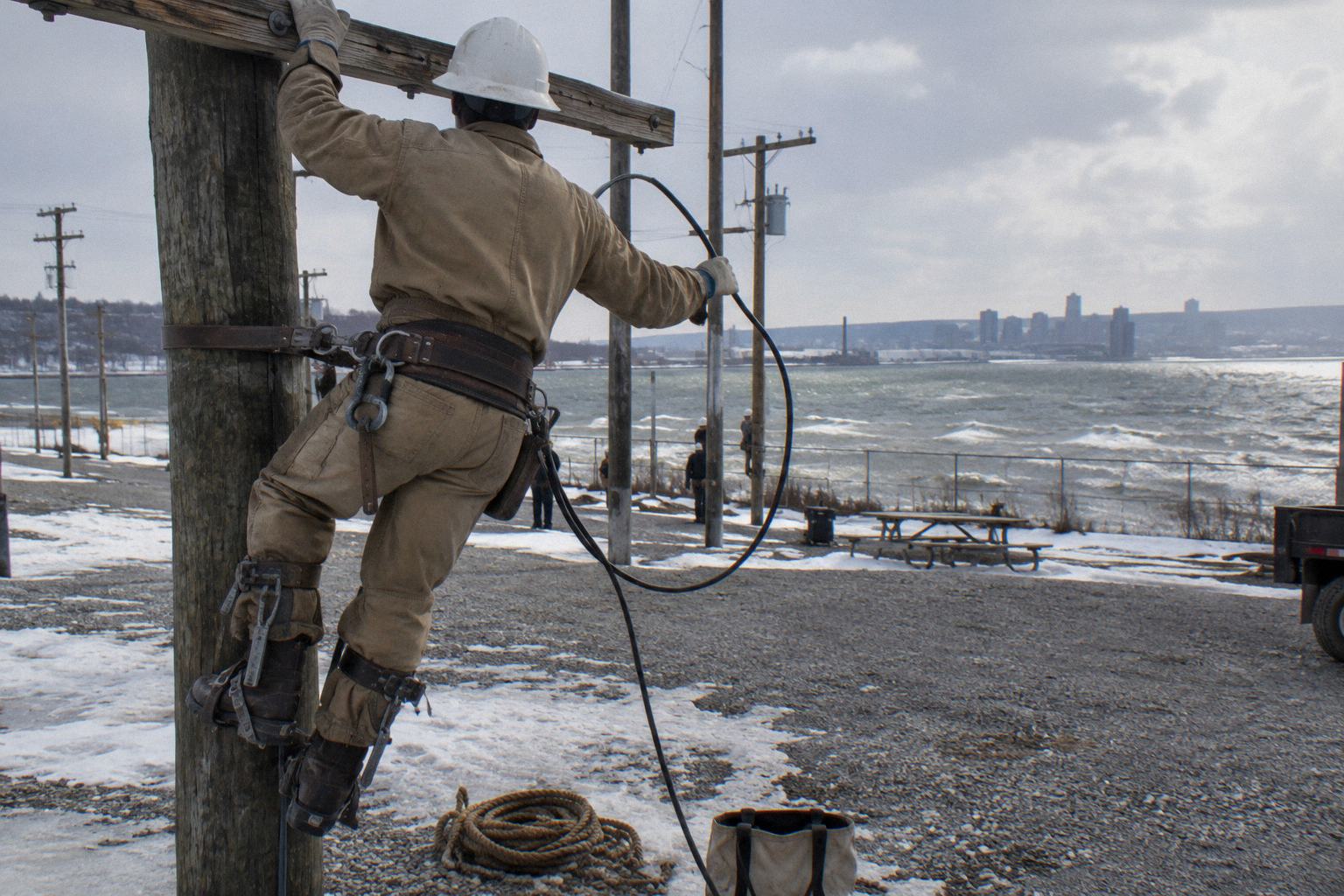
A Powerline Technician constructs, maintains and repairs overhead and underground electrical power transmission and distribution systems and communication networks. The standard way in is a registered apprenticeship: about 4 years and 8,000 hours in Ontario, with most of those hours logged on the job with a sponsoring employer.
Before anyone signs a training agreement, I tell clients to test the field with a short online course. My Coursera pick takes 4 weeks at 10 hours a week, and this page sets it against the apprenticeship, diploma and certification routes, with the wages and fees that matter for 2026.
What Are The Ways To Become A Powerline Technician In Canada?
Powerline technician entry in Canada comes down to apprenticeship, but the doorway differs by province: a sponsor first in Ontario, compulsory registration in British Columbia, and college programs for applicants who need a stronger file first. The table compares the main routes.
| Route | Time | Cost (CAD) | What You Get | Recognised By | Best For |
|---|---|---|---|---|---|
| A Practitioner's Approach to Power Distribution & Automation on Coursera | 4 weeks at 10 hours a week | Not listed | Shareable certificate in power distribution and automation | No provincial trade body | Testing the field before a 4 year commitment |
| Apprenticeship (Ontario) | 4 years / 8,000 hours | Not listed; exam $150 plus HST ($169.50) | Certificate of Apprenticeship plus Certificate of Qualification, Red Seal eligible | Skilled Trades Ontario | Ontario applicants who land a sponsor |
| Apprenticeship (British Columbia) | 4 years / 6,720 hours work-based plus 16 weeks technical | Not listed | Red Seal / Skilled Trades Certification | SkilledTradesBC | Working in BC, where the trade is compulsory |
| Apprenticeship (Alberta) | 4 periods, about 4 years (periods 1 to 3: 1,525 work hours each, 7 weeks classroom each) | Not listed | Journeyperson Certificate, Red Seal optional | Tradesecrets Alberta | Alberta's $55.00 median wage market |
| College diploma (Conestoga) | 2 years | Not listed | Ontario College Diploma, optional co-op | Ontario colleges | Applicants who want a diploma before approaching sponsors |
| NBCC Powerline Technician Program | 14 weeks classroom plus 23 weeks practicum | $18,000 | Practicum based New Brunswick training, credential not listed | NBCC | New Brunswick applicants; gear included in the fee |
I recommend the Ontario or BC apprenticeship for anyone who can land a sponsor, the Conestoga or NBCC programs for those who cannot yet, and the Coursera specialization for everyone as a first taste.
What Is The Fastest Way To Become A Powerline Technician In Canada?
The fastest way in is to find a sponsoring employer and register your apprenticeship agreement the same season, because your hour clock only starts once the agreement is signed. In Ontario the sequence looks like this.
- Finish high school with English, Math and Science, the entry baseline listed for trade 434A.
- Take A Practitioner's Approach to Power Distribution & Automation first: 4 weeks at 10 hours a week to confirm the electrical theory suits you before you commit four years.
- Find a sponsor or employer and register a training agreement with Skilled Trades Ontario; expect the search to take weeks to months.
- Work and study through 4 levels: 7,680 on-the-job hours plus 320 in-school hours, about 4 years in total.
- Pay the $150 exam fee plus HST ($169.50) and pass the certifying exam for your Certificate of Qualification.
- Add the Red Seal once you qualify: Powerline Technician has held Red Seal designation in 12 provinces and territories, including Ontario and BC, since 1976.
Do You Need Certification To Work As A Powerline Technician In Canada?
Certification is compulsory in British Columbia, voluntary in Ontario, and conditional in Alberta, so the answer depends on your postal code rather than the trade itself. Here is what each regulator says.
| Province | Required? | Regulator Or Registry | What It Means |
|---|---|---|---|
| Ontario | No, voluntary | Skilled Trades Ontario | Trade 434A: you can legally work in it without certification |
| British Columbia | Yes, compulsory | SkilledTradesBC | Powerline Technician is a compulsory Skilled Trades Certification trade in BC |
| Alberta | Conditional | Alberta Apprenticeship and Industry Training | No certification needed if you are self-employed or your employer is satisfied you have journeyperson skills and knowledge |
The Red Seal sits above all three provincial systems. Powerline Technician is a Red Seal trade in 12 provinces and territories, including Ontario and British Columbia, since 1976. Each provincial route ends in a Red Seal option: Ontario's Certificate of Qualification is Red Seal eligible, BC's pathway lists Red Seal, and Alberta's Journeyperson Certificate carries it as optional.
One thing I make clear to every client: these online certificates are not provincial licences, registrations or trade certificates. Coursera and Udemy certificates are evidence of study. They still have value as a taste test and as interview vocabulary, but know exactly what you are buying.
Which Powerline Technician Courses Are Worth Taking?
Courses for this trade split three ways: short online theory programs, lineworker primers, and college programs that feed apprenticeship intakes. Every online certificate below is study evidence only, so treat them as preparation and proof of interest rather than credentials.
A Practitioner's Approach to Power Distribution & Automation
A Practitioner's Approach to Power Distribution & Automation is a 4 week online specialization from L&T EduTech, at 10 hours a week, covering power distribution and automation with a shareable certificate.
| Provider | L&T EduTech |
|---|---|
| Length | 4 weeks at 10 hours a week |
| Rating | 4.6 (from 254 reviews across courses) |
| Credential | Shareable certificate |
| Format | online |
Fiona's take: This is my Coursera pick because it is short, rated 4.6 from 254 reviews across its courses, and it maps to the distribution side of the work you would actually do. Use it to decide whether feeder protection and automation hold your interest before you chase a sponsor. It does not qualify you for certification or registration anywhere.
Skip it if: Skip it if you already hold an electrical qualification and want field skills rather than theory.
Not a provincial licence, registration or certificate.
Start On CourseraTransmission Line Engineering: Civil, Mechanical and Cables
Transmission Line Engineering: Civil, Mechanical and Cables is a 3 month online specialization from L&T EduTech, at 10 hours a week, covering route survey, right-of-way management and crossing methodologies for HV transmission projects.
| Provider | L&T EduTech |
|---|---|
| Length | 3 months at 10 hours a week |
| Credential | Shareable certificate |
| Format | online |
Fiona's take: This one leans engineering: route survey, right of way management and crossing methodologies for HV transmission projects. It suits a pre-apprentice who wants to understand how transmission lines are planned, and it pairs well with the distribution pick above for the full picture. Treat it as vocabulary and interview preparation, not a credential.
Skip it if: Skip it if three months of theory before any field contact would drain your motivation.
Not a provincial licence, registration or certificate.
Start On CourseraElectric Power Systems
Electric Power Systems is a 4 module online course, about 12 hours total, from the University at Buffalo, The State University of New York, introducing utility-industry standards, policies and vocabulary.
| Provider | University at Buffalo, The State University of New York |
|---|---|
| Length | 4 modules (approx. 12 hours total) |
| Credential | Shareable certificate |
| Format | online |
Fiona's take: It is a short 12 hour online course from the University at Buffalo that introduces utility-industry standards, policies and vocabulary. I suggest it as an evenings-and-weekend project in the month before you start applying to employers.
Skip it if: Skip it if you already understand how generation, transmission and distribution connect.
Not a provincial licence, registration or certificate.
Start On CourseraPower System: Generation, Transmission and Protection
Power System: Generation, Transmission and Protection is a 4 week online specialization from L&T EduTech, at 10 hours a week, rated 4.6 from 162 reviews, covering how power is generated, moved and protected.
| Provider | L&T EduTech |
|---|---|
| Length | 4 weeks at 10 hours a week |
| Rating | 4.6 (162 reviews) |
| Credential | Shareable certificate |
| Format | online |
Fiona's take: Protection is the piece apprentices meet constantly on the job, and this is the L&T option that addresses it head on. If you take only one longer specialization, choose between this and the distribution pick based on whether your target employers lean transmission or distribution.
Skip it if: Skip it if the distribution specialization already covered your interest; expect some overlap.
Not a provincial licence, registration or certificate.
Start On CourseraPower Utility Lineworker Level 0
Power Utility Lineworker Level 0 is an on-demand online course from Mike L introducing utility linework basics, ending with a certificate of completion.
| Provider | Mike L |
|---|---|
| Rating | 2.4 (2 ratings) |
| Credential | Certificate of completion |
| Format | online |
Fiona's take: The rating, 2.4 from 2 ratings, is too thin for me to point clients here, and no length is listed, so you cannot even plan it against a sponsor application date. The Coursera options cover similar ground with far more review history behind them.
Skip it if: Skip it; two ratings are not enough of a base to trust with your money.
Not a provincial licence, registration or certificate.
View On UdemyPower Utility Lineworker Level 1
Power Utility Lineworker Level 1 is an on-demand online course from Mike L building on Level 0 toward early lineworker skills, with a certificate of completion.
| Provider | Mike L |
|---|---|
| Rating | 3.0 (3 ratings) |
| Credential | Certificate of completion |
| Format | online |
Fiona's take: At 3.0 from 3 ratings it edges its sibling, but the review base is still almost nonexistent and no length is listed. The credential is a certificate of completion, not a provincial licence, registration or trade certificate. I would put the same evenings into a Coursera specialization with a rating record you can actually inspect.
Skip it if: Skip it for the same reason as Level 0: too little review history.
Not a provincial licence, registration or certificate.
View On UdemyLineworker Knowledge: Foundations & Apprenticeship Readiness
Lineworker Knowledge: Foundations & Apprenticeship Readiness is an 8.5 hour on-demand video course from Feras Alzubi aimed at people preparing to enter a lineworker apprenticeship.
| Provider | Feras Alzubi |
|---|---|
| Length | 8.5 hours on-demand video |
| Credential | Certificate of completion |
| Format | online |
Fiona's take: The apprenticeship readiness angle is the right idea: vocabulary, tools and safety culture before day one on a crew. With 8.5 hours of video and no rating shown, I treat it as optional priming rather than preparation. Pair it with the Coursera distribution specialization if you want theory plus trade vocabulary.
Skip it if: Skip it if 8.5 hours of unreviewed video would sit unwatched in your queue.
Not a provincial licence, registration or certificate.
View On UdemyPre-Powerline Technician Certificate
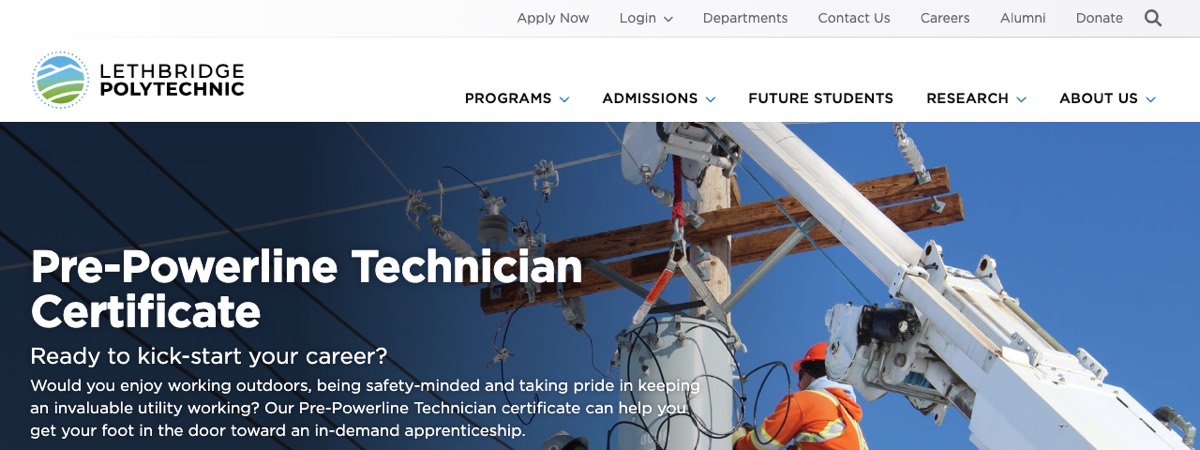
The Pre-Powerline Technician Certificate is a 15 week in person program from Lethbridge Polytechnic in Alberta designed for people who aren't yet employed in the trades.
| Provider | Lethbridge Polytechnic |
|---|---|
| Length | 15 weeks |
| Credential | Certificate |
| Format | in person, AB |
Fiona's take: Fifteen weeks in Alberta, where the median wage sits at $55.00 an hour, is a short commitment next to a 4 period apprenticeship. The program is designed for people who aren't yet employed in the trades, which is exactly the situation most of my Alberta bound clients are in. Tuition is not listed in our data, so ask Lethbridge directly for the current fee schedule.
Skip it if: Skip it if you already have a sponsor and are employed in the trade.
See Program DetailsPowerline Technician Apprenticeship
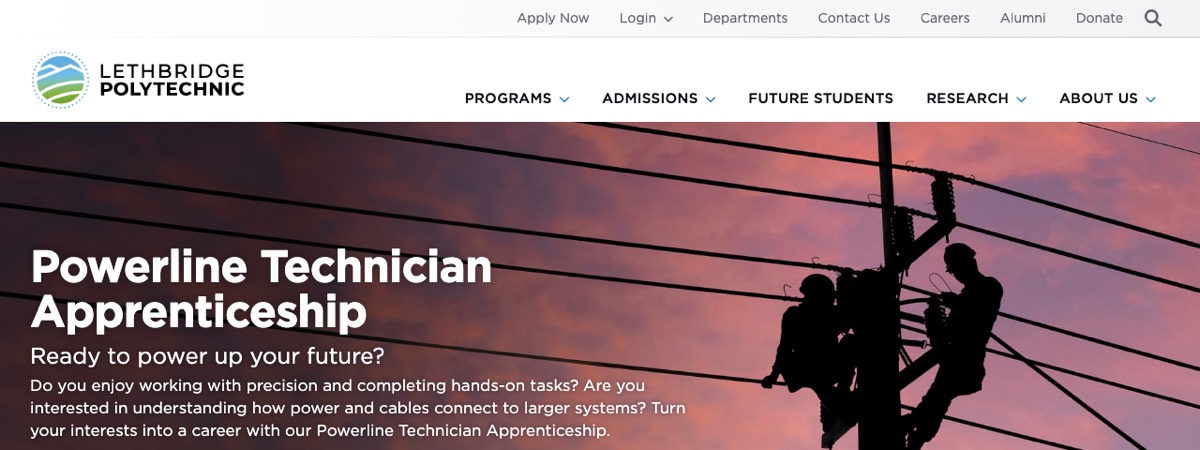
The Powerline Technician Apprenticeship at Lethbridge Polytechnic is a hybrid Alberta program with 630 instructional hours over a 3 year apprenticeship, leading to certified Journeyman papers.
| Provider | Lethbridge Polytechnic |
|---|---|
| Length | 3 year apprenticeship (630 instructional hours) |
| Credential | Certified 'Journeyman' Papers |
| Format | hybrid, AB |
Fiona's take: This is the registered Alberta route: 630 instructional hours through the polytechnic across a 3 year apprenticeship, field work with your employer, and certified Journeyman papers at the end. Note that Alberta's official profile lists 4 periods of about 4 years while Lethbridge publishes 3 years and 630 instructional hours, so ask how the two structures align before you sign anything.
Skip it if: Skip it if you are outside Alberta; start with your own province's regulator instead.
See Program DetailsPowerline Technician (Optional Co-op)
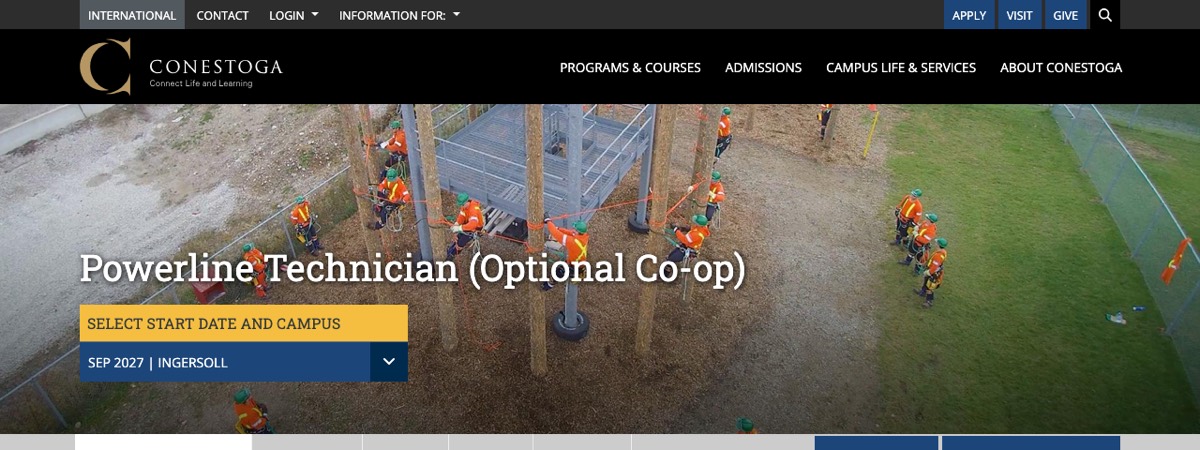
Powerline Technician (Optional Co-op) is a 2 year in person diploma at Conestoga College in Ontario that awards an Ontario College Diploma with an optional co-op.
| Provider | Conestoga College |
|---|---|
| Length | 2 years |
| Credential | Ontario College Diploma |
| Format | in person, ON |
Fiona's take: Two years at Conestoga leads to an Ontario College Diploma, with the co-op available as an option in the program. I see it as one way to prepare before you approach sponsors; the apprenticeship route is the other door, and this diploma is the longer, more structured one. Tuition is not listed in our data, so request it from the college.
Skip it if: Skip it if you already hold a signed training agreement with a sponsor; the apprenticeship takes you straight into on-the-job training.
See Program DetailsPowerline Technician
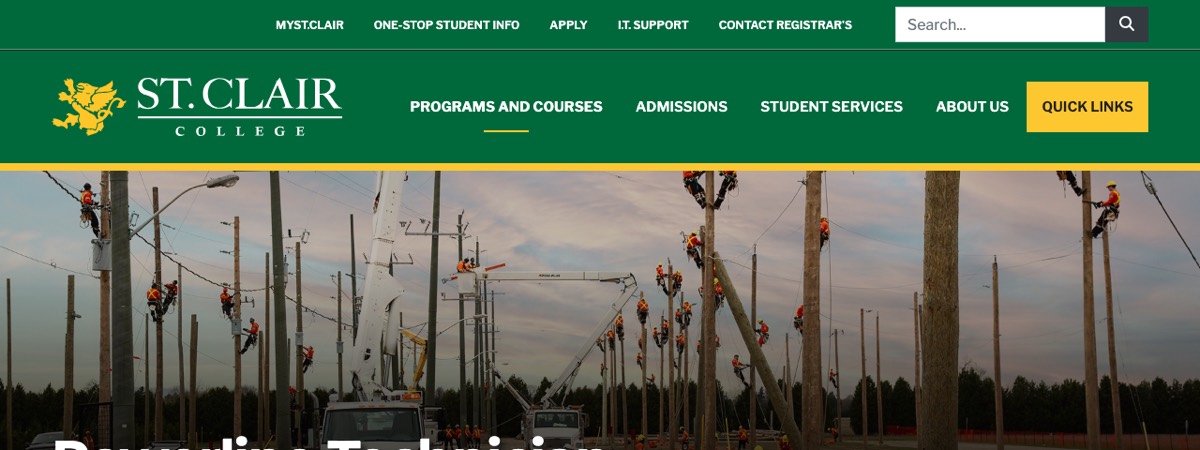
Powerline Technician at St. Clair College is a two year in person program in Ontario leading to an Ontario College Diploma.
| Provider | St. Clair College |
|---|---|
| Length | Two Year |
| Credential | Ontario College Diploma |
| Format | in person, ON |
Fiona's take: Same credential class as Conestoga, different campus and region, which matters when utility hiring runs regional. The real differentiators will be co-op placement and which employers recruit on campus, so ask those two questions before comparing anything else.
Skip it if: Skip it if you cannot relocate for a campus program; Ontario gives you several diploma choices.
See Program DetailsPowerline Technician
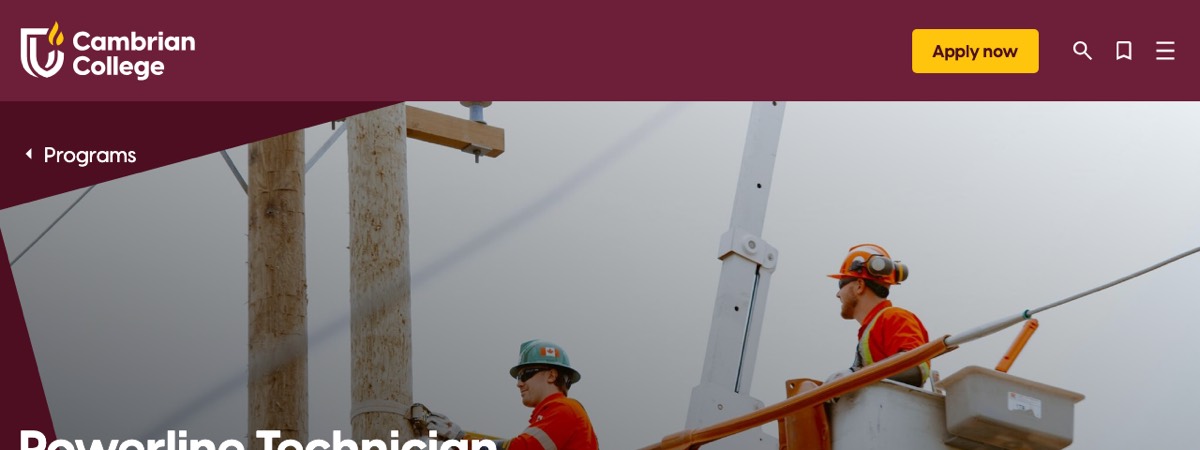
Powerline Technician at Cambrian College is a 4 semester, 2 year in person program in Ontario leading to an Ontario College Diploma.
| Provider | Cambrian College |
|---|---|
| Length | 4 Semesters / 2 Years |
| Credential | Ontario College Diploma |
| Format | in person, ON |
Fiona's take: Cambrian adds a 4 semester, 2 year Ontario College Diploma option to this list. Applying to more than one diploma program is a sensible hedge, though admission is up to each college. Our data lists no tuition or admission details, so ask Cambrian directly for both.
Skip it if: Skip it if Conestoga's optional co-op matters to you and is within reach; only Conestoga lists a co-op option among these.
See Program DetailsPowerline Technician
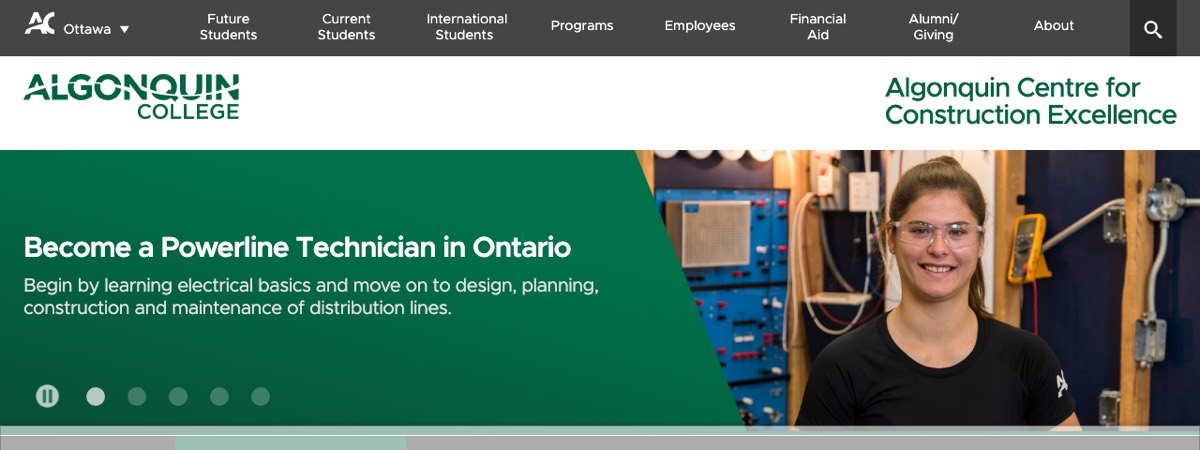
Powerline Technician at Algonquin College is a 2 year in person program in Ontario that awards an Ontario College Diploma.
| Provider | Algonquin College |
|---|---|
| Length | 2 Years |
| Credential | Ontario College Diploma |
| Format | in person, ON |
Fiona's take: Algonquin rounds out the Ontario diploma field with a 2 year program. Where the list helps is choice: four Ontario diploma options mean more calendars and locations to weigh. Compare them on fees and details you confirm with each college, since our data lists no tuition for any of them.
Skip it if: Skip it if another campus on this list is closer to you or fits your start date better.
See Program DetailsPowerline Technician Program
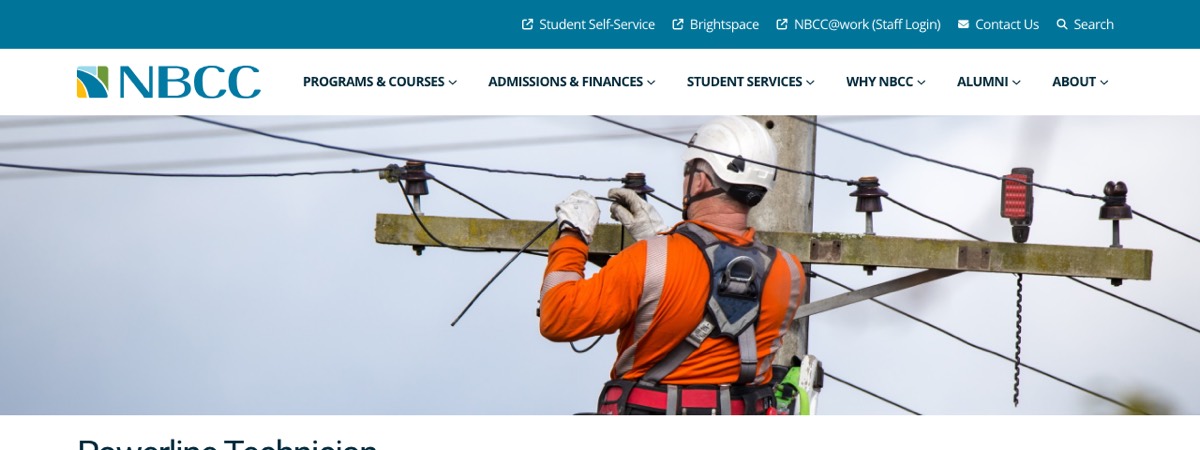
NBCC's Powerline Technician Program is a hybrid New Brunswick program of 14 weeks in class plus a 23 week practicum, costing $18,000 including tuition, books, safety gear and the confirmation fee.
| Provider | NBCC |
|---|---|
| Length | 14 weeks (classroom) 23 weeks (practicum) |
| Cost (CAD) | $18,000 (includes tuition, books, safety gear, confirmation fee) |
| Format | hybrid, NB |
Fiona's take: This is the one program in our data with a full price attached, and $18,000 covering tuition, books, safety gear and the confirmation fee makes budgeting honest. The structure is 14 weeks in class plus a 23 week practicum, a combination of classroom and on-the-job training. New Brunswick's median wage sits at $47.26 under NOC 72203.
Skip it if: Skip it if you cannot fund $18,000 up front and no sponsoring employer is within reach.
See Program DetailsPowerline Technician
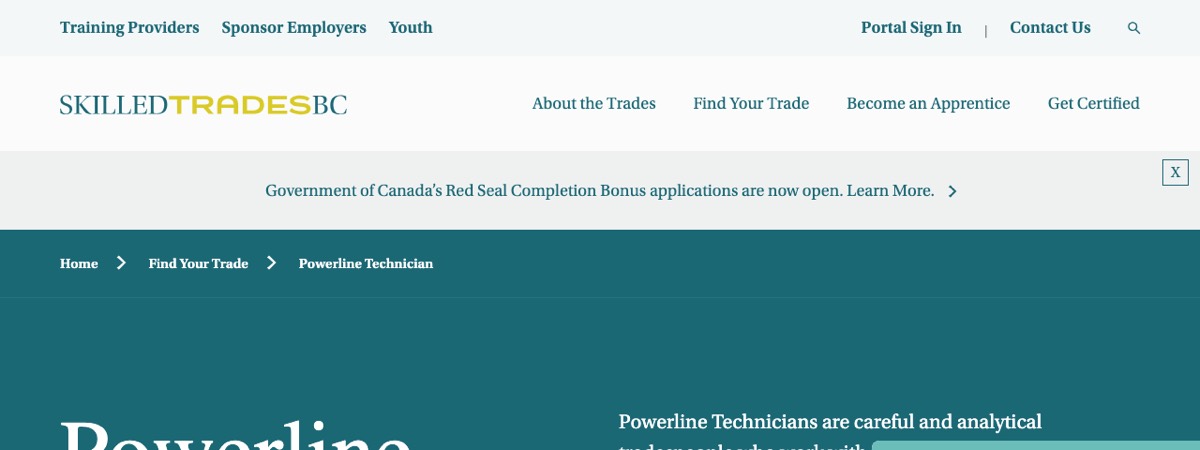
Powerline Technician with SkilledTradesBC is the official BC registration pathway, with 16 weeks of technical training spread over 4 years, leading to Red Seal endorsement in a compulsory trade.
| Provider | SkilledTradesBC |
|---|---|
| Length | Technical Training 16 weeks over 4 years |
| Credential | Red Seal |
| Format | in person, BC |
Fiona's take: If you will work in BC, this is the regulator page to read: Powerline Technician is a compulsory Skilled Trades Certification trade there, and the page carries the trade's structure of 6,720 work-based training hours plus 16 weeks of technical training over 4 years. The Government of Canada's Red Seal Completion Bonus listing appears on the same page.
Skip it if: Skip this page only if you will never work in British Columbia; otherwise bookmark it.
See Program DetailsHow Much Does It Cost To Become A Powerline Technician In Canada?
Costs for this trade split into small regulator fees and one big program price: $169.50 for Ontario's certifying exam, $235 plus HST for an equivalency assessment, and $18,000 for NBCC in New Brunswick. Most apprenticeship tuition figures are not listed in our data.
| Item | Cost (CAD) | Notes |
|---|---|---|
| Ontario certifying exam | $150 plus HST ($169.50) | Skilled Trades Ontario, trade 434A |
| Trade Equivalency Assessment | $235 plus HST | Skilled Trades Ontario, for experienced workers |
| NBCC Powerline Technician Program | $18,000 | Includes tuition, books, safety gear, confirmation fee |
| Apprenticeship tuition (ON, BC, AB) | Not listed | Ask the regulator and the training provider |
| College and program tuition (Conestoga, St. Clair, Cambrian, Algonquin, Lethbridge) | Not listed | Request fee schedules directly |
$18,000 at NBCC covers 14 weeks in class, a 23 week practicum and your safety gear, which is why it looks large next to a $169.50 exam fee. The two prices buy different things: one buys training access, the other buys the right to sit the exam that ends an Ontario apprenticeship. Budget for whichever path you take, plus travel to your in-school blocks.
The five college programs on this page, Conestoga, St. Clair, Cambrian, Algonquin and Lethbridge, do not publish tuition in our data, so request fee schedules before comparing them with the $18,000 NBCC figure, the only full price our data holds. Ask each program what safety gear is included versus billed separately, because that line adds up fast in this trade.
How Much Does A Powerline Technician Earn In Canada?
Powerline technicians earn a median of $46.00 an hour in Canada under NOC 72203 (Electrical power line and cable workers), Job Bank's wage report for the occupation, with provincial medians running from $42.00 in Prince Edward Island to $55.00 in Alberta.
| Region | Median Hourly Wage |
|---|---|
| Canada | $46.00 |
| Ontario | $45.00 |
| British Columbia | $50.00 |
| Alberta | $55.00 |
| Saskatchewan | $47.85 |
| Manitoba | $47.00 |
| Quebec | $42.49 |
| New Brunswick | $47.26 |
| Nova Scotia | $51.35 |
| Prince Edward Island | $42.00 |
| Newfoundland and Labrador | $44.00 |
The Canada range under NOC 72203 runs from $28.40 at the low end to $62.00 at the high end, and Ontario's own spread runs $29.70 to $62.00. Where you land inside that range depends on your province and your employer. Alberta's $55.00 median tops the provincial list, with Nova Scotia at $51.35 and British Columbia at $50.00 close behind.
Read these numbers as planning data, not promises. The Job Bank Canada range is $28.40 to $62.00, and actual apprentice and journeyperson rates depend on employer and province. When you compare openings, ask what the pay is at each stage of training and after certification, because the median does not show that split.
Is A Powerline Technician Apprenticeship Worth It In 2026?
A powerline technician apprenticeship is worth it in 2026 if you want structured training toward a formal credential. The case is straightforward: you complete 8,000 hours of on-the-job and in-school training in Ontario, the Canada median sits at $46.00 an hour under NOC 72203, and Powerline Technician has been a Red Seal trade in 12 provinces and territories, including Ontario and BC, since 1976. The apprenticeship model pairs employment with a formal trade credential at the end.
It is not worth it if you cannot secure a sponsor, because the entire model depends on an employer signing your training agreement, and that search takes weeks to months even for strong candidates. It is also the wrong fit if your interest is the engineering side of the grid: the L&T EduTech specializations on Coursera cover engineering topics such as transmission line route survey and power system protection rather than field work.
Can You Get Funding For Powerline Technician Training In Canada?
Funding support for this trade in our data is a single open federal program, with no dollar figure or eligibility rules listed. Here is what exists right now.
- Red Seal Completion Bonus. The Government of Canada's Red Seal Completion Bonus applications are open, and SkilledTradesBC lists the program on its Powerline Technician page. Our data carries no dollar figure or eligibility rules for it, so read the program page carefully before counting the money.
Powerline Technician Questions Canadians Ask
How Long Is The Powerline Technician Apprenticeship In Ontario?
The Ontario apprenticeship runs 8,000 hours, about 4 years: 7,680 hours on the job and 320 hours in school across 4 levels. Skilled Trades Ontario sets those totals for trade 434A. Plan around four years of field work with short school blocks, not one full time study year.
Is Powerline Technician A Red Seal Trade?
Powerline Technician holds Red Seal designation in 12 provinces and territories, including Ontario and British Columbia, since 1976. Ontario's Certificate of Qualification for trade 434A is Red Seal eligible, BC's pathway lists Red Seal, and Alberta's Journeyperson Certificate carries it as optional. If a move between provinces is in your plans, ask the destination regulator how your credential is treated.
Is Certification Mandatory To Work As A Powerline Technician In Ontario?
Certification is not mandatory in Ontario. Skilled Trades Ontario lists Powerline Technician (434A) as a voluntary trade, so you can legally work in it without a certificate of qualification. I still tell clients to certify: it provides formal proof of competency, and the Ontario Certificate of Qualification is Red Seal eligible.
What Is The Median Hourly Wage For Powerline Technicians In Canada?
The median hourly wage is $46.00 per hour for NOC 72203 (Electrical power line and cable workers), the code Job Bank uses for wage reporting on this occupation. The Canada range runs $28.40 to $62.00, and provincial medians stretch from $42.00 in Prince Edward Island to $55.00 in Alberta. Use the code itself when you compare postings across provinces.
How Do I Start A Powerline Technician Apprenticeship In Ontario?
Starting in Ontario means finding a sponsor or employer first, then registering a training agreement with Skilled Trades Ontario, then completing the on-the-job and in-school training. The sponsor search itself takes weeks to months. Skilled Trades Ontario sets the training at 8,000 hours total: 7,680 on the job and 320 in school across 4 levels.
Is Powerline Technician Compulsory In British Columbia?
Powerline Technician is compulsory in British Columbia. SkilledTradesBC classifies it as a compulsory Skilled Trades Certification trade in BC. Ontario treats the same trade as voluntary under Skilled Trades Ontario, and Alberta Apprenticeship and Industry Training waives certification if you are self-employed or your employer is satisfied with your skills and knowledge.
What NOC Code Is Used For Powerline Technician Wages?
NOC 72203, Electrical power line and cable workers, is the code Job Bank uses for wage reporting on this occupation. The Canada median under this code is $46.00 an hour, inside a range of $28.40 to $62.00, and provincial medians run from $42.00 in Prince Edward Island to $55.00 in Alberta. Use NOC 72203, Electrical power line and cable workers, when comparing Job Bank wage data.
Can Experienced Workers Challenge The Certification Exam?
Experienced workers can challenge the certification exam. Ontario's route is the Trade Equivalency Assessment through Skilled Trades Ontario at $235 plus HST, and SkilledTradesBC describes a Trade Qualifier path in BC. With years of line work from another jurisdiction, start with an assessment, not a fresh 4 year apprenticeship.
What's The Bottom Line On Powerline Technician Apprenticeships?
- A registered apprenticeship is the realistic route: about 4 years and 8,000 hours in Ontario, 7,680 on the job and 320 in school, with a $169.50 exam fee at the end.
- Certification is compulsory in British Columbia through SkilledTradesBC, voluntary in Ontario under trade 434A, and conditional in Alberta under Alberta Apprenticeship and Industry Training.
- Job Bank's NOC 72203 median is $46.00 an hour Canada wide, inside a range of $28.40 to $62.00, with Alberta's median at $55.00.
- Start with A Practitioner's Approach to Power Distribution & Automation on Coursera: 4 weeks at 10 hours a week to test the trade, with no certification attached.
- Worth it in 2026 if you can land a sponsor and want on-the-job training in a Red Seal trade designated in 12 provinces and territories since 1976.