Key Takeaways
- The fastest realistic route to working with young children in Canada is one approved BC ECEA course, about 2 to 4 weeks of study at roughly $750, followed by an application to the BC ECE Registry.
- A certificate is mandatory for assistants in licensed child care in British Columbia (BC ECE Registry) and Alberta (Child Care Staff Certification Office, within 6 months of hire); Ontario requires registration only of ECEs with the College of Early Childhood Educators, and Quebec does not regulate assistants.
- The Coursera try-first option is Home-Based Child Care, a 4-week, 3-course specialization from The State University of New York that lets you test the field; it does not qualify you for ECE Registry certification in BC or Level 1 certification in Alberta.
- Pay under NOC 42202 is $22.30 per hour at the national median, with British Columbia and Quebec at $24.00, Ontario at $22.00, Alberta at $19.00 and Manitoba at $18.00, per Job Bank.
- Fiona's verdict: this path suits patient, practical career changers who want paid work in months rather than years, provided they complete a registry-recognised course rather than a general interest one.
An Early Childhood Assistant (ECA, also called an ECE Assistant or ECEA) supports early childhood educators with care, activities and supervision of young children in licensed child care settings. The shortest realistic route in Canada is a single approved course, roughly 2 to 4 weeks at about $750, that makes you eligible for the BC ECE Registry's ECE Assistant certificate.
Before committing that money, I recommend testing the field with a Coursera course first. Prices are not listed in the pack, so check the course page before enrolling, and note that the registry routes in BC and Alberta are the ones employers actually recognise. This page compares all of them, plus college certificates, wages under NOC 42202 and BC funding.
What Are The Ways To Become An Education Or Early Childhood Assistant In Canada?
The routes split into general-interest online courses, short registry-recognised certification courses, and longer college certificates.
| Route | Time | Cost (CAD) | What You Get | Recognised By | Best For |
|---|---|---|---|---|---|
| Coursera: Home-Based Child Care | 4 weeks at 10 hours/week | Varies | Specialization Certificate | Not a regulator; does not lead to certification | Testing the field first |
| BC ECEA Certificate (one approved course) | 2-5 weeks | $750 | ECEA Certificate | BC ECE Registry | Fastest certified route in BC |
| Alberta Level 1 ECE | Varies (course or orientation) | Not listed | Level 1 Early Childhood Educator | Alberta Child Care Staff Certification Office | Working in licensed daycare in Alberta |
| Canadian College of Educators ECA Certificate & Diploma | 100-hour Certificate or 300-hour Diploma | $450 per session; $1,800 for both | Certificate or Diploma | Not listed | Online ECA study at your own pace |
| College Education Assistant certificates (e.g., Okanagan College) | 447-hour program; others 1 year | $4,607 at Okanagan College (2025-26) | Certificate | Colleges in BC and Alberta | School-based assistant roles |
I recommend the Coursera route for anyone still deciding, and the $750 BC ECEA course for anyone in British Columbia who is ready to work.
What Is The Fastest Way To Become An ECEA In Canada?
The fastest certified route runs through British Columbia's ECE Registry.
- Complete one ECE Registry-recognised course in child guidance, child health, safety and nutrition, or child development, completed within the last 5 years. Coastal College of BC lists this at about $750 over 2 to 4 weeks.
- Apply to the BC ECE Registry with your transcript, a reference and a criminal record check.
- Registry processing varies from weeks to months, so apply as soon as your course ends.
- Once certified, you can work as an ECE Assistant in any licensed child care facility in BC.
- In Alberta, the parallel route is Level 1 Early Childhood Educator certification through the Child Care Staff Certification Office; staff must be certified within 6 months of being hired.
Is Certification Mandatory For Early Childhood Assistants In Canada?
Certification is mandatory for assistants in licensed child care in British Columbia and Alberta, but not everywhere in Canada.
| Province | Required? | Regulator Or Registry | What It Means |
|---|---|---|---|
| British Columbia | Yes | BC ECE Registry | You must be certified by the ECE Registry to work as an ECE or ECE Assistant in a licensed facility. |
| Alberta | Yes | Alberta Child Care Staff Certification Office | Staff in licensed childcare programs must be provincially certified within 6 months of being hired. |
| Ontario | No, for assistants | College of Early Childhood Educators (ECEs only) | Only ECEs must register with the College; assistants are not registered. |
| Quebec | No | None | Early childhood educators and assistants are not regulated in Quebec. |
Per the CICIC, early childhood educators and assistants are regulated everywhere in Canada except New Brunswick, Northwest Territories, Nunavut and Quebec. So in most of the country the assistant role sits under a provincial regulator, and the exact certificate you need depends on your province.
A criminal record check is typically required for certification and employment, so budget time for that step alongside your course.
Which Online ECA And Education Assistant Courses Are Worth Taking?
The options run from a 3-hour Coursera introduction to 16-month college certificates. Here is where each one fits.
Home-Based Child Care
Home-Based Child Care is a 3-course, 4-week specialization at 10 hours per week from The State University of New York on Coursera.
| Provider | The State University of New York |
|---|---|
| Length | 3 courses, 4 weeks at 10 hours/week |
| Rating | 4.8 (106 reviews) |
| Credential | Specialization Certificate |
| Format | online |
Fiona's take: This is my first recommendation for anyone who has never worked with children and wants a structured preview of the field before spending $750 or more on certification. It is built around providing learners with the tools to develop and operate a home-based childcare centre, so you get practical, operational content rather than abstract theory. It does not qualify you for the BC ECE Registry's ECEA certificate or Alberta's Level 1 certification, so plan a registry-recognised course afterwards if you want licensed work.
Skip it if: Skip it if you already know you want to work in a licensed facility in BC or Alberta, since you will need a registry-recognised course regardless.
Start On CourseraIntroduction to Early Childhood
Introduction to Early Childhood is a 10-hour course from The State University of New York on Coursera.
| Provider | The State University of New York |
|---|---|
| Length | 10 hours |
| Rating | 4.9 (146 reviews) |
| Credential | Course Certificate |
| Format | online |
Fiona's take: At 10 hours total, this is the one-evening-per-week version of the test drive, rated 4.9 from 146 reviews. I suggest it for people who want a taste of early childhood concepts before deciding whether the full specialization or a certification course is worth their money. Like every Coursera option on this page, it does not lead to registry certification in any province.
Skip it if: Skip it if you have already done any formal child care training, since the material overlaps heavily with the Home-Based Child Care specialization.
Start On CourseraEarly Childhood
Early Childhood is a 3-hour course from Pearson on Coursera.
| Provider | Pearson |
|---|---|
| Length | 3 hours |
| Credential | Course Certificate |
| Format | online |
Fiona's take: Three hours is a coffee-weekend commitment, and that is exactly the point. I recommend it as the very first stop for someone curious about the field, and it covers key physical, cognitive and socioemotional changes in early childhood. It is a sampler, not a credential path, and it will not move your BC ECE Registry or Alberta application forward.
Skip it if: Skip it if you are ready to enrol in a certification course, because 3 hours will teach you less than the first module of a registry-recognised program.
Start On CourseraUnderstanding Early Childhood Care and Education
Understanding Early Childhood Care and Education is a 47-minute course on Udemy.
| Provider | Udemy |
|---|---|
| Length | 47min |
| Rating | 4.4 (40 ratings) |
| Credential | Certificate of completion |
| Format | online |
Fiona's take: At 47min and a 4.4 rating from 40 ratings, this is the fastest overview on the page. It suits someone who wants to explain what an ECA actually does before deciding anything. Udemy certificates of completion are not recognised by any regulator, so treat it purely as orientation.
Skip it if: Skip it if you want depth, since 47min cannot cover what a 10-hour Coursera course does.
View On UdemyEducation 101: Hassle-Free Classroom Management Strategies
Education 101: Hassle-Free Classroom Management Strategies is a 1 hour 17 minute course on Udemy.
| Provider | Udemy |
|---|---|
| Length | 1h 17m |
| Rating | 4.2 (120 ratings) |
| Credential | Certificate of completion |
| Format | online |
Fiona's take: This 4.2-rated course from 120 ratings focuses on classroom management strategies, helping teachers and assistants avoid discipline problems. I suggest it as a supplement alongside a certification course, not a substitute.
Skip it if: Skip it if you are still at the exploring stage, since management tactics make more sense once you know the basics.
View On UdemyMaster Course in Early Childhood Education
Master Course in Early Childhood Education is an online Udemy course of unstated length.
| Provider | Udemy |
|---|---|
| Rating | 4.2 (333 reviews) |
| Credential | Certificate of completion |
| Format | online |
Fiona's take: With 333 reviews at 4.2, this is one of the more heavily reviewed Udemy options, and it surveys the field broadly. The unstated length makes it hard to plan around, so check the syllabus before paying. It does not lead to any provincial certification.
Skip it if: Skip it if you need a guaranteed schedule, since a duration is not stated.
View On UdemyEducation Assistant Certificate
Education Assistant Certificate is a 16-month, 46-credit online program from Northern Lights College in BC.
| Provider | Northern Lights College |
|---|---|
| Length | 16-month program (46 credits) |
| Credential | Certificate |
| Format | online, BC |
Fiona's take: This is a full college credential for the school-based assistant role, delivered online from a BC college. I recommend it for people who want to work in classrooms supporting teachers rather than in daycare. Sixteen months is a real commitment, so I advise testing interest with a Coursera course first.
Skip it if: Skip it if you want to work in licensed child care specifically, since it is aimed at the school system.
See Program DetailsEducational Assistant Certificate
Educational Assistant Certificate is a 1-year online certificate from Lethbridge Polytechnic in Alberta.
| Provider | Lethbridge Polytechnic |
|---|---|
| Length | 1 year |
| Credential | Certificate |
| Format | online, AB |
Fiona's take: A one-year online certificate from an Alberta polytechnic, suited to future school division employees in that province. Pair your application with questions about practicum placement, since that placement usually determines your first job.
Skip it if: Skip it if you need to be earning within a couple of months, because a year of study comes first.
See Program DetailsEducational Assistant Certificate
Educational Assistant Certificate is a 1-year program from Red Deer Polytechnic in Alberta, offered full-time, part-time, online, blended and on campus.
| Provider | Red Deer Polytechnic |
|---|---|
| Length | 1 Year |
| Credential | Certificate |
| Format | Full-Time Part-Time Online Blended On Campus, AB |
Fiona's take: The delivery flexibility is the standout here: it is listed with full-time, part-time, online, blended and on-campus delivery options. For Alberta residents targeting school-based assistant roles, this is one of the more adaptable options I reviewed. Tuition is not listed, so request current figures before you apply.
Skip it if: Skip it if you are outside central Alberta and want a fully online option, since the blended format assumes some campus access.
See Program DetailsEducation Assistant Certificate
Education Assistant Certificate is a 447-hour program from Okanagan College in BC, costing $4,607 for 2025-26, delivered online, full-time or part-time.
| Provider | Okanagan College |
|---|---|
| Length | 447-hour program |
| Cost (CAD) | $4,607 (2025-26) |
| Credential | Certificate |
| Format | Online, Full-Time, Part-Time, BC |
Fiona's take: This is the one college option with a published price, $4,607, and 447 hours is a substantial credential for school-based assistant work in BC. Part-time delivery means you could keep working while you study. At roughly six times the cost of the BC ECEA route, it is for people committed to the school system rather than child care.
Skip it if: Skip it if your goal is daycare work in BC, where the $750 ECEA course plus registry application gets you there faster.
See Program DetailsEducational Assistant Certificate
Educational Assistant Certificate is a 1-year, 2-term program from Keyano College in Alberta, delivered online and in person.
| Provider | Keyano College |
|---|---|
| Length | 1 year (2 terms) |
| Credential | Certificate |
| Format | Online & In-person, AB |
Fiona's take: Keyano College offers a 1-year, 2-term Educational Assistant Certificate in Alberta, delivered online and in person. Two terms over one year is the format to plan around if you are considering it. Ask the college directly about current tuition, since it is not listed.
Skip it if: Skip it if you want a fully online program, since the in-person component requires attendance.
See Program DetailsEarly Childhood Assistant (ECA) Certificate & Diploma
Early Childhood Assistant (ECA) Certificate & Diploma is a 100-hour certificate or 300-hour diploma from the Canadian College of Educators, online, at $450 per session or $1,800 total for both.
| Provider | Canadian College of Educators |
|---|---|
| Length | 100-hour Certificate or 300-hour Diploma |
| Cost (CAD) | $450 per session; Total $1,800 for both |
| Credential | Certificate or Diploma |
| Format | online |
Fiona's take: This is the most direct online program named for the ECA title itself, at $450 per session or $1,800 for both the certificate and diploma. The certificate is listed as 100 hours and online. Note that this is a provider credential, so if you are in BC or Alberta you still need to confirm your course is recognised by the ECE Registry or the Child Care Staff Certification Office before counting on it for licensed work.
Skip it if: Skip it if a registry-recognised course in your province is available, since that is the credential employers must accept.
See Program DetailsEducation Assistant Professional Certificate
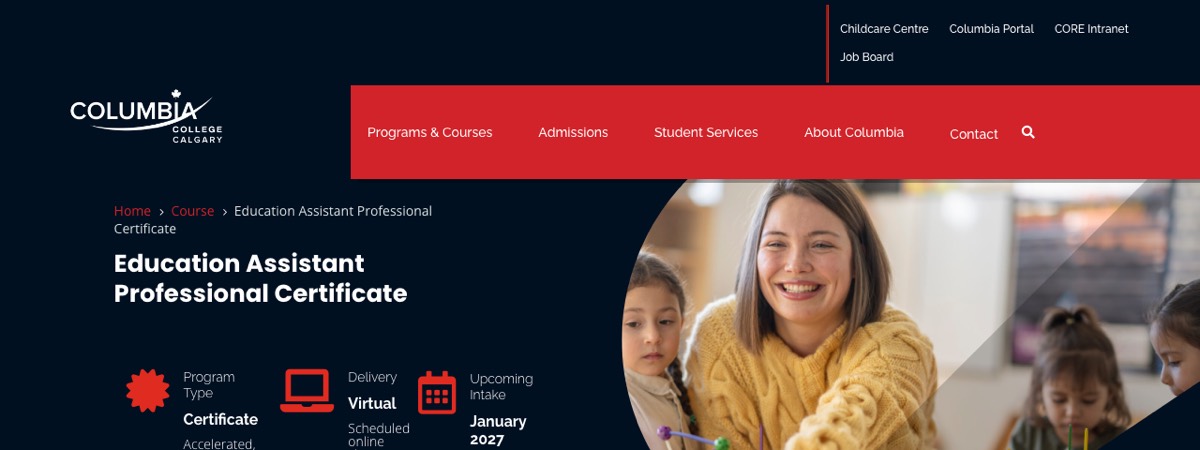
Education Assistant Professional Certificate is an accelerated 6-month, 25-week program from Columbia College in Alberta, delivered through scheduled virtual classes.
| Provider | Columbia College |
|---|---|
| Length | Accelerated, 6 Months (25 weeks) |
| Credential | Professional Certificate |
| Format | Virtual (Scheduled online classes), AB |
Fiona's take: Twenty-five weeks is the shortest college-format program on this page, aimed at Alberta students who want a school-based assistant credential quickly. The scheduled virtual classes give you a cohort and deadlines, which helps if self-paced study has failed you before. Tuition is not listed, so ask before enrolling.
Skip it if: Skip it if you cannot commit to a fixed class schedule, since the virtual classes are timed, not on-demand.
See Program DetailsHow Much Does An ECA Course Cost In Canada?
ECA course tuition generally runs from about $750 to $2,000, with college programs higher and published at up to $4,607.
| Item | Cost (CAD) |
|---|---|
| BC ECEA course (e.g., Coastal College of BC) | $750 |
| ECA course tuition, typical range | $750 - $2,000 |
| Canadian College of Educators ECA Certificate & Diploma | $450 per session; $1,800 for both |
| Okanagan College Education Assistant Certificate (2025-26) | $4,607 |
| BC ECE Registry application fee | Not listed |
| Renewal | Requires additional course and professional development |
The $750 ECEA course is the lowest listed ECEA tuition example in the pack, and it is the exact credential the BC ECE Registry asks for: one recognised course in child guidance, child health, safety and nutrition, or child development, completed within the last 5 years. Registry application fees are not listed, so confirm them when you apply.
Renewal is not a one-time affair: maintaining your certificate requires an additional course and professional development, so budget for that beyond the initial tuition. College certificates at $4,607 buy a much broader credential, and you are paying for range, not speed.
How Much Does An Early Childhood Assistant Earn In Canada?
Under NOC 42202, Job Bank puts the national median at $22.30 per hour.
| Region | Median Hourly Wage |
|---|---|
| Canada | $22.30 |
| British Columbia | $24.00 |
| Quebec | $24.00 |
| Ontario | $22.00 |
| Alberta | $19.00 |
| Manitoba | $18.00 |
The spread matters more than the average here. British Columbia and Quebec sit at $24.00, while Alberta at $19.00 and Manitoba at $18.00 pull the national median down to $22.30. If you are choosing where to certify, BC pairs its mandatory registry route with the higher median wage.
Nationally, Job Bank projects a moderate risk of shortage for this occupation over 2026-2035, which means steady hiring rather than a boom. That is decent news for a role you can reach in about a month of study: the entry cost is low and the demand does not depend on a hot market.
Is An ECA Course Worth It In 2026?
For the right person, yes, and the arithmetic is straightforward. One recognised course at about $750 plus a registry application in BC opens a role with a $24.00 median hourly wage in that province and a moderate national shortage risk through 2035. Few career changes pay for themselves this quickly.
The honest caveats: certification is mandatory in BC and Alberta, so your course choice is constrained there, and the Coursera and Udemy options on this page will not substitute for it. In Ontario and Quebec the assistant role is not regulated, which lowers the barrier but also means your credential matters mainly to employers, not a registry.
I tell clients to treat this as a two-step decision. Test the field with Introduction to Early Childhood or the full specialization, then, if you like the work, pursue the recognised route for your province. If you are in BC, budget about $750 for a recognised ECEA course; if you are in Alberta or another province, confirm the recognised route and cost with the provincial body. That sequence protects both your money and your time.
Can You Get Funding For ECA Training In Canada?
Yes, in British Columbia, through provincial supports aimed at early childhood education staffing.
- BC ECE Education Support Fund. The B.C. government's ECE Education Support Fund, along with bursary options, covers tuition costs for eligible domestic students. I tell every BC-based client to check eligibility before paying the $750 course fee out of pocket.
ECA Course Questions Canadians Ask
How Long Does It Take To Become An ECEA In BC?
Becoming an ECEA in BC takes about 2 to 4 weeks of study to complete one approved course, such as child development, followed by an application to the BC ECE Registry. Registry processing varies from weeks to months, so the total timeline depends mainly on that processing window.
Is ECEA Certification Mandatory In Canada?
ECEA certification is mandatory in licensed child care facilities in British Columbia and Alberta. In BC the ECE Registry must certify you before you work; in Alberta you must be certified within 6 months of being hired. Ontario requires registration only of ECEs, and Quebec does not regulate assistants.
What Is The Median Wage For Early Childhood Educators And Assistants?
The median wage for early childhood educators and assistants is $22.30 per hour nationally, per Job Bank 2025 data under NOC 42202. British Columbia and Quebec sit at $24.00, Ontario at $22.00, Alberta at $19.00 and Manitoba at $18.00.
What NOC Code Is Used For ECA Jobs?
ECA jobs use NOC 42202, the code for early childhood educators and assistants. You will need it for Job Bank wage research and for resume keywords, so it is worth memorising.
Can I Take ECEA Courses Online In BC?
Yes, some providers offer asynchronous online ECEA courses in BC for about $750. Coastal College of BC, for example, lists a $750 tuition for its ECEA course. Confirm any provider is recognised by the BC ECE Registry before you pay, since only recognised courses count toward certification.
Do ECAs Need A Criminal Record Check?
A criminal record check is typically required for both certification and employment in this field. The BC ECE Registry requires one as part of your ECEA application, and employers in licensed facilities expect one as standard. Start it early, since it can add time to your application.
What Is The Job Outlook For This Occupation?
The job outlook for this occupation is a moderate risk of shortage nationally over 2026-2035, according to federal projections. That signals steady demand without a hiring boom, which suits a role reachable in about a month of study at roughly $750.
Are There Funding Programs For ECA Training?
Funding for ECA training exists in British Columbia through the ECE Education Support Fund and bursaries, which cover tuition costs for eligible domestic students. If you are in BC, check your eligibility before paying the roughly $750 course fee yourself.
What's The Bottom Line On ECA Courses In Canada?
- The fastest certified route in Canada is one BC ECE Registry-recognised course, about 2 to 4 weeks at roughly $750, followed by your registry application.
- Coursera's Home-Based Child Care is the low-commitment way to test the field first, but it does not qualify you for ECEA certification in BC or Level 1 certification in Alberta.
- Pay under NOC 42202 is a $22.30 national median, with BC and Quebec at $24.00 per hour and a moderate shortage risk through 2035.
- The pack confirms mandatory certification in licensed child care in BC and Alberta; requirements vary elsewhere, while Ontario and Quebec are listed here as not requiring assistant registration or certification.
- If you are in BC, check the ECE Education Support Fund before paying tuition, since it covers costs for eligible domestic students.







Thanks for sharing, simply wanted to share that the New Brunswick Community College – Educational Assistant Course (online option) seems to no longer be available as per their site> https://nbcc.ca/programs-courses/part-time-education/programs/educational-assistant
No need to post this comment if the correction/edit is made in the article.
Cheers!