
Key Takeaways
- The fastest realistic route is a short college butchery program: Olds College runs a 15-week Meat Processing Certificate for $3,100 tuition plus fees, while Fanshawe's Professional Butchery Techniques runs 30 weeks in Ontario.
- No licence is required to work as a butcher anywhere in Canada. NOC 63201 is not a licensed occupation; voluntary certification exists through SkilledTradesBC in British Columbia and SATCC in Saskatchewan.
- You can test the field first with The Meat We Eat from the University of Florida on Coursera, about 1 week at 10 hours a week. It does not qualify you for any provincial licence, registration or Certificate of Qualification.
- Job Bank puts the median butcher wage at $20 per hour for NOC 63201 in its most recent update, ranging from $17 in Manitoba to $24.23 in British Columbia among the provinces listed.
- Fiona's verdict: short college certificates are listed as 15 to 52 weeks, while the voluntary BC and Saskatchewan apprenticeship requires 4500 hours of work-based training plus technical training; take the Coursera course first if you are still deciding whether butchery suits you.
A butcher prepares standard and specialty cuts of meat, poultry, fish and shellfish for sale in retail or wholesale food establishments, working under NOC 63201. In Canada you do not need a licence to do this work; employers hire people with on-the-job training, a college butchery certificate, or a voluntary trade credential.
The shortest realistic route is a short college program. Olds College offers a 15-week Meat Processing Certificate, and Fanshawe College offers a 30-week Ontario College Certificate in Professional Butchery Techniques. If you are unsure, start with a Coursera course such as The Meat We Eat before you commit tuition money.
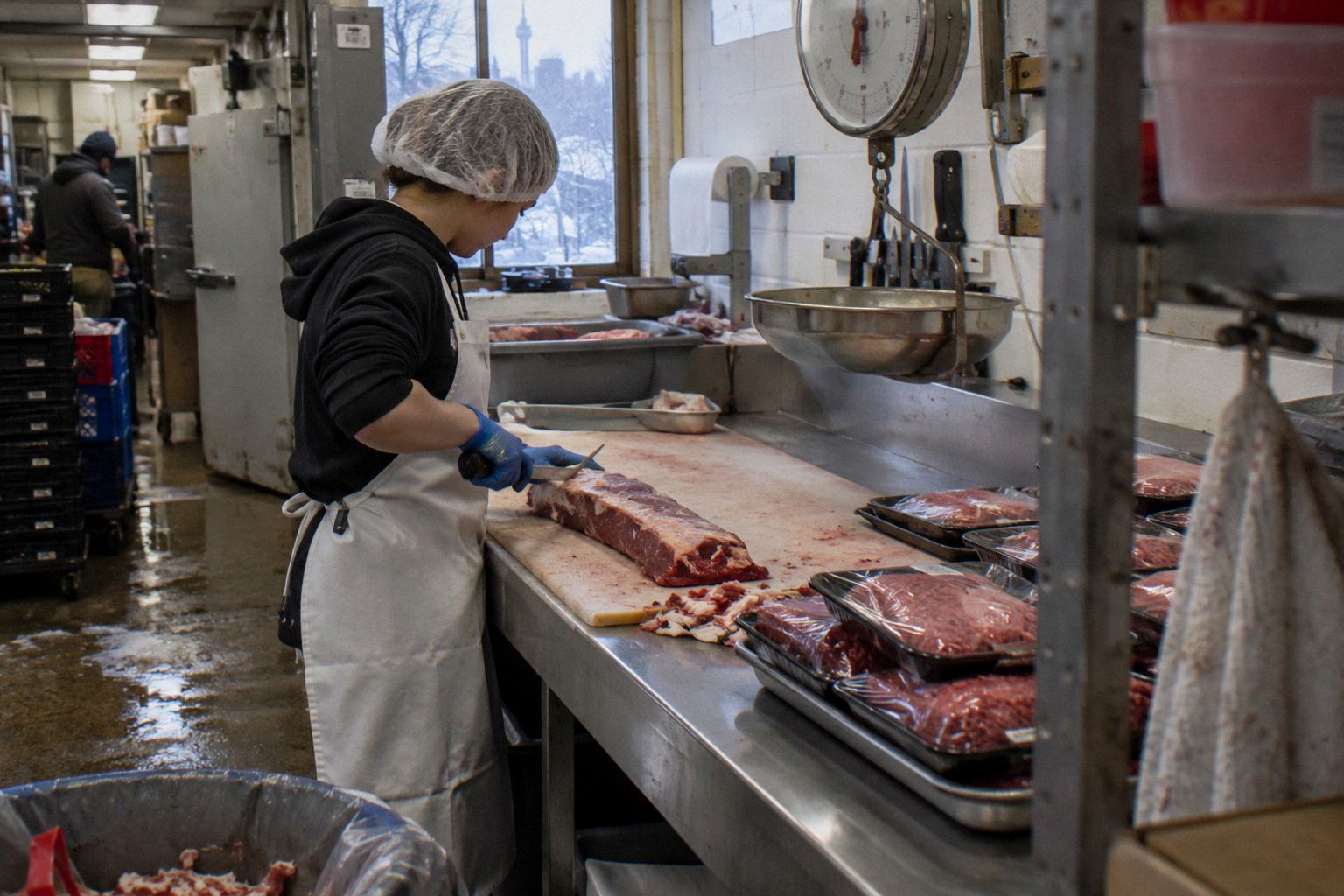
What Are The Ways To Become A Butcher In Canada?
There are three main routes into butchery in Canada: learning on the job, a college certificate program, or a voluntary apprenticeship in British Columbia or Saskatchewan.
| Route | Time | Cost (CAD) | What You Get | Recognised By | Best For |
|---|---|---|---|---|---|
| The Meat We Eat (test the field first) | 1 week at 10 hours a week | Varies | Shareable certificate, theory of meat production | No employer credential | Anyone deciding whether butchery suits them |
| On-the-job training | Several years | $0 | Employer training, no credential | Employers | People who can get hired directly at a food store |
| College certificate (e.g. SAIT Professional Butchery) | 1 year | Varies | Certificate | Employers | People wanting structured skills training |
| Apprenticeship (BC/SK only) | 4500 hours work-based plus technical training, roughly 2-3 years | Varies | Certificate of Qualification | SkilledTradesBC or SATCC | People in BC or Saskatchewan wanting the trade credential |
I recommend the Coursera route for anyone still deciding, and a short college certificate such as Olds College's 15-week program for anyone who has decided and wants a structured credential.
What Is The Fastest Way To Become A Butcher In Canada?
The fastest route is a short college meat processing certificate, followed by food safety certification and a job search. Here is the sequence I give clients.
- Complete a short college meat processing or butchery certificate program: Olds College runs 15 weeks, Fanshawe runs 30 weeks, and tuition at Olds College is $3,100 plus fees for domestic Year 1 students.
- Obtain FoodSafe or equivalent certification, which takes about 1 day to complete.
- Secure employment in retail or wholesale butchery, which you can do immediately upon completing your program.
- Skip the apprenticeship unless you are in British Columbia or Saskatchewan and want the Certificate of Qualification, since it takes 4500 hours of work-based training plus technical training, roughly 2 to 3 years.
Do You Need A Licence Or Certification To Be A Butcher In Canada?
No licence is required to work as a butcher anywhere in Canada. NOC 63201 is not a licensed occupation, though employers expect food safety training, and voluntary certification exists in two provinces.
| Province | Required? | Regulator Or Registry | What It Means |
|---|---|---|---|
| All provinces and territories | No | None, not a licensed occupation | You can work as a butcher without any licence; employers expect food safety training |
| British Columbia | Voluntary | SkilledTradesBC (Meatcutter) | Certification is available but not mandatory |
| Saskatchewan | Voluntary | Saskatchewan Apprenticeship and Trade Certification Commission (Meat Cutter) | Certification is available but not required to work in the trade |
There is no Red Seal endorsement for butchers, which is why the Apprenticeship Service program, aimed at employers hiring first-year apprentices in Red Seal trades, does not apply to this occupation. This matters: you cannot rely on a national trade credential to prove your skills.
A Coursera course such as The Meat We Eat does not give you any licence, registration or certificate of qualification, because none is required. Its value is the theory, and a sensible way to test the field before you spend tuition money at Olds College or Fanshawe.
Which Butchery Courses Are Worth Taking In Canada?
The best choice depends on where you live and how quickly you need work. College programs give hands-on cutting skill; online courses give theory only.
The Meat We Eat
The Meat We Eat is a roughly 1 week at 10 hours a week online course from the University of Florida that explains how meat is produced and evaluated, with a shareable certificate at 4.7 from 210 reviews.
| Provider | University of Florida |
|---|---|
| Length | 1 week at 10 hours a week |
| Rating | 4.7 (210 reviews) |
| Credential | Shareable certificate |
| Format | online |
Fiona's take: I recommend this as the first stop before any tuition payment. It will not teach you to break down a carcass, but it introduces meat quality, safety, healthfulness and sustainability topics. This course does not qualify you for a provincial licence, registration, or Certificate of Qualification; voluntary certification exists in BC and Saskatchewan.
Skip it if: Skip it if you already work in a food store and just need knife-in-hand training.
Not a provincial licence, registration or certificate.
Start On CourseraFeeding the World
Feeding the World is an online course from the University of Pennsylvania with a shareable certificate.
| Provider | University of Pennsylvania |
|---|---|
| Credential | Shareable certificate |
| Format | online |
Fiona's take: This one covers food systems more broadly than meat alone. It suits someone weighing butchery against other food sector jobs, such as processing or distribution. Like every Coursera course here, it is not a licence or trade credential.
Skip it if: Skip it if you specifically want meat cutting content.
Not a provincial licence, registration or certificate.
Start On CourseraWhole Animal Butchery: Process Wild Venison with Chef James
Whole Animal Butchery: Process Wild Venison with Chef James is an online on-demand video course from The Outdoor Specialists, rated 4.2 from 19 ratings, with a certificate of completion.
| Provider | The Outdoor Specialists |
|---|---|
| Rating | 4.2 (19 ratings) |
| Credential | Certificate of completion |
| Format | online |
Fiona's take: This shows actual breaking down of an animal, which theory courses do not. The wild venison focus makes it relevant to learners interested in wild game processing, though a retail employer will still want in-person practice.
Skip it if: Skip it if you want training on beef, pork or poultry cuts used in retail stores.
Not a provincial licence, registration or certificate.
View On UdemyCharcuterie and Home Meat Curing Course with Richard Bosman
Charcuterie and Home Meat Curing Course with Richard Bosman is a 2-hour on-demand video course for $94.99, rated 4.7 from 42 ratings, with a certificate of completion.
| Provider | Richard Bosman |
|---|---|
| Length | 2 hours on-demand video |
| Cost (CAD) | $94.99 |
| Rating | 4.7 (42 ratings) |
| Credential | Certificate of completion |
| Format | online |
Fiona's take: The course teaches deboning a pig and making cured products including prosciutto, bacon, sausages, salami and chorizo. At $94.99 it is a low-risk add-on after a college program, not a substitute for one. This is not a provincial licence or certificate.
Skip it if: Skip it if you are still at the deciding stage; it assumes comfort with basic butchery.
Not a provincial licence, registration or certificate.
View On UdemyMeat Processing Certificate
The Meat Processing Certificate at Olds College is a 15-week on-campus program in Alberta costing $3,100 tuition plus fees for domestic Year 1, awarding a certificate.
| Provider | Olds College |
|---|---|
| Length | 15 Weeks |
| Cost (CAD) | $3,100.00 tuition + fees (domestic Year 1 estimate) |
| Credential | Certificate |
| Format | On-Campus, Alberta |
Fiona's take: This is the shortest college credential in the pack, and Alberta's listed median butcher wage is $22 per hour. I recommend it for anyone in Alberta or willing to relocate who wants structured training in one semester.
Skip it if: Skip it if you cannot move to Olds, Alberta for 15 weeks.
See Program DetailsProfessional Meat Cutting and Merchandising
Professional Meat Cutting and Merchandising is an in-person program at NAIT in Alberta.
| Provider | NAIT |
|---|---|
| Format | in person, Alberta |
Fiona's take: NAIT's program is an in-person Alberta program for people interested in a hands-on meat-industry career. The pack does not list its length or cost, so check current details with NAIT before applying.
Skip it if: Skip it if you are outside Alberta, since it is delivered in person.
See Program DetailsProfessional Butchery Techniques
Professional Butchery Techniques is a 30-week full-time in-person program at Fanshawe College in Ontario, awarding an Ontario College Certificate.
| Provider | Fanshawe College |
|---|---|
| Length | 30 weeks |
| Credential | Ontario College Certificate |
| Format | Full-Time (in person), Ontario |
Fiona's take: Thirty weeks is still fast. It awards an Ontario College Certificate and provides hands-on training, in a province where the median butcher wage is $21.75 per hour. I recommend this as the first choice for Ontarians who want a real credential.
Skip it if: Skip it if you need to work full time while studying, since it is full time and in person.
See Program DetailsFood Processing (Animal Proteins)
Food Processing (Animal Proteins) is an 8-month in-person certificate program at Assiniboine College in Manitoba, 11 months for international students, costing $6,107 tuition plus fees for domestic students.
| Provider | Assiniboine College |
|---|---|
| Length | 8 months (11 months international) |
| Cost (CAD) | $6,107 tuition + fees (domestic estimate) |
| Credential | Certificate |
| Format | in person, Manitoba |
Fiona's take: This program covers animal proteins processing more broadly than retail cutting. At $6,107 it costs roughly double Olds College tuition, but Manitoba applicants get a local credential in a province with the pack's lowest median wage at $17 per hour. Weigh that trade-off honestly.
Skip it if: Skip it if you can access the shorter, cheaper Olds College program instead.
See Program DetailsRetail Meat Processing & Manufacturing Program
The Retail Meat Processing & Manufacturing Program at Thompson Rivers University is a 9-month, 38-week in-person program in British Columbia.
| Provider | Thompson Rivers University (TRU) |
|---|---|
| Length | 9 months (38 weeks) |
| Format | in person, British Columbia |
Fiona's take: For British Columbians this is a natural option, and BC has the highest median wage among the provinces listed in the pack, at $24.23 per hour. You could follow it later with voluntary Meatcutter certification through SkilledTradesBC if you want the trade credential.
Skip it if: Skip it if you are in BC only short term; at 9 months it is a serious commitment.
See Program DetailsHow Much Does Butcher Training Cost In Canada?
On-the-job training costs nothing; college programs range from short course fees to thousands in tuition depending on the institution and province.
| Item | Cost (CAD) |
|---|---|
| On-the-job training | $0 |
| George Brown Introduction to Butchery short course (example) | $979.46, includes food used in class |
| Olds College Meat Processing Certificate, domestic Year 1 | $3,100 tuition plus fees |
| Assiniboine College Food Processing (Animal Proteins), domestic | $6,107 tuition plus fees |
| NAIT Professional Meat Cutting and Merchandising | Not listed |
| Fanshawe Professional Butchery Techniques | Not listed |
The pack does not list a fixed Canadian price for The Meat We Eat, so check the Coursera page for current pricing before you rely on it as your test of the field.
The pack does not verify total BC or Saskatchewan apprenticeship costs; it notes registration and exam related costs, and SkilledTradesBC states that challenging the certification exam requires valid FOODSAFE Level 1. There is no Red Seal exam for butchery.
How Much Does A Butcher Earn In Canada?
Job Bank's latest wage report for NOC 63201, butchers in retail and wholesale, puts the median at $20 per hour.
| Province | Median Hourly (CAD) |
|---|---|
| Alberta | $22.00 |
| British Columbia | $24.23 |
| Manitoba | $17.00 |
| New Brunswick | $18.75 |
| Nova Scotia | $19.72 |
| Ontario | $21.75 |
| Quebec | $20.00 |
| Saskatchewan | $19.16 |
British Columbia has the highest median wage among the provinces listed in the pack, at $24.23 per hour, which is one reason I point BC clients toward the Thompson Rivers University program. Manitoba sits lowest among the listed provinces at $17 per hour, which is a real factor when you weigh Assiniboine's $6,107 tuition against expected earnings there.
The outlook varies by province, with moderate risk of shortage nationally. Shortage risk is good news for job seekers: employers in food stores often accept on-the-job training, which keeps the entry door open while you decide whether a credential is worth it.
Is A Butcher Course Worth It In 2026?
The answer depends on your own numbers. Because NOC 63201 is not a licensed occupation, a course never gates you out of the job the way a licence would. What a college program buys you is speed: 15 weeks at Olds College or 30 weeks at Fanshawe gets you structured training that would otherwise take several years of on-the-job learning.
Compare the listed training cost with Job Bank median wages before deciding. At a $20 national median, a $3,100 certificate at Olds College in Alberta, where the median is $22, is a very different calculation from $6,107 at Assiniboine in a $17 median province. The pack does not list a fixed Canadian price for The Meat We Eat, so check current pricing if you want to test the field there first.
If you have any doubt about whether the trade suits you, start with a Coursera course before you enrol. It answers the only question that matters before you commit tuition: do you actually want to spend your days around carcasses and cold rooms? If yes, the college route is the structured way in 2026.
Can You Get Funding For Butchery Training?
Funding options exist but they are thinner for butchery than for Red Seal trades, since butchery has no Red Seal endorsement.
- Canada Apprentice Loan. Federal grants, loans and funding exist to help apprentices, but note that a loan must be repaid. Because butchery certification is voluntary and exists only in BC and Saskatchewan, check eligibility with the administering body before counting on it.
- Apprenticeship Service. This federal program supports employers to hire new first-year apprentices in 39 Red Seal trades. Butchers are not listed as a compulsory Red Seal trade, so this incentive does not apply to butchery hiring.
Butcher Course Questions Canadians Ask
How To Become A Butcher In Canada?
Becoming a butcher starts with completing secondary school, then either on-the-job training or a college butchery program. Programs include Olds College at 15 weeks, Fanshawe at 30 weeks, SAIT at 1 year and Assiniboine at 8 months. Apprenticeship is available voluntarily in BC and Saskatchewan for those who want a Certificate of Qualification.
Is Butcher Certification Mandatory In Canada?
Certification is not mandatory in any province or territory. NOC 63201 is not a licensed occupation, so no licence exists to obtain. Voluntary Meatcutter certification is available through SkilledTradesBC, and voluntary Meat Cutter certification through the Saskatchewan Apprenticeship and Trade Certification Commission.
What Is The Median Wage For Butchers In Canada?
The median wage for butchers, NOC 63201, is $20.00 per hour nationally in Job Bank's latest wage report. Provincially it ranges from $17.00 in Manitoba to $24.23 in British Columbia among the provinces listed, with Ontario at $21.75 and Alberta at $22.00.
Are There Butchery Courses In Canada?
Butchery courses exist at several Canadian institutions: SAIT runs a 1-year program, Olds College a 15-week Meat Processing Certificate, Fanshawe a 30-week Ontario College Certificate, Assiniboine an 8-month program, and Thompson Rivers University a 9-month Retail Meat Processing & Manufacturing Program.
What NOC Code Is For Butchers?
The NOC code for butchers is 63201, titled Butchers, retail and wholesale. It covers workers who prepare standard and specialty cuts of meat, poultry, fish and shellfish for sale in retail or wholesale food establishments. Use this code when searching Job Bank wages.
Is There A Red Seal For Butchery?
There is no Red Seal endorsement for this occupation. That means no interprovincial standard exam exists, and the federal Apprenticeship Service, which covers 39 Red Seal trades, does not apply. Provincial certification is voluntary and exists only in BC and Saskatchewan.
How Long Is A Butcher Apprenticeship?
A butcher apprenticeship in British Columbia typically requires 4500 hours of work-based training plus technical training, which works out to roughly 2 to 3 years. This is the slowest route to the trade, and since the credential is voluntary, I suggest it mainly for people who want the Certificate of Qualification while working in the field.
What Training Do Butchers Need?
Training requirements are flexible: secondary school may be required, and employers usually want either a college program or several years of on-the-job training in food stores. Food safety training such as FOODSAFE Level 1 is expected by employers, and in BC you need valid FOODSAFE Level 1 to challenge the SkilledTradesBC Meatcutter exam.
What's The Bottom Line On Butcher Courses In Canada?
- You need no licence to work as a butcher in Canada; NOC 63201 is not a licensed occupation, and certification is voluntary only in BC and Saskatchewan.
- The shortest college certificate listed in the pack is Olds College's 15-week Meat Processing Certificate at $3,100 tuition plus fees, with Fanshawe's 30-week Ontario College Certificate as the Ontario equivalent.
- Test the field first with The Meat We Eat, about 1 week at 10 hours a week; it teaches theory, not knife skills, and qualifies you for nothing but an informed decision.
- Job Bank's most recent median wage for NOC 63201 is $20 per hour, from $17 in Manitoba to $24.23 in British Columbia among the provinces listed.
- Short college certificates are listed as 15 to 52 weeks, while the voluntary BC and Saskatchewan apprenticeship requires 4500 hours of work-based training plus technical training; compare the two against your own timeline before choosing.