
Key Takeaways
- The fastest realistic start is Keyano College's CNC Table Operator Program in Alberta: 5 weeks in person, courses priced $495 to $595 plus GST, ending in a non-credit certificate with 5 micro-credentials.
- No certificate is legally required: machinist certification is voluntary in all provinces and territories, with records kept by bodies such as Skilled Trades Ontario, SkilledTradesBC and Alberta Apprenticeship and Industry Training.
- Try the field first with Intelligent Machining on Coursera, an 11 hour online course from the University at Buffalo; it does not qualify you for any provincial trade certificate or apprenticeship level.
- Job Bank lists machinists under NOC 72100 at a $30.00 median hourly wage, with Ontario at $30.00, Alberta at $36.50 and British Columbia at $38.00.
- Fiona's verdict: the apprenticeship suits anyone committed to the full trade, Keyano suits anyone who needs machine time now, and Coursera suits anyone still deciding.
A CNC machinist is a machinist who sets up and operates machine tools, computer numerically controlled ones included, to cut or grind metal, plastic or other materials into parts with precise dimensions. Canada trains them through a 4 year apprenticeship or a college diploma, and no province compels certification.
The shortest realistic start is Keyano College's 5 week CNC Table Operator Program in Alberta at $495 to $595 plus GST per course. If even that is a commitment, an 11 hour Coursera course tests the field first.
What Are The Ways To Train For CNC Machining In Canada?
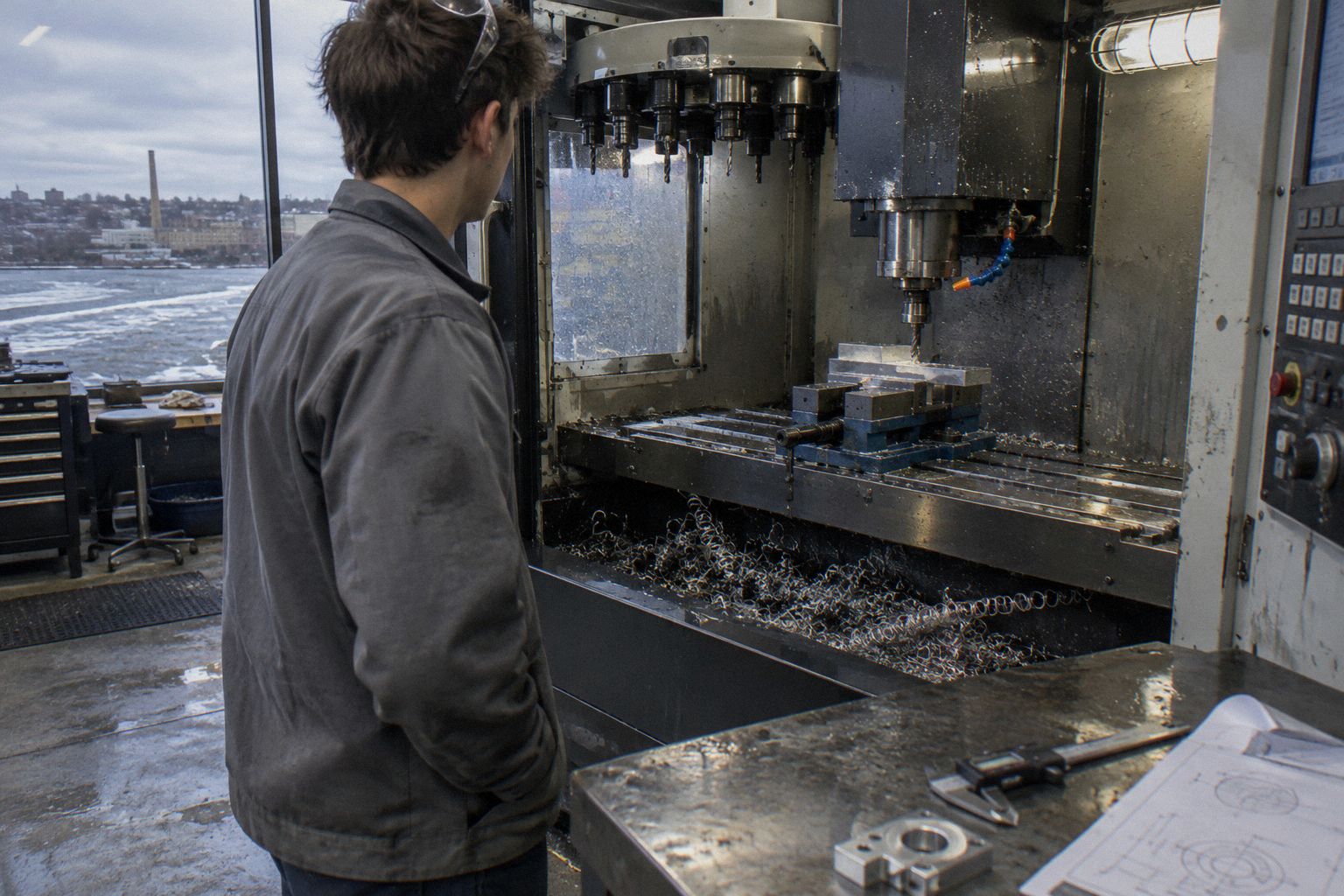
CNC machining training in Canada runs through four doors: online courses, the 4 year apprenticeship, college diplomas and short operator programs. Because machinist certification is voluntary, none of these routes is legally required; they differ in speed, cost and what employers see.
| Route | Time | Cost (CAD) | What You Get | Recognised By | Best For |
|---|---|---|---|---|---|
| Intelligent Machining (Coursera) | 11 hours | Not listed | Course certificate in machining theory | Coursera only, not a provincial trade credential | Testing interest before committing money |
| Apprenticeship, Machinist / General Machinist | 4 years, 7200-8000 hours | Varies by province | Certificate of Apprenticeship, Certificate of Qualification, optional Red Seal | Provincial apprenticeship authority and Red Seal | The full trade credential |
| College diploma, e.g. Seneca Mechanical Technician - CNC Programming | 2 years, 4 semesters | Not listed | Ontario College Diploma | Ontario College Diploma; Conestoga's Mechanical Technician - CNC may provide Level 1 apprenticeship credit/exemption | Classroom-first learners |
| NSCC CNC Machining | 1 year | Not listed | Diploma | Diploma; not a provincial trade credential | Maritimes residents wanting a quick diploma |
| Keyano College CNC Table Operator Program | 5 weeks | $495 - $595 per course + GST | Non-credit certificate with 5 micro-credentials | Non-credit certificate with 5 micro-credentials; not a provincial trade credential | The fastest hands-on start |
Fiona's route advice: the Coursera test for the undecided, Keyano for the fastest hands-on start in Alberta, and the apprenticeship for anyone committed to the full trade.
What Is The Fastest Way To Start CNC Machining In Canada?
The fastest way to start CNC machining with a credential is Keyano College's CNC Table Operator Program in Alberta: 5 weeks in person, courses at $495 to $595 plus GST, ending in a non-credit certificate with 5 micro-credentials. The fastest way to the full trade is the apprenticeship, and it runs like this.
- Finish secondary school. Grade 12 is the recommendation Skilled Trades Ontario lists for General Machinist.
- Register as an apprentice with your provincial authority, Skilled Trades Ontario, SkilledTradesBC or Alberta Apprenticeship and Industry Training, and find a sponsor employer. Timing varies with the job market.
- Log the on-the-job hours, 6330 to 7280 depending on jurisdiction, alongside 720 hours of in-school technical training across 4 levels. Plan on about 4 years; Ontario counts 8,000 hours in total.
- Budget for registration and exam fees that vary by province; Alberta, for example, requires a theory exam at each level.
- Write your certifying exam in the final period, then the optional Red Seal interprovincial exam if you want endorsement that travels.
- If you want school first, a diploma such as Conestoga's Mechanical Technician - CNC covers all Level 1 apprenticeship outcomes and may provide exemption or credit toward the apprenticeship.
Do You Need A Certificate To Work As A CNC Machinist In Canada?
A certificate is not required to work as a CNC machinist in Canada: trade certification is voluntary in all provinces and territories, per Job Bank. The regulators still keep the records, and employers still ask.
| Province | Certificate Required? | Regulator Or Registry | What It Means |
|---|---|---|---|
| Ontario | No, non-compulsory | Skilled Trades Ontario | General Machinist certification exists, and because the trade is non-compulsory the certificate does not have to be renewed |
| British Columbia | No, voluntary | SkilledTradesBC | Trade certification for machinists is available in B.C. but is not required |
| Alberta | No, optional | Alberta Apprenticeship and Industry Training | Certification is optional, with a theory exam in the trade profile |
Certification is voluntary in all provinces and territories, per Job Bank, so no regulator gates entry to machinist work. The regulators still matter: Skilled Trades Ontario keeps General Machinist non-compulsory and its certificate does not have to be renewed, SkilledTradesBC offers certification that is available rather than required, and Alberta Apprenticeship and Industry Training lists optional certification.
What online courses give you on the registry side is nothing. The Coursera courses on this page, Intelligent Machining included, do not produce a licence, registration or certificate that any province recognises. They test interest and teach theory; the apprenticeship route leads to the Certificate of Qualification and the optional Red Seal.
Which CNC Machining Courses Are Worth Taking In Canada?
CNC machining courses worth taking split three ways: online theory courses that test your interest, Udemy programming courses that teach specific software, and college programs that put you at a machine. I list them in that order, shortest test of interest first.
Intelligent Machining
Intelligent Machining is an 11 hour online course from the University at Buffalo, The State University of New York, that introduces how sensors, data and computing connect to machine tools in modern shops.
| Provider | University at Buffalo, The State University of New York |
|---|---|
| Length | 11 hours |
| Credential | Course certificate |
| Format | online |
Fiona's take: This is my try-first pick for anyone weighing a CNC machining course. It explains what happens inside a machine tool once programming and automation take over, which is the part of the trade that surprises people. Treat it as an aptitude test that takes 11 hours, because it does not qualify you for any provincial trade certificate.
Skip it if: Skip it if you already run a CNC machine or hold a Certificate of Qualification, because it stays at the introductory level.
Not a provincial licence, registration or certificate.
Start On CourseraElements of Computer Aided Manufacturing
Elements of Computer Aided Manufacturing is a 2 week online course at 10 hours a week from the Indian Institute of Technology Guwahati that covers the theory behind computer aided manufacturing.
| Provider | Indian Institute of Technology Guwahati |
|---|---|
| Length | 2 weeks at 10 hours a week |
| Credential | Shareable certificate |
| Format | online |
Fiona's take: CAM software is where most CNC programming happens, so this course previews the desk side of the trade. The shareable certificate is a CV line, not a credential any province recognises for machinist work. I suggest it for people deciding between programming-heavy and machine-heavy roles.
Skip it if: Skip it if you want machine time, because there is no shop component.
Not a provincial licence, registration or certificate.
Start On CourseraDigital Manufacturing & Design Technology
Digital Manufacturing & Design Technology is a 4 month online specialization at 10 hours a week from the University at Buffalo, The State University of New York, that surveys how digital tools shape manufacturing from design to production.
| Provider | University at Buffalo, The State University of New York |
|---|---|
| Length | 4 months at 10 hours a week |
| Credential | Specialization certificate |
| Format | online |
Fiona's take: Four months at 10 hours a week is a real commitment, close to part-time study, so I only recommend it once you know the field fits. The specialization certificate signals breadth in digital manufacturing, not machinist status. It pairs well with a college application and poorly as a stand-alone job credential.
Skip it if: Skip it if your goal is a shop job this year, because it leads to no provincial certification.
Not a provincial licence, registration or certificate.
Start On CourseraCNC Programming for Beginners, Turning, Milling, G Codes
CNC Programming for Beginners, Turning, Milling, G Codes is a 1.5 hour on-demand video course from J Aatish Rao that introduces G code for turning and milling.
| Provider | J Aatish Rao |
|---|---|
| Length | 1.5 hours on-demand video |
| Rating | 4.2 (80 ratings) |
| Credential | Certificate of completion |
| Format | online |
Fiona's take: At 1.5 hours this is the shortest introduction to G code in this list, rated 4.2 from 80 ratings. Reading simple G code is the core literacy of CNC work, so it answers one narrow question: does the code side interest you? A certificate of completion comes with it, and no province treats it as anything more.
Skip it if: Skip it if you want structured feedback, because on-demand video offers none.
Not a provincial licence, registration or certificate.
View On UdemyMastercam CNC Programming: Masterclass 2026
Mastercam CNC Programming: Masterclass 2026 is an online course from Addika Academy that teaches CNC programming in Mastercam; its length is not listed.
| Provider | Addika Academy |
|---|---|
| Rating | 4.3 (24 ratings) |
| Credential | Certificate of completion |
| Format | online |
Fiona's take: The course covers Mastercam from scratch through 2D, 3D, 4-axis, lathe, wire EDM and thread milling, and it holds a 4.3 rating from 24 ratings. That small rating count is a caution, since the content is less proven than a college syllabus. The certificate of completion carries light weight with employers next to shop experience.
Skip it if: Skip it if you have no access to Mastercam for practice, because the software is the whole point.
Not a provincial licence, registration or certificate.
View On UdemyCNC Machining
CNC Machining is a 1 year in person diploma program from Nova Scotia Community College (NSCC) that trains students on machine tool operation.
| Provider | Nova Scotia Community College (NSCC) |
|---|---|
| Length | 1 Year |
| Credential | Diploma |
| Format | in person, Nova Scotia |
Fiona's take: For Maritimes readers this is the cleanest full-time option on the page: one year, in person, ending in a diploma. A diploma is not a Certificate of Qualification, so plan for the apprenticeship path separately if you want the trade credential. Ask NSCC about graduate outcomes before you commit a year.
Skip it if: Skip it if you cannot attend in person in Nova Scotia, because delivery is on campus only.
See Program DetailsMechanical Technician – CNC Programming
Mechanical Technician - CNC Programming is a 2 year hybrid diploma program from Seneca Polytechnic in Ontario, delivered over 4 semesters.
| Provider | Seneca Polytechnic |
|---|---|
| Length | 4 Semesters (2 Years) |
| Credential | Ontario College Diploma |
| Format | hybrid, Ontario |
Fiona's take: Hybrid delivery suits people who cannot be on campus five days a week. Two years is a serious investment for a voluntary trade, so I frame it as the programming-heavy route into shops running complex parts. An Ontario College Diploma carries weight with Ontario employers.
Skip it if: Skip it if the trade credential itself is your goal, because the diploma is not a Certificate of Qualification.
See Program DetailsCNC Table Operator Program
The CNC Table Operator Program is a 5 week in person program from Keyano College in Alberta, with courses individually priced from $495 to $595 plus GST, ending in a non-credit certificate with 5 micro-credentials.
| Provider | Keyano College |
|---|---|
| Length | 5 weeks |
| Cost (CAD) | Courses individually priced: ranging from $495 - $595 + GST |
| Credential | Non-credit Certificate with 5 micro-credentials |
| Format | in person, Alberta |
Fiona's take: This is the fastest hands-on start on the page and the only short program with published fees. The 5 micro-credentials let you show incremental progress to employers. It is non-credit, so it neither substitutes for apprenticeship levels nor counts as a Certificate of Qualification.
Skip it if: Skip it if you need a credential a registry recognises, because this one is for employers, not regulators.
See Program DetailsMechanical Technician - CNC and Precision Machining
Mechanical Technician - CNC and Precision Machining is a 42 week in person diploma program from Canadore College in Ontario.
| Provider | Canadore College |
|---|---|
| Length | 42 weeks |
| Credential | Ontario College Diploma |
| Format | in person, Ontario |
Fiona's take: Forty-two weeks compresses diploma training into under a year, which suits career changers who want classroom intensity. Precision machining is exactly the skill set CNC shops hire for. Like other diplomas it confers no trade certification, though some programs, such as Conestoga's Mechanical Technician - CNC, may support Level 1 apprenticeship credit.
Skip it if: Skip it if you cannot relocate to Ontario, because delivery is in person only.
See Program DetailsApprentice Industrial Mechanic L1
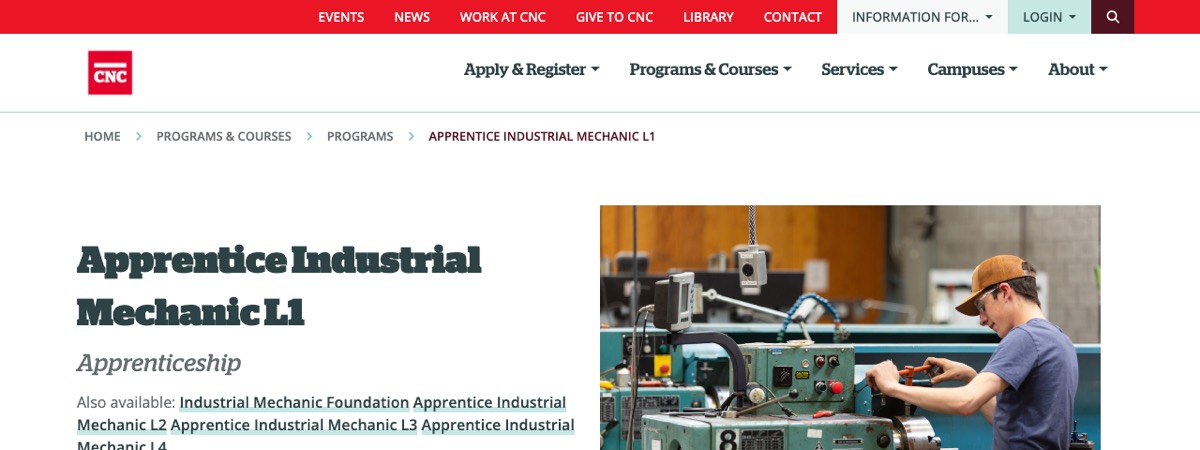
Apprentice Industrial Mechanic L1 is a 7 week in person technical training course from the College of New Caledonia (CNC) in British Columbia, starting at $961.85.
| Provider | College of New Caledonia (CNC) |
|---|---|
| Length | 7 weeks |
| Cost (CAD) | Starting at $961.85 |
| Credential | Apprenticeship technical training |
| Format | in person, British Columbia |
Fiona's take: This is Level 1 technical training for Industrial Mechanic, a related trade rather than Machinist, so treat it as an adjacent path into plant work. It suits registered apprentices sent by a sponsor, not newcomers shopping for an intro. The published starting fee of $961.85 makes budgeting simple.
Skip it if: Skip it if your target is the Machinist trade specifically, because this course trains a different trade.
See Program DetailsCNC Machine Tool Operator & Programmer
CNC Machine Tool Operator & Programmer is a 42 week hybrid diploma program from IMTT Canada, a training provider in Ontario.
| Provider | IMTT Canada |
|---|---|
| Length | 42 Weeks |
| Credential | Diploma |
| Format | hybrid, Ontario |
Fiona's take: IMTT Canada is an Ontario provider with a 42 week hybrid diploma, and 42 weeks matches Canadore's pace. The fee is not listed, so get the full cost in writing before you sign, and compare the program against Seneca and Canadore before you enrol. The diploma is an employer-facing credential, not a trade certificate.
Skip it if: Skip it if you want an Ontario College Diploma specifically, because IMTT Canada grants its own diploma.
See Program DetailsHow Much Does CNC Machining Training Cost In Canada?
CNC machining training costs are mostly unpublished: only Keyano College and the College of New Caledonia list fees. I table every figure I have and mark the rest as not listed rather than guess.
| Training | Cost (CAD) | Notes |
|---|---|---|
| Keyano College, CNC Table Operator Program, 5 weeks | $495 - $595 per course + GST | Non-credit certificate with 5 micro-credentials, in person in Alberta |
| College of New Caledonia, Apprentice Industrial Mechanic L1, 7 weeks | Starting at $961.85 | Level 1 technical training for a related trade, in person in BC |
| Apprenticeship registration and exam fees | Varies by province | Alberta requires a theory exam per level |
| College diplomas: NSCC, Seneca, Canadore, Conestoga | Not listed | Request fee sheets from each registrar |
| Coursera and Udemy online courses | Not listed | Certificates of completion only |
The published fees are narrow. Keyano College prices its CNC Table Operator courses individually at $495 to $595 plus GST, and the College of New Caledonia starts its Apprentice Industrial Mechanic L1 at $961.85 for 7 weeks. Apprenticeship registration and exam fees vary by province, and Alberta requires a theory exam at each level, so ask your authority for the current schedule.
For Seneca's 2 year diploma, Conestoga's 2 year Mechanical Technician - CNC program, Canadore's 42 week program and NSCC's 1 year diploma, no fees are listed, so request fee sheets directly from each registrar. Set any tuition beside the Job Bank wage data under NOC 72100, a $30.00 median hourly wage nationally, before you commit.
How Much Does A CNC Machinist Earn In Canada?
A CNC machinist in Canada earns a median of $30.00 per hour under Job Bank code NOC 72100, Machinists and machining and tooling inspectors. The provincial spread is wide.
| Region | Median Hourly Wage, Job Bank NOC 72100 |
|---|---|
| Canada | $30.00 |
| Ontario | $30.00 |
| Alberta | $36.50 |
| British Columbia | $38.00 |
NOC 72100 covers Machinists and machining and tooling inspectors, the code Job Bank uses for this work. The national median is $30.00 per hour. Ontario matches it at $30.00, Alberta runs $36.50 and British Columbia $38.00. Outlook varies by province and territory, so read your own region before you move.
That spread is why the optional Red Seal matters: endorsement from the Red Seal program signals your Certificate of Qualification across provinces, which matters when the highest median on this list, British Columbia at $38.00, may not be where you trained. I tell clients to pick the province first and the school second.
Is CNC Machining Worth It In 2026?
CNC machining is worth it in 2026 if you like precise, physical work and want a trade you can enter without compulsory licensing. Certification is voluntary in all provinces and territories, Job Bank posts a $30.00 median hourly wage under NOC 72100, and British Columbia sits at $38.00. Open entry plus that pay range is a rare combination.
The honest cost is time. The full trade runs 4 years and 7200 to 8000 hours through an apprenticeship, with 720 hours of that in school. College shortcuts exist: Conestoga's 2 year Mechanical Technician - CNC diploma covers all Level 1 apprenticeship outcomes and may earn credit, and Keyano's 5 week program puts you at a machine fast.
My verdict: start with the 11 hour Intelligent Machining course on Coursera to test your interest, then choose between Keyano for speed, a diploma for structure, or the apprenticeship for the full credential. Do not spend on any online certificate expecting it to function as a trade credential, because none of them do.
Can You Get Funding For CNC Machining Training?
Funding for CNC machining training comes mainly through apprenticeship grants and incentives, provincial and federal. Here is what I can confirm is open now.
- Apprenticeship grants and incentives (provincial/federal). Governments run grants and incentives for registered apprentices, and SkilledTradesBC lists these supports on its machinist page. Once you register with a sponsor employer, ask your provincial authority which incentives apply at your level.
- Red Seal Completion Bonus. The Government of Canada's Red Seal Completion Bonus applications are now open, per the SkilledTradesBC machinist page. Check the current eligibility rules before applying.
CNC Machining Questions Canadians Ask
Is CNC Machinist A Red Seal Trade In Canada?
CNC machinist work sits inside the Machinist trade, which has Red Seal endorsement available when you pass the interprovincial exam. Red Seal is an optional add-on to a provincial Certificate of Qualification. I tell clients who may move between provinces, Ontario to Alberta for example, to write it in their final apprenticeship period rather than return to it later.
How Long Is A CNC Machinist Apprenticeship In Ontario?
A CNC machinist apprenticeship in Ontario, the General Machinist trade, is generally 8,000 hours, about four years: 7,280 hours on the job and 720 hours of in-school technical training. Skilled Trades Ontario administers the trade. Red Seal harmonization recommends 7,200 total training hours, so expect roughly four years either way.
Is Trade Certification Mandatory For Machinists In Canada?
Trade certification for machinists is voluntary in all provinces and territories, per Job Bank. Ontario's General Machinist is non-compulsory under Skilled Trades Ontario, certification is available but not required through SkilledTradesBC, and Alberta Apprenticeship and Industry Training lists it as optional. You can work without it; check employer postings in your area to see what they ask for.
What Is The Median Wage For CNC Machinists In Canada?
The median wage for CNC machinists in Canada is $30.00 per hour under Job Bank code NOC 72100. Ontario matches the national median at $30.00, Alberta sits at $36.50 and British Columbia at $38.00. Location moves your pay more than most training choices do, so weigh the province before you pick a school.
Can College CNC Programs Count Towards Apprenticeship?
College CNC programs can count towards apprenticeship. Conestoga's Mechanical Technician - CNC program covers all the learning outcomes for Level 1 of Ontario's precision machining apprenticeship programs, and diplomas like it may provide exemption or credit. Confirm with the college and Skilled Trades Ontario before you enrol, because credit is decided case by case.
What NOC Code Is Used For CNC Machinist On Job Bank?
NOC 72100 is the code Job Bank uses for CNC machinists, titled Machinists and machining and tooling inspectors. Use it for wage lookups: the code shows the $30.00 national median hourly rate plus provincial figures such as $38.00 in British Columbia. Outlook for this occupation varies by province and territory, so read your own region too.
How Many Levels Are In The Harmonized Machinist Apprenticeship?
The harmonized Machinist apprenticeship recommends 4 levels and 7,200 total training hours, combining on-the-job and in-school training, per Red Seal. Ontario structures General Machinist around the same shape, with 7,280 hours on the job plus 720 in school. The levels give you checkpoints, one exam window per stage, rather than a single final hurdle.
Where Can I Find CNC Machinist Apprenticeship Programs In BC?
BC CNC machinist apprenticeships run through SkilledTradesBC: register there, then complete technical training at institutions like BCIT. Certification is available but not compulsory in the province. For related trades training, the College of New Caledonia offers Apprentice Industrial Mechanic L1 over 7 weeks starting at $961.85, which suits registered apprentices.
What's The Bottom Line On CNC Machining Training?
- Certification to work as a machinist is voluntary in all provinces and territories; the credential that carries weight is the Certificate of Qualification plus the optional Red Seal.
- Keyano College's 5 week CNC Table Operator Program in Alberta, at $495 to $595 plus GST per course, is the shortest listed hands-on start on this page.
- Job Bank puts machinists at a $30.00 median hourly wage under NOC 72100, with British Columbia at $38.00 and Alberta at $36.50.
- Start with Intelligent Machining if you are unsure: 11 hours online, and it gives you no provincial trade certificate.
- The full trade runs through a 4 year apprenticeship of 7200 to 8000 hours, registered with Skilled Trades Ontario, SkilledTradesBC or Alberta Apprenticeship and Industry Training.